One of the most noted barriers to manufacturing growth, particularly in rural locations, is the workforce numbers game: Not enough skilled labor, more retirees than apprentices, and dwindling vocational program funding. That creates a ripple effect, where both new and established manufacturers are hesitant to establish or expand operations outside of metro areas, leading younger rural employees to move where there are more opportunities.
Leaders at Bemidji-based Wells Technology are deeply aware of all the components of this challenge. They face these issues as a manufacturer as well, but they’re dedicated to changing the equation. That’s not just for their own operations, either.
“Investing time and effort into training and supporting employees isn’t just about what drives our business and our bottom line,” says Andy Wells, Sr., CEO and founder of the company. “This is about community and even humanity. We try to see what’s good for all of us, and then ask ourselves, how can we expand that? We’re always looking at how to answer that question in new and meaningful ways.”
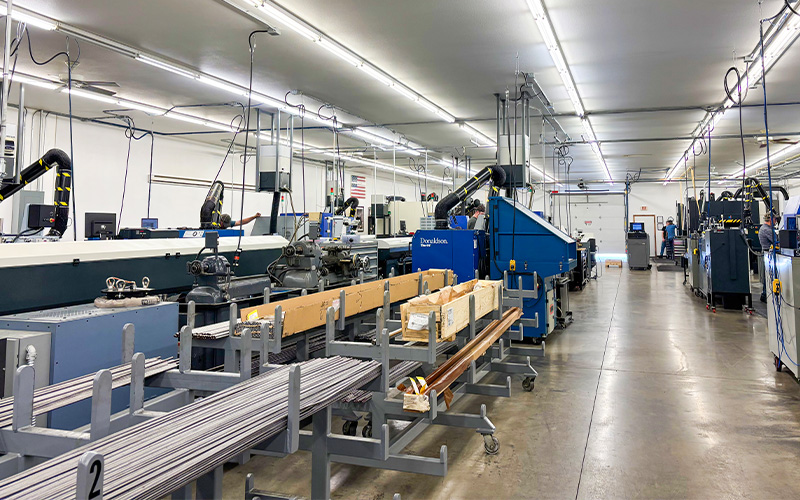
Wells’ 54,000-square-foot production floor looks like many other precision CNC manufacturers, carefully creating components that will be used in the aerospace, medical device, automotive, industrial equipment, and electronics industries. The company specializes in complex geometries with tight tolerances as well as rigorous testing, and to do that, it has the latest machinery, including Star CNC machines and Makino DA300 5-axis machining centers.
At one point during a tour, Wells holds up a part that’s so small and intricate, he jokes that it should be turned into jewelry. But he and others at the manufacturer never seem to lose sight of what the real treasure is here: The person who’s turning a slim rod of metal into this complex and beautiful object. Without that employee, and everyone else on the floor, these machines would just be extremely expensive decor.
Established history and community roots
Throughout his childhood and teen years, Wells would find discarded parts in junkyards and build go-carts and scooters, as well as tinker with potential inventions like small rockets. After high school, he attended Bemidji State University and majored in physics, followed by a number of roles including a stint as a designer at Polaris, and a supplier of innovative air-powered tools for the food processing industry. Along the way, he also taught as a professor at Bemidji State University for 17 years.
In 1989, at the age of 45, he decided to start his own company to manufacture precision components, and his work attracted notice from large firms like Fastenal, an industrial supplier based in Winona. Over the next several decades, he secured manufacturing contracts from clients like BAE Systems, NASA, and the Department of Defense, necessitating the construction of a much bigger manufacturing space and steady hiring. The company currently employs 54, but Wells says he anticipates growing that number since orders continue to come in at a steady pace.
In the vestibule of the company’s offices, next to a sizeable classroom and large manufacturing floor, Wells stands in front of a glass cabinet that showcases some of his notable inventions — a few date back to his early 20s — and above the tools are an assortment of U.S. patents he has received for those creative developments.
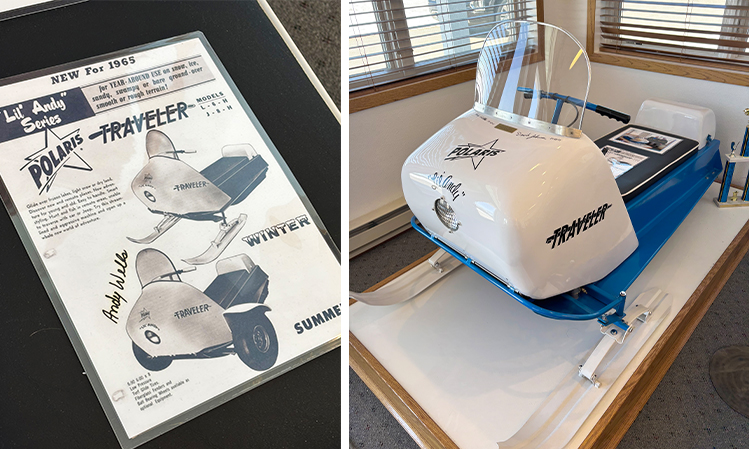
To his right is a small, lightweight snowmobile he designed while working at Polaris, and it’s marked as “Lil’ Andy” to recognize his contributions. A large sculpture, as well as three shelves in the case, are awards granted for his design and manufacturing work. Outside the window is another creative endeavor for Wells and his team: One of many solar panel arrays that rotate throughout the day to capture sunlight, allowing most of the company’s production to run on solar power. And behind that is a small two-car garage, which would be modest even by city standards — it’s notable here for being the first manufacturing location for Wells, when he started the company with his wife and 12-year-old son as his team.
Tucked inside the case, on the second-to-bottom shelf, is a photo of an even smaller building, but this one is where Wells grew up, on the Red Lake Reservation. Like many of his neighbors at the time, Wells and his family dealt with poverty, which is still a significant issue for Native American reservations, he says. Much like now, the high school dropout rate was high, but his parents insisted he get his diploma, and that focus on persistence and accomplishment was not only part of what drove him, but also what continues to inform the mission of Wells Technology.
“Growing up where I did, so many people gave me encouragement and a chance,” Wells says. “There were opportunities at school and later at work to show what I could do, and having those helped in the creation of everything you see here. I didn’t do this on my own, it is all due to the great team of employees we have and the opportunities we have received. So, I’ve made it my life’s work to give others their opportunities as our business grows.”
Mission wall
Nearly every company has a mission statement, often boiled down to a single line. For example, a manufacturer might claim something like, “Our mission is to deliver the highest quality, innovative products on time, offering service and value to customers.”
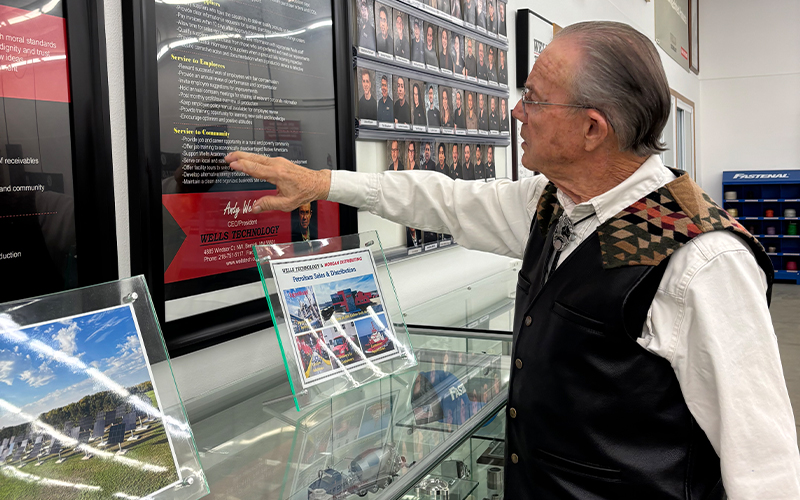
At Wells Technology, a simple mission statement didn’t seem like enough, so instead there are two large posters in the entrance to the manufacturing floor that detail the company vision, mission, and values plus the company’s strategy for successful management, manufacturing, and distribution, while also serving customers, suppliers, employees, and community.
Wells points out the last section first, talking about the manufacturer’s commitment to providing job and career opportunities in rural communities where poverty is a notable factor, as well as serving on local and state boards for health, education, and economic development.
Next to the mission posters are photos of the company’s employees, some of whom are graduates of Wells Academy. Although most of the employees wear similar shirts with the company’s logo, Wells notes that there’s a strong focus on their individual needs — particularly when it comes to cultural factors.
Meeting employee needs
For example, on the manufacturing floor, nestled among the numerous large machines is a spacious room that’s quiet compared to the rest of the busy industrial space. It’s here that managers and supervisors meet with employees and apprentices so they can talk about expectations and concerns.
“With a non-traditional workforce, employees may not know what’s expected of them, and managers might not understand some of the challenges or trauma that these employees have faced and are still dealing with,” says Wells. “There may not be an awareness of even subtle cultural factors.”
For example, he points toward an apprentice who has a neatly tied, single braid and explains for some people, there is a cultural significance of hairstyle, and each part of the braid may represent different phases in life, such as a marriage or other significant memory in their family.
Building more cultural sensitivity and camaraderie happens in the break room, too, says James King, a supervisor who grew up on the Red Lake Reservation and still lives in that community.
“Some of the Native apprentices can be a little shy and humble, and they might sit alone when they’re first here,” he explains. “I help get them out of their shell and encourage them to talk with others so they feel part of the team.”
In its formal training efforts through Wells Academy, the company focuses on predominantly non-traditional candidates, says Tim Knudson, vice president of marketing at Wells Technology, who helps recruit students and acts as a mentor.
Some of the students left high school without a diploma, for instance, or are single mothers with young children. Others may have been incarcerated for a time or have dealt with addiction issues in the past. A large portion tend to come from one of the three local Native American reservations, where widespread poverty has significantly impacted their ability to pursue educational and professional opportunities.
“We don’t shut our doors to someone just because they’ve had challenges in life,” Knudson says. “We believe that with the right support and guidance, they can thrive and act on their desire to do better and to be productive.”
Sometimes, that support comes in the form of providing gas cards for those who can’t afford the cost of driving to class or finding resources such as childcare. In one instance, Knudson found out a student was walking six miles each way, because he didn’t have transportation, so Knudson started picking him up and dropping him off every day. This continued for six months until the weather improved, when Wells Technology bought him a bicycle.
“We really try to find out what their struggles might be, and what they need,” Knudson says. “For instance, when a student is only showing up part of the time, that doesn’t mean an automatic dismissal, as it might at some schools or training programs. We find out why and work together on a solution.”
Looking ahead
In a small conference room near the exit, Wells points to a large map of the United States, with pins representing specific customers. In some areas, it’s difficult to make out state boundaries, given the number of pins squeezed into the same space. Considering his travel schedule, it sounds like Wells is determined to visit every one of them.
That’s not just about maintaining sales numbers. Instead, as he does with employees, Wells consistently aims to show gratitude and engage in productive conversations, and he feels that making an effort to meet them in person rather than virtually says a great deal about how Wells and his team value their role in the company’s success.
In many ways, that effort is an analogy for everything that happens in the Wells Technology building: Acknowledge the contributions of others, try to meet people where they are, and show appreciation in a way that’s meaningful.
“When you focus on community, and that means the larger community in every sense of that word, then you are contributing to building a stronger, better world,” says Wells. “That’s the investment we’ve always made, our highest mission, and it will always be our priority.”
Return to the Summer 2026 issue of Enterprise Minnesota® magazine.