Minnesota soon will be able to add another innovation to its list of breakthroughs that have made a difference, joining the likes of pacemakers, home thermostats, and Scotch tape. Niron Magnetics of Minneapolis is on the cusp of commercializing a powerful permanent magnet, free of rare-earth minerals — a feat that could have broad economic and geopolitical implications.
The business that began as a start-up in 2013 to bring University of Minnesota research to the market is now constructing its first full-scale facility in Sartell, Minn. When Niron powers up manufacturing in 2027, it will become the first company in the world to make iron nitride magnets without rare-earth minerals.
There is much excitement about Niron and its growth for numerous reasons. Magnets power essential parts of the world we live in, from all types of vehicles and computers to cell phones, drones, and data centers. Niron’s iron nitride magnets, made from abundant and inexpensive iron and nitrogen, eliminate the need for costly rare-earth minerals and their environmentally damaging production process, says John Larson, vice president of plant readiness and start-up. This is momentous because China currently controls about 95% of the world’s rare-earth supply. Dependence on rare-earth minerals for magnet production creates risks if they become unavailable.
“If you don’t have magnets, you don’t have a modern economy,” Larson says. “Our magnets significantly solve the problems of supply chain, resilience, and the capability for high-powered magnets.”

Launched in collaboration with the University of Minnesota, with initial research work funded by the U.S. Department of Energy, Niron is commercializing technology developed by Jian-Ping Wang, a professor of electrical and computer engineering. Its patented processes manufacture powerful magnets that rival those made from rare-earth minerals, yet in a sustainable fashion. Accomplishing this manufacturing feat while also building an independent, domestic magnet supply chain is propelling Niron’s rapid growth.
Niron’s progress and potential for its permanent magnets has generated significant attention. It also prompted outside investment of more than $400 million from government programs and commercial partners like Stellantis and General Motors. After years of work that began when Niron opened its doors in 2013, it’s now go time.
That means making hundreds of decisions big and small, including selecting a location and building the plant, hiring and training an approximate 175-person team, and ensuring that operations are hitting scientific, volume, efficiency, and safety objectives. Niron already knows that this won’t be the first time it will be executing on rapid growth plans. That has led Niron to use the Sartell operation as a model for future expansions.
That future is already here. Niron announced in March that it will start building a second high-volume manufacturing plant in the United States, slated for 2028, with site selection underway. Niron anticipates opening additional sites as it plays a greater role in the permanent magnet market.
A production prototype
Niron’s management of its rapid expansion serves as a guide for other manufacturers going through quick growth. Keys to a successful execution include the partnerships Niron has developed and a blueprint approach for developing its future sites. The Sartell plant will serve as an engineering, design, and manufacturing model for its next facilities as Niron continues to grow its capacity and meet market demand. “Sartell is that next critical step forward in commercialization,” Larson says. “It’s a building block approach.”
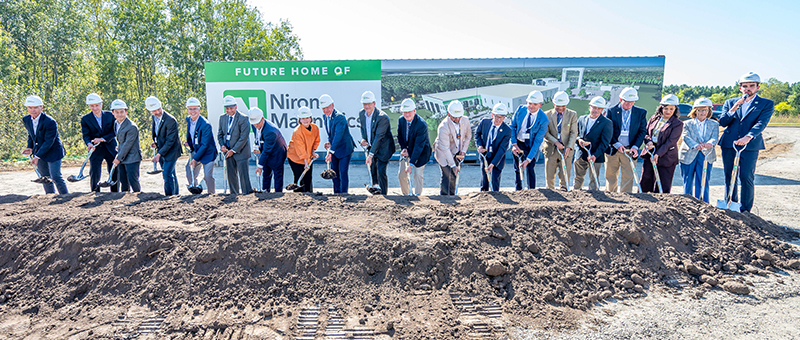
He continues: “Sartell is the blueprint that we can rinse and repeat over and over. It’s a massive step forward for the business. When you are building out manufacturing, you can’t just go from zero miles an hour to 100 miles an hour in a second. You have to accelerate and do it in a strategic and deliberate way.”
While Niron is making plans for Sartell and its next plant, it has been growing in parallel in Minneapolis. There, the company operates its research and development work and the pilot site for its manufacturing methods. It has taken significant resources and effort because Niron is developing a “new to the world” process for making its magnets, Larson says.
Niron is expected to expand in Minneapolis from 150 employees to close to 200 by the end of 2026, while simultaneously determining how to staff its Sartell plant, Larson says. When the new location is fully operational, it will offer 1,500 tons of capacity, with the ability to produce around 100 million magnets a year, or about 1,000 times more than the Minneapolis pilot plant. Employees focused on manufacturing, engineering, and operations will work in the new 280,000-square-foot facility.
Niron’s second full-scale plant will boast 10,000 tons of capacity. The 1.6 million-square-foot project is expected to have approximately 700 employees, who will be manufacturing 1-2% of the world’s permanent magnets, CEO Jonathan Rowntree recently announced. Over time, the company plans to exceed $1 billion in revenue, raise several hundred million additional investment dollars, and open more manufacturing plants globally.
Demanding development process
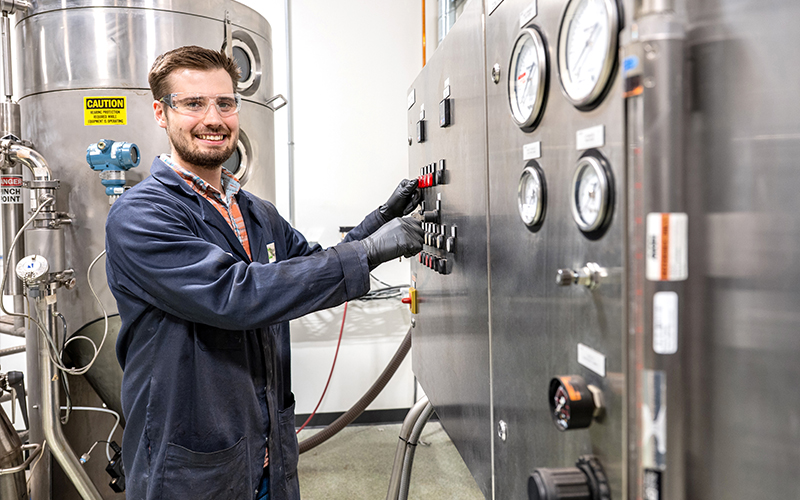
Part of the pilot’s marching orders are to perfect Niron’s two-part manufacturing process. The initial manufacturing is grounded in chemical engineering, as it produces the magnetic powder from nitrogen and iron. The second phase turns that powder into magnet bricks, which can be cut into the forms that customers want, Larson says.
Perfecting these processes for Niron’s magnets and then scaling up the amount it produces is an accomplishment in itself. In its research and development phase, Niron made skinny magnets, about the size of a pen, that customers could test by running them through their own manufacturing equipment, Larson says. The company also succeeded in ensuring that its magnets could perform well in an expansive range of temperatures.
As Niron made progress with engineering and technology, it built bigger magnets with enhanced capacity and performance. This allowed the company to ship its magnets to industry leaders such as Stellantis, the company behind brands including Chrysler, Dodge, and Jeep. In mid-2025, Niron’s customers began testing the magnets in their own products to determine if they work as well as magnets made with rare-earth minerals — another proof point of Niron’s progress.
A big part of Niron’s growth story has been its work to develop trust with customers, notably that the company is delivering on its promises about the magnets’ strength and potential. Its Minneapolis pilot plant serves as the site where “we’re developing commercial reliability,” Larson says. “That will be so critical so that we can get preorders from customers as we develop the plant in Sartell. We want to sell magnets from that plant, and we need to have those relationships firmed up.”
Emphasizing partnerships
During its rapid growth, Niron has sought to make decisions and execute on plans in a strategic fashion. Its answer: Don’t do it alone. Finding partners to help has been an integral way that the company is meeting this moment of growth, Larson says.
To develop its large-scale facility, Niron partnered with Wood Group, a global consulting, engineering, and operations services company with a major U.S. hub in Houston. It has rich experience in working with manufacturers that are transitioning from the pilot phase to full-fledged manufacturing. Wood Group is engaged in plant design, engineering, construction, and equipment set-up, including seamlessly incorporating systems like safety and electrical. This “single source of truth” approach allows for a smooth integration between engineering and construction, Larson says.
“It’s a faster approach. We could hire people, train them internally, and develop the processes ourselves, versus hiring a global engineering firm with 33,000 employees who have done this countless times,” Larson adds. “They have experience and best practices they use to make it all work.”
Niron also leveraged partnerships as it selected its first plant site. It worked with the Minnesota Department of Employment and Economic Development (DEED) to complete and process its request for information from cities in the state. Initially, 75 cities responded. Niron narrowed that list to 12, then selected five finalists.
DEED helped Niron set up site visits and meetings with city councils and economic development agencies from Owatonna to the Iron Range and everywhere in between, Larson says. On top of evaluating the different sites, Niron also sought to gather insights about each area’s workforce, housing, and childcare availability, as well as the area’s capacity to supply the needed power for magnet manufacturing.
Partnerships played a role for Sartell, too. To show off the city and the St. Cloud region, Sartell brought together the pillars of the area, including Greater St. Cloud, an economic development agency, St. Cloud Technical & Community College (SCTCC), the Sartell-St. Stephen School District and its award-winning robotics team, regional business leaders, and peer manufacturers. Overall, the group wanted to show Niron’s decision-makers that Sartell and the region provide a great quality of life and the workforce it needs to thrive, says Anna Gruber, Sartell city administrator.
“It was a unique opportunity for us to sell our community and show Niron that we do things differently. We have a long history of setting companies up to succeed, we’re progressive, and we’re not like most governments,” Gruber says. “We were confident that if we could build a relationship with them, we could help them realize there are some factors in Sartell that are different. It’s bigger than just utilities and roads and acreage and square footage. This is their future home. It’s about community and the people and the trust you build with the company.”
The effort won over Niron. “Sartell just popped off the page in terms of community engagement, the leadership there, and how they engaged with Niron during the search process,” Larson says. “They were fantastic, and that has been borne out through the more than two years that we’ve been working with these folks. There has been a partnership that really put them over the top.”
An example of that partnership came after Niron selected Sartell and the plot that used to be part of the Verso Paper Corporation footprint. This winter, Niron realized that it needed to complete an additional regulatory process that normally takes nine months. Sartell jumped on the work, completing its obligations in just three months to keep the project on track, Larson says.
Another factor in Sartell’s favor was that its location opened the door for Niron to access a 30% tax credit worth $52.2 million. The federal Section 48C Advanced Energy Project Credit is designed to advance energy manufacturing development including critical materials in communities with retired coal plants. A note to expanding manufacturers: Look for all available tax credits to support your plans.
Readying the workforce
Another key strategy for Niron: tapping into the expertise of local economic development and workforce training partners. It needs to build a pipeline of immediate and future employees who can get the plant running and producing effectively. The company has designed a multifaceted strategy to attract young workers as well as those with manufacturing experience, Larson says.
Niron forged partnerships with leaders at SCTCC, St. Cloud State University, and the Sartell and St. Cloud Area School Districts. The company is developing internship and apprenticeship programs, as well as scholarships for college and training, Larson says. Niron has committed to funding two four-year scholarships for students to pursue degrees at a Minnesota college or university in manufacturing engineering, information technology, or supply chain management. It also is awarding three scholarships for students to attend SCTCC.
“We’re investing in the development of students, and maybe some will come back to Niron,” Larson says. “We’re trying to develop programs with the schools and the community where the rising tide lifts all boats, so that these programs help other businesses there as well.”
Seeds of Niron’s partnership with SCTCC were planted early, when the site selection team visited campus to learn about its advanced manufacturing lab, training opportunities, and other ways Niron could build its central Minnesota workforce, says Ken Matthews, vice president of academic affairs and institutional effectiveness at the college. Once Niron picked Sartell, Matthews and Sarah Hansen, director of customized training, visited the company’s Minneapolis plant to learn about the skills the company seeks in its new employees.
SCTCC leaders and Niron are working closely on different programs and approaches to help the company fill varied jobs, as well as how to recruit people to pursue these fields. For example, some needs could be filled through existing degree programs or certificates like those focused on machining, robotics, automation, and mechanics. Other future employees might engage in customized training programs that the college develops, Hansen says. Some participants might already be in the workforce but want to upskill, while others might be entry-level learners like high school students or recent graduates.
“Our partnership with Niron reflects a shared commitment to investing in people and the long‑term strength of our community,” says Lori Kloos, president of SCTCC. “By supporting scholarships, internships, and career pathways, Niron is helping students access transformative education, leading to meaningful, family‑sustaining careers.”
Because Niron needs to have its workforce ready when the Sartell plant opens its doors, it is teaming with SCTCC to start training employees in Minneapolis. This will help with employee readiness and get training programs established that ultimately can be delivered in Sartell, too, Hansen says.
Another component of Niron’s workforce development involves helping to launch new opportunities for apprenticeships in Minnesota. Rowntree, a National Association of Manufacturers board member, learned about the Federation for Advanced Manufacturing Education (FAME) program. That prompted Niron to partner with Greater St. Cloud to work on establishing a chapter in Minnesota. “FAME is employer-led, and it allows manufacturers to come together and co-design what training pipeline is needed in your particular region,” says NeTia Bauman, president and CEO of Greater St. Cloud.
Through FAME, 15 to 20 businesses each commit to hiring at least one high school graduate who gets paid to work three days at a company and attend community college the other two. Apprentices learn technical skills on the job that will benefit that area’s manufacturers. It’s a strong employment pathway as 95% of companies hire their apprentices, Larson says.
Greater St. Cloud also paves the way for economic development by providing information to companies and decision-makers. When businesses are looking to expand, it prepares an economic impact analysis that gives companies, city councils, state lawmakers, lenders, and investors a perspective on how its development would affect the region, Bauman says.
For example, the latest projections show Niron’s Sartell location is expected to result in approximately $500 million in capital investment and roughly $115 million in annual economic output when the plant is fully operational.
Niron is doing its own work to forge relationships in the area, joining the Central Minnesota Manufacturers Association in Sauk Rapids to develop potential partners and the company’s future business network. During this process, “one of the lessons I have learned is that if you are expanding or growing into new communities, make sure you find partners who are willing to work with you,” Larson says. “That hit home with Sartell and the engaged partners in the community.”
Return to the Summer 2026 issue of Enterprise Minnesota® magazine.