
President Ronald Reagan once said that the nine most terrifying words in the English language are: “I’m from the government, and I’m here to help.” The Small Business Administration’s (SBA) Office of Advocacy wants to show that’s not always the case.
At Enterprise Minnesota’s annual State of Manufacturing® (SOM) event last November, two representatives of the agency described their mission and explained how manufacturers might help advance it. Their goal: bring the voices and concerns of Minnesota businesses to the highest levels of policymaking.
The Office of Advocacy aims to cut $100 billion in regulatory costs for small businesses. Andrew Coffield, the Office advocate for small businesses in six Great Lakes states, including Minnesota, says since early 2025 they’ve reduced that burden by about $48 billion.
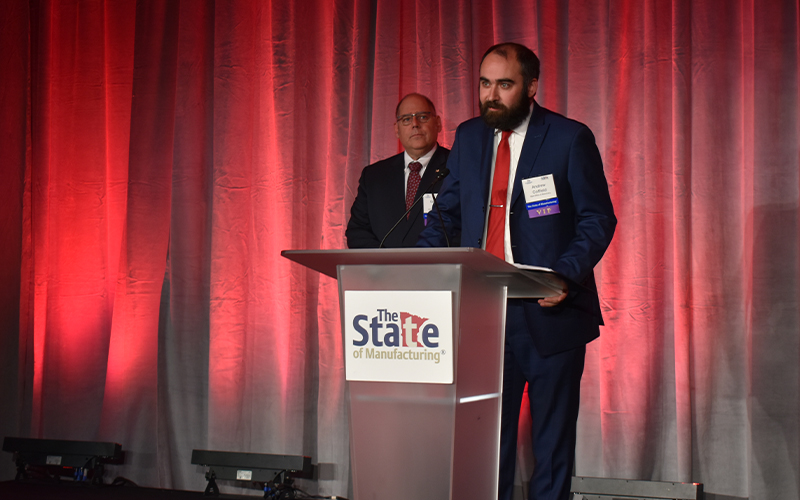
Despite their efforts, many have never heard of the Office of Advocacy. “We’ve got a PR problem as an agency because these small businesses are used to doing everything themselves,” says Deputy Chief Counsel for Advocacy Chip Bishop, noting the advocacy arm was established in 1976.
“We work with Congress, we work with the agencies, and we work with the White House to amplify what small business owners are saying,” says Coffield. “Ultimately, our job is to be their voice.”
Coffield and National Special Advisor Geoffrey Grove introduced themselves at the SOM event as small manufacturers’ “bridge for a better policy,” especially when it comes to handling serious regulatory challenges. “As a national advocate, my charge is to advocate for a regulatory environment that supports, not stifles, your success,” Grove told onlookers.
In Enterprise Minnesota’s latest SOM survey, government policies and regulations ranked as the top concern (53%) among manufacturers, along with taxes (44%) and tariffs (42%).
SBA’s marching orders
Within days of taking office, President Donald Trump launched a new era of deregulation with an executive order saying, “For every new regulation, 10 must be cut.” To achieve that goal, Bishop says his office hopes to complete its hiring of 10 regional advocates and two national special advisors to wage the battle on behalf of the country’s 36 million small businesses.
Advocates engage with small business owners at conferences, small roundtables, and one-on-one meetings. They field complaints about labor and environmental regulations, but “one of the top things I hear about not only in Minnesota but around the Great Lakes is the concern around CMMC (Cybersecurity Maturity Model Certification),” says Coffield.
Business owners who want to manufacture for and sell to the federal government must be certified first to protect sensitive non-public information based on CMMC standards. “I’m hearing from small businesses that they’ve spent over $300,000 and they’re still not certified,” Coffield says.
“Small firms are shouldering a regulatory load designed with the larger businesses in mind,” Grove says. Regulations should be “right sized” and scaled for the resources of employers with 50 employees or less, he says.
Minnesota companies weigh in
“It’s encouraging to see that [the Office of Advocacy] is reaching out and making an effort to be a little bit more business friendly than I have experienced in the past,” says Brandon Andersen, president and owner of Fireside Lodge Furniture Company in Pequot Lakes, Minn. The company has been selling its hand-crafted wood furniture to retailers and the hospitality industry across the U.S. for more than 20 years.
One of the more costly regulations for Andersen’s company has been the STURDY Act (Stop Tip-overs of Unstable, Risky Dressers on Youth Act), which went into effect in 2023 after several children were killed. “It’s obviously a horrible thing,” he says, “but the over-reaction on that was to change the whole industry.”
Previously, the company included hardware so customers could attach the furniture to the wall. Today, furniture manufacturers must also increase the weight of dressers and chests by 25 to 30%, and limit how much a top drawer can open.
At Fireside Lodge Furniture Company, the extra weight means higher material and transportation costs, plus more workers’ comp claims for strained backs. “We have to comply with these federal rules and testing requirements that are ridiculous, just to make sure [the furniture] complies,” Andersen says, noting his company’s cost to comply has run from $30,000 to $50,000.
While Andersen says he hasn’t brought this issue to the Office of Advocacy, he has talked about other pressing matters such as Minnesota’s workers’ compensation rules and the Minnesota Paid Leave program, which took effect Jan. 1, 2026. He’s also complained about federal trucking regulations. “If we just increase the allowable weight on trucks by 10%, it’s going to have a minimal impact on the roads, but it’s going to help drive down the costs significantly,” he says.
For Dan Ortloff and his company, Falls Fabricating in Little Falls, Minn., it’s the paperwork that takes a toll. His ownership group used several SBA loan products to purchase the company in 2021 and to add equipment in 2024-2025. “Sometimes that process can be almost overbearing with the hoops you need to jump through and the paperwork that’s required,” he says.
Falls Fabricating offers a range of services in sheet metal, machined components, and welded assemblies. The company is required to report everything from where the materials originate and who produced them to how it got the materials. “All that paperwork takes time and money,” he says. “You’re just asking yourself, ‘Why is this required? Why do I have to fill this out?’”
Without the resources to hire somebody to handle it, Ortloff says an employee who already has a full-time job takes on the task.
A hotline for help
To encourage small business owners to share the kinds of concerns expressed by Andersen and Ortloff, the Office of Advocacy launched a “Red Tape Hotline” last May. Bishop calls it a “relief valve” that owners can use to call or email about anything from costly regulations to permitting delays to excessive paperwork requirements.
The hotline will also allow small business owners to comment as regulations are being developed, Coffield says. The Office of Advocacy wants to know what will work or what might be burdensome for their business.
The website lists other targets for reform, which it says will save small businesses billions of dollars. At the top of the list is IRS Form 941, which employers fill out quarterly to report federal income tax withholding, along with Social Security and Medicare taxes, to determine their total payroll tax liability. They’re recommending changing to annual reporting, saving each employer $2,000 a year — a potential aggregate savings of $90 billion.
With all the energy the Office of Advocacy is investing to reduce or eliminate regulations, advocates say it’s a long game. “Please keep in mind that most of this is glacial,” says Coffield.
“They’re saying the right things. It’s definitely coming from the top down…but bureaucracy and all the stuff at the federal level — you know as well as I do that it takes time to do that,” says Andersen. At the moment, they’re listening.
Return to the Summer 2026 issue of Enterprise Minnesota® magazine.