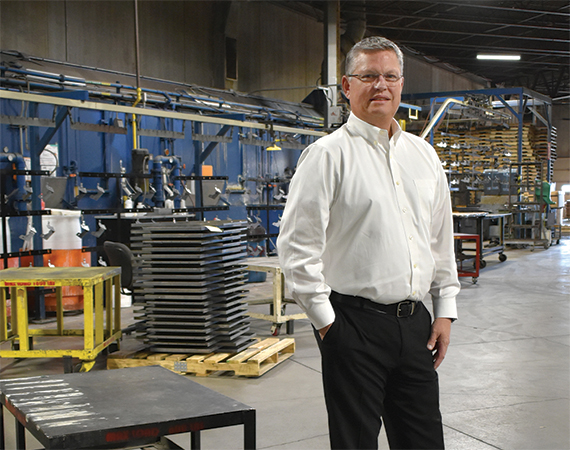
Mike Jensen, president and CEO of Gauthier Industries, an 85-employee Rochester-based custom metal fabricator, holds a big picture perspective on manufacturing. Since taking over as owner and leader of the company in 2007, Jensen has led Gauthier through the Great Recession, COVID-19 and the supply chain challenges that followed. He has also served on Enterprise Minnesota’s board, including as chair, and has advocated for manufacturing at the Minnesota Legislature. As a long-term and active peer council member, he understands the challenges other manufacturers face and offered his insight midway between the 2025 and 2026 State of Manufacturing® (SOM) results.
In the last State of Manufacturing® survey, a record number said the economy was flat, and smaller manufacturers were pessimistic about gross revenues and profitability. How is the outlook for Gauthier, what are you hearing from other manufacturers, and how does that compare to expectations from last fall?
Mike: I feel optimistic. We started the year with a strong first quarter, after finishing pretty strongly at the end of last year. There are economic concerns and challenges in front of us, but we try to stay fairly diverse with our customer base by supporting a number of different industries. That helps balance us out; certain industries can be up while others are down, which helps keep an ebb and flow. I feel good about things going forward. A lot of it depends on controlling our own destiny: keeping customers happy and our quality, lead times, and on-time delivery at or beyond expectations. That seems to make a big difference.
For other manufacturers I talk to, it tends to be reliant on the industry and the type of customer base they have, and how heavily they’re impacted by tariffs and other regulations coming into play in Minnesota. We’re not impacted by tariffs very much; it’s mainly on smaller hardware. Aluminum can fluctuate from time to time, but we’re not in a position to jack up our prices because of tariffs. I’m more concerned about energy prices spiking because of the war. In my opinion, the war needs to end sooner rather than later so energy prices stabilize later this year. We’re seeing fuel surcharges again, and this impacts our deliveries along with diesel fuel consumed by our semi-tractor trailers.
The survey also revealed deep concerns about government regulations and the Minnesota business climate, including paid leave, which launched shortly after the survey results were published. How have paid leave and other regulatory changes impacted your business and others you know?
Mike: We’ve certainly been impacted by the sick and safe time, which took effect before paid leave did. We haven’t been affected quite as much by paid family leave yet, but it’s still early. I’m concerned about it because I think these regulations inhibit opportunities for business growth and reduce our capacity in manufacturing when people are out for an extended period. Our customers aren’t going to be interested in why we can’t get their work done on time — they’ll want to know what we can do to make it happen.
I haven’t seen a real big financial impact yet. We’re using a third party to conduct our paid family leave, so any claims that come through are handled by them.
There are probably 11 or 12 of us manufacturing owners in my Enterprise Minnesota peer council, and there are definitely others who are impacted way more than I am with paid family leave, and they’re frustrated.
And the regulations just keep coming. I just received a letter from the Minnesota Department of Commerce requiring us to comply with the new large building energy benchmarking program created by the legislature. Owners of properties with 50,000 square feet or larger must report their energy usage for Jan. 1 through Dec. 31, 2025, by June 1st. It’s a new annual requirement. I don’t understand what they do with it or whether it’s just another program to funnel money into. Continued interference from our state is simply not helping our business.
As they have for years, manufacturers continue to identify workforce challenges as a top concern. Is Gauthier Industries facing the same shortage of qualified employees?
Mike: Finding qualified workers is really tough. You have to have a strong training group to onboard people, because the skills coming in are pretty limited. Whether someone’s coming from a different career path or it’s their first time in manufacturing, we have to be ready to train them properly to give them a chance to succeed. Cross-training is also important, so we have flexibility when certain areas are slower and can use those employees in other departments.
Culture fit is really the key right off the bat. We’re fortunate to have real longevity here — our average tenure is around 14 years. We have family combinations working here: husband and wife, father and sons. That’s been a good thing. Some people might say equipment is your asset, and yes, equipment is on the balance sheet, but our employees are our major assets.
What are the biggest challenges you expect to face in the coming months?
Mike: Finding qualified workers is right at the top. Having to continue complying with state regulations is way up there too. Even though the impact has been somewhat minimal so far, I think it’s going to be more problematic in the future.
Being able to obtain equipment financing at competitive rates is also a concern. We’re creating space for an additional machining center and other support equipment. Investing for growth is a key factor in strategic planning.
Return to the Summer 2026 issue of Enterprise Minnesota® magazine.