I often begin sessions with manufacturers by asking a simple question: Who executes your business strategy? It’s the kind of question that seems almost too obvious, but it reveals something important. Strategies don’t execute themselves. Processes, equipment, and technology don’t execute strategies either. People do. The individuals inside your walls are the ones translating ideas into action, goals into results, and strategies into reality.
That’s why talent management and leadership development aren’t simply HR activities. They are strategic levers, and arguably the most powerful ones that manufacturers can control in an uncertain environment.
I share this message with urgency because companies that manage talent well gain a substantial competitive advantage. Not marginal, not incremental — substantial. A McKinsey study shows that companies with effective people strategies are 2.2 times more likely to outperform their peers. When I share that number, I usually hear a collective exhale. It’s a reminder that developing people isn’t just a nice thing to do for employees; it’s essential.
People drive strategy
I’m encouraged by how many manufacturers I talk to who have a formal strategic plan. They’ve defined where they want to go, the markets they want to serve, and the growth they expect to achieve. But something interesting happens whenever I ask if they review their job descriptions whenever they update their strategic plans.
That’s when the room gets quiet.

The truth is, many organizations update their strategy annually but continue operating with job expectations that were written five or 10 years ago. The business has evolved — sometimes dramatically — while the expectations for employees have stayed the same.
If the strategy evolves but the roles don’t, misalignment is inevitable. Leaders feel frustrated that the workforce isn’t quite keeping pace.
Employees feel unclear about what success looks like. And organizations experience gaps that seem like talent shortages but are often simply communication or development shortfalls.
I encourage companies to look at talent management the same way they look at their business management: an ongoing process. Recruitment is just the entry point.
What truly matters is whether employees are supported, developed, and positioned to succeed once they arrive. That means thinking about the entire employee lifecycle — from how you attract people, to how you onboard them, to how you keep them engaged and productive, to how you capture knowledge when they eventually transition out.
The first step is to clearly define your employment brand and hire people who fit your organizational culture. It all starts with the recruitment process; consider the experience people have, from an applicant perspective, when they’re interacting with your company. Your talent management starts here.
Then once you’ve hired them, you need to be able to onboard them and ensure that they are productive in the organization. When you find people who fit your values and fit well in your organization, you have to work intentionally to ensure their skills continue to evolve and match your company’s needs.
The longer you retain someone, the more you need to invest in their development. The knowledge, skills, and abilities your company needs today are not necessarily the knowledge, skills, and abilities it will need tomorrow. Employees’ skills will need to adapt. Remember, they’re the ones driving and executing the business strategy.
The Productivity Zone: Where employees — and companies — gain momentum
There’s a point in every employee’s journey when things start to click. They’re confident. They know the processes. They understand expectations. They solve problems effectively. They contribute meaningful value. I call that place the Productivity Zone.
The longer manufacturers can keep employees in that zone, the more value they create — not just through output, but through initiative, insight, and consistency. But here’s the part many companies overlook: People don’t stay in the Productivity Zone on their own. If we allow their roles, expectations, or skills to stagnate, the zone starts to shrink.
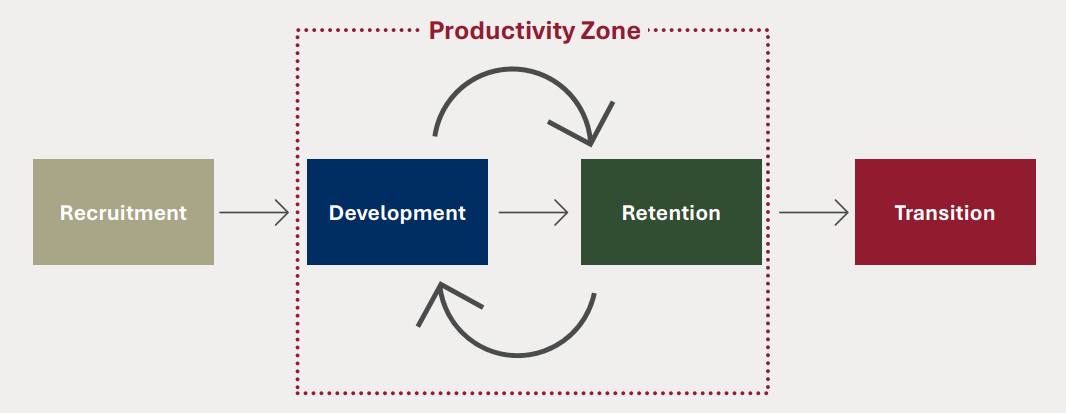
The reason is simple. The skills that made an employee successful yesterday won’t always be the skills the organization needs tomorrow. Technology changes. Customer demands evolve. Quality expectations shift. Processes improve. And the business strategy continues to move forward. Development isn’t a perk; it’s the engine that keeps employees aligned with where the company is going.
But talent management isn’t just about preparing people for what’s ahead; it’s also about preserving what’s already been built. I once asked a group to consider how much tribal knowledge existed inside their organizations — those unwritten, often hidden insights that only long-tenured employees understand. Nearly every head in the room nodded. They knew exactly what I meant. And they also knew how vulnerable that made them.
When employees leave — and they all leave at some point, whether through retirement, career transitions, or personal changes — companies lose more than a person. They risk losing knowledge that was never captured.
Maximizing employee time in the Productivity Zone and capturing employee knowledge consistently both depend on developing leaders who can manage the evolving needs of the organization and support the growth of their teams.
That brings me to one of the most powerful frameworks I share with manufacturers: the leadership pipeline.
Filling the leadership pipeline
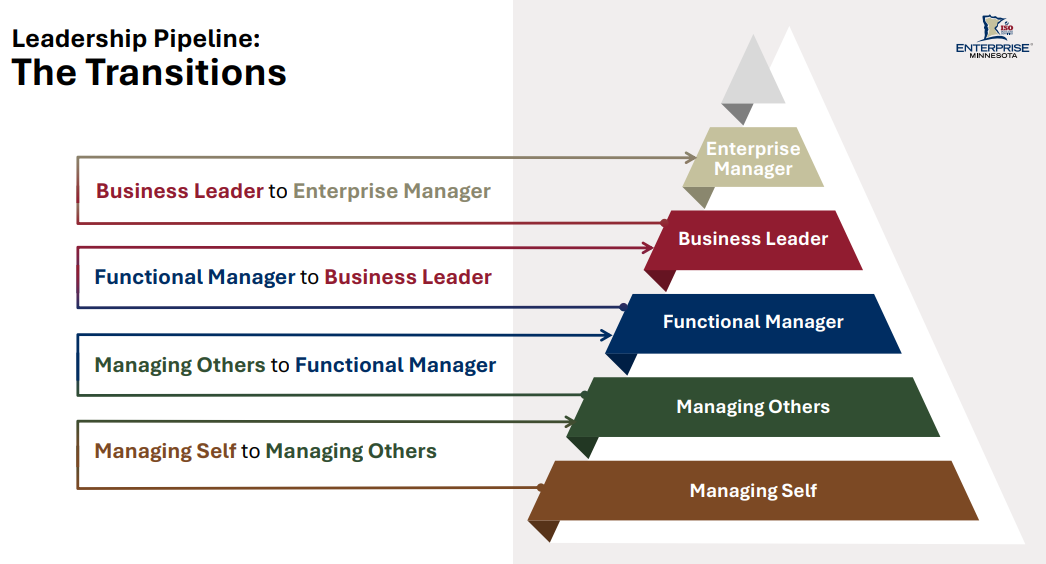
The leadership pipeline provides a structured way to think about how people grow inside an organization. It breaks down leadership into five primary levels: leading yourself, leading others, leading a function, leading the business, and leading the enterprise.
Not every manufacturing company uses these exact five levels, and that’s perfectly fine. Smaller organizations may combine levels or operate with fewer distinctions, and larger organizations may have additional levels.
The value of the pipeline isn’t in the number of rungs; it’s in understanding the transitions between them. Those transitions are where most leadership challenges occur — and where development is most essential.
Transition 1: From buddy to boss
This shift — often called the “buddy to boss” moment — is the transition I see most frequently in manufacturing, and it is arguably the hardest. Up until this point, success was based on individual performance. Now, for the first time, success depends on the performance of others.
Frontline supervisors must still manage some of their own work, but they must also plan, assign, coach, develop, and hold people accountable. They must begin valuing leadership work over technical work. They must navigate relationships that may have previously been purely social. And they must figure out how to balance doing and leading — something that can feel unsettling when every skill that got them here was rooted in the doing.
Without support, many new supervisors lean heavily on what they know best: the technical tasks. But when supervisors spend too much time doing rather than leading, they unintentionally deprive their employees of opportunities to grow. They also exhaust themselves, because leading requires time — to think, observe, communicate, and coach.
This transition sets the tone for every leadership move that follows.
Transition 2: From leading others to leading a function
When leaders move into department-level roles, the nature of their responsibilities shifts dramatically. They become responsible for shaping a function — HR, finance, sales, engineering, operations — rather than a single team. Their decisions now impact the organization more broadly.
This level requires a deeper understanding of how goals align with company strategy. It demands fluency with performance metrics. It requires the ability to select future leaders — because frontline supervisors often determine the company’s long-term leadership health. And it depends on cross-functional collaboration, because departments cannot function in isolation.
Leaders at this stage must learn to value managerial work. They must resist the urge to drop back into tactical tasks just because they’re comfortable. When leaders drop down, they inadvertently create silos and slow the development of the people behind them.
Transition 3: From functional manager to business leader
At this level, leaders begin thinking in terms of the entire organization, not just one area. They must elevate their perspective from departmental performance to overall business performance. This means balancing short-term needs with long-term strategy, understanding the external environment, and recognizing that every decision affects the organization as a whole.
Leaders at this level often face a challenge they don’t expect: letting go of the bias toward the function they grew up in. Whether someone came from operations, engineering, sales, or finance, it can be hard to step back and value all areas equally. But it’s essential. Without that shift, the organization becomes siloed and disconnected.
The success of a business leadership team depends heavily on how well its members work together. Collaboration, communication, and shared respect are the glue that holds senior leaders together. When this group functions well, the organization feels it. When it doesn’t, everyone feels it.
Transition 4: From business leader to enterprise leader
This final transition carries the greatest weight. CEOs, presidents, owners — those at the enterprise level — are responsible for setting the vision, shaping the culture, and inspiring the entire organization. Their decisions guide performance across every level. Their leadership determines whether the organization drifts or moves forward with intention.
Enterprise leaders must know which levers drive performance, and they must build a senior leadership team capable of pulling those levers effectively. They must balance internal and external responsibilities, remain visible and accessible, and model the behaviors that define their company’s identity.
And perhaps most importantly, they must have the patience to value slow, evolutionary progress. Long-term results rarely happen overnight. They come from consistent steps taken over time, guided by clarity and conviction.
When leaders at all levels understand the expectations of their role — and when they are supported in making these transitions successfully — the organization gains strength, agility, and momentum.
Leadership development is a system
Once companies understand the leadership pipeline, the next step is thinking about how to develop leaders intentionally. Many organizations promote people and hope they “figure it out.” Others send employees to a training session, check the box, and assume the job is done.
Leadership development doesn’t stick without structure. And it must be woven into the organization — not added on top of it.
A strong system begins with clarity about what leadership looks like at each level. Every organization needs to define the competencies it values. Whether it’s communication, collaboration, composure, business acumen, or financial fluency, those expectations should be visible, consistent, and meaningful.
Once those competencies are defined, leaders can begin assessing where people currently stand. That might involve a skills matrix, a gap assessment, or 360-degree feedback. It might include manager feedback or self-reflection. Whatever the method, the goal is the same: understand the current state, define the future state, and identify the gap. Only then can development become intentional.
Development doesn’t have to be formal or expensive. It can happen through stretch assignments, mentoring, coaching conversations, or opportunities to lead a project. What matters is that leadership development becomes part of the day-to-day reality of the workplace — not something abstract or occasional.
Organizations that excel at leadership development build systems that support leaders, reinforce expectations, and provide opportunities to grow. And when that happens, everything flows more smoothly: the leadership pipeline, employee retention, and the company’s ability to execute its strategy.
One small step in the next 30 days
I always end my sessions with a simple invitation: What’s one thing you can do in the next 30 days to strengthen leadership in your organization? It doesn’t need to be monumental. Big results often start with small steps.
Maybe it’s reviewing one job description. Or having a conversation with a promising employee. Or thinking more intentionally about how your supervisors are being supported. Every small improvement contributes to the long-term health of your organization.
The manufacturers I meet with across Minnesota are committed, creative, and resilient. They want to build strong companies, and they want to take care of their people. When those two goals align through intentional talent management and leadership development, organizations thrive.
Your future leaders are already inside your building. Make sure your systems are ready to help them grow.
Return to the Spring 2026 issue of Enterprise Minnesota® magazine.