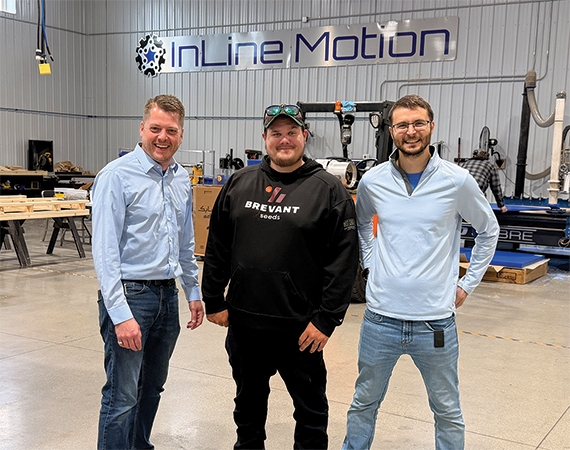
Food conveyance designer and manufacturer InLine Motion is expecting 2026 to be a stellar year. The Detroit Lakes company is building many of the conveyances and coordinating other vendors for an expansion at health brand
Amylu Foods in Chicago. The project will more than double the line’s production of frozen chicken products.
InLine Motion is also designing the layout and equipment for the packaging side of a $135 million pork processing and packaging plant in Iowa for multinational JBS Foods. Combined with sales to other food companies, the firm expects to top $7 million in revenue this year as it celebrates its 10th year in business.
Not bad for a company that started with two engineers and basically no cash.
Founders Marco Fenu, president and CEO, and Lucas Hoffman, chief financial officer, attribute the growth to a “squeaky clean” approach to engineering and design, a laser focus on customer satisfaction, and constant awareness of cash flow. With 15 employees and a 22,000-square-foot facility, the company is close to the growth projections the two hoped to achieve when they started the firm in 2016 — and the potential is much greater. “This could be a $70 million company someday,” Fenu says.
The size and stability of the food conveyance industry is one reason for optimism. Building and installing conveyors, platforms, hoppers, and accessories for food processing and packaging is a $1.7 billion-a-year global business today, with compound annual growth rates of 3.5%, according to market research firm Data Insights Reports. Changes in eating habits, new food safety regulations, and technology advances all require food processors and packagers to improve or replace equipment regularly.
Getting rolling
Breaking into the industry was not easy, however. Fenu, 35, and Hoffman, 45, graduated from North Dakota State University in Fargo about 10 years apart. They met when working as mechanical engineers at another food conveyance firm and decided to strike out on their own.
While the industry is large, many food processing firms have established connections with conveyance suppliers and are wary of switching vendors. Design-build companies also require capital to start, something the two young engineers lacked. They were fortunate to get their first job within weeks of starting the firm and often used the cash from one job to fund the materials needed for the next.
That’s where squeaky-clean design comes in. Every aspect of food processing requires attention to frequently changing safety regulations. Material selection is limited to stainless steel and a few types of engineered plastic. And because of the constant cleaning required, designs have to consider water flow to avoid spreading germs as water pools or oozes behind parts.
For its first seven years, InLine Motion’s founders focused on those challenges with impeccable engineering and design while contracting with Neuweg Industries in Milnor, N.D., about two hours away, for laser cutting and machining of parts. “The parts would come in, and Marco and I would put it together, test it, and then go out and install it,” says Hoffman.
“We were extremely careful,” says Fenu of how products were engineered. “If anything did not work, it was two extra weeks on the build and a whole bunch of extra money that we needed to pay.”
Exceptional customer service
“The first opportunity we get with a customer, typically we get it because they are impressed with our designs or our lead time,” Fenu says. “But the reason somebody comes back is because we went the extra mile to take care of something.”
In one case, the (literal) extra mile meant a $1,200 airplane ticket. Fenu and a crew of employees had just finished installing a large conveyance system for a customer. Everything seemed to work well during initial tests, but during an overnight shift, one of the shafts broke, stopping the line. Engineers at InLine Motion figured out how to fix the problem, fabricated the part in Detroit Lakes, then sent an employee, with the shaft in his luggage, to install it.
Building a reputation for unmatched service has allowed the company to expand its book of business by one or two companies a year. Its list of customers currently includes food processing giants such as Tyson Foods, Monogram Foods, and JBS.
A mix of smaller jobs along with the big ones has allowed the company to manage cash flow and grow steadily.
Next steps
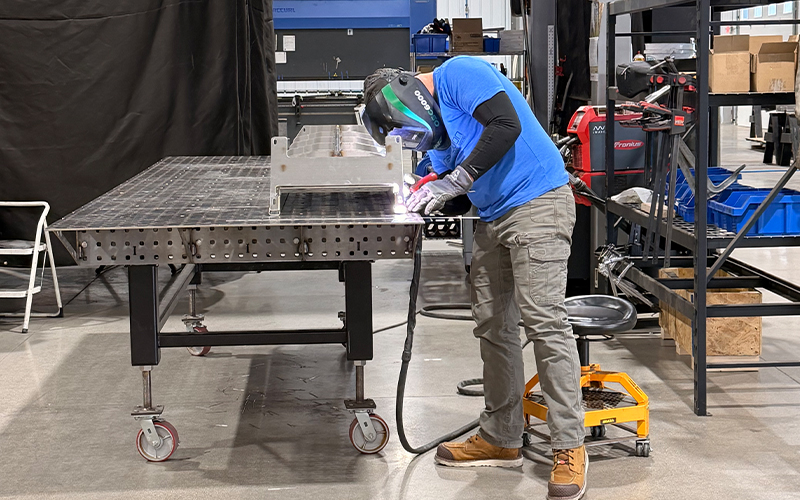
As sales increased, the founders hired Tony Friesen, chief operating officer, to manage fabrication, and they brought the welding and assembly in house. In 2022, the firm moved into its current building, with ample space for large projects and state-of-the-art equipment, including a 12 kilowatt fiber laser cutter and a 245-ton CNC press brake.
With excess capacity on both the laser cutter and the press brake, employees can try different designs and work through options in a few hours rather than days or weeks, which has given them more freedom to develop custom equipment. It also has given the company the flexibility to provide some on-the-job training for designers. Two of their four current designers came from the shop floor — one was a laser cutting operator, the other an assembler. “When we have people who we sense can do more, we want to give them a chance,” says Friesen.
Among the company’s recent innovations is a line that feeds packages through a conveyor, closes one of the flaps at the top of the box, then automatically lays down a bead of glue, folds in the other flap, and seals it. Other custom projects include a cat-food packaging system that can process and pack up to 1 million cans a day and create variety packs with the push of a button; a fully custom extruder for twisted licorice; and a robotic arm that transfers boxes from one conveyor to another.
Having a dedicated, flexible workforce has been essential, since one of the company’s growth goals is a ratio of one employee per $500,000 of billings, says Hoffman. “We have to have efficiency in the shop.”
With its team in place, customers returning for more of InLine Motion’s innovative designs, and a sustainable cash management strategy, the company is ready for its next steps. It owns 11 acres around its current plant, so there is plenty of room to grow as the food business expands and changes.
Return to the Fall 2026 issue of Enterprise Minnesota® magazine.