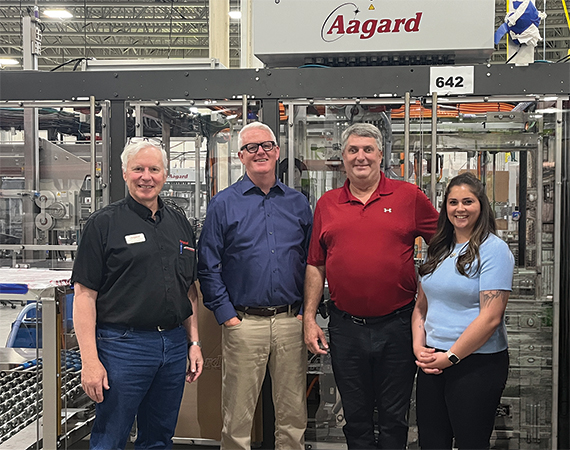
In the western Minnesota city of Alexandria, population 14,700, Aagard has built an international manufacturing operation that serves Fortune 500 companies in the booming consumer-packaged goods market. By customizing every piece of equipment it builds and anticipating market shifts to help customers stay ahead of the competition, Aagard is booming too. Ask company leaders what drives its success, and the answer isn’t the machinery. It’s the people.
From batteries to guacamole to Peeps, every item that goes into a package gets there through a highly advanced machine that readies the final product for shipping, display, sale, and consumer use. Aagard, founded in 1997, builds the advanced equipment required to complete that process.
“Our purpose-built approach certainly sets us apart. We tailor our machines to every unique situation,” says Jason Norlien, vice president of technical sales, noting that Aagard has nearly doubled both its headcount and revenue in the past five years.
Every order is a challenge
Aagard’s work with Energizer demonstrates its highly customized approach. When Walmart asked the battery producer to eliminate all plastic in its packaging, Energizer partnered with Aagard to find a solution.
Aagard teamed up with a crew from Energizer — including marketing, sales, engineering, and production specialists — to create a system that meets sustainability demands and improves the consumer experience. The project required a blank-slate approach, with partners from Energizer and Aagard rethinking formats, consumer usability, and end-to-end packaging automation. They developed a fully recyclable package that’s easier to open, better at protecting and organizing the product, and optimized for automated production.
Aagard’s experience with Energizer shows how shifting trends and consumer sentiment drive demand for new packaging systems. From economic downturns to hot new food trends, these shifts can necessitate entirely new packaging systems.
The 2008 economic crisis drove growth at Aagard as consumers cut back on dining out and replaced restaurant spending with packaged food. A similar trend drove sales during the pandemic. “Our food customers couldn’t keep enough food on the shelf, so they were buying automated equipment, even in the middle of the COVID crisis, because they couldn’t keep up with production,” Norlien says. Aagard equipment enables them to make more product in the same amount of time, he says.
Smaller trends also drive demand for Aagard’s equipment. “Think about the consumer demand for high-protein foods,” he says. “You wouldn’t believe how many product launches and reformulations there are. Now everybody’s buying Greek yogurt and cheese.”
Norlien and his team monitor industry trends, join trade associations, and attend conferences to gauge trends. “We want to be looked at as a strategic vendor, helping educate them versus them coming to us with what they need, and we give them exactly that,” he says.
Those market shifts can occur every two to three years. “Whoever serves that market now needs new or different equipment. They’re seeing their volumes double or triple in just a few years, and they need to automate,” Norlien says.
Each piece of customized equipment represents a significant capital expenditure. To make those investments more palatable to customers, Aagard integrates “future-proofing” into design processes.
“We have a plan to reconfigure the equipment to accommodate changes, which means they don’t have to spend the money today; but they have a plan, and they know what it will cost, how long it will take, and how they can reutilize as much of the asset as possible,” Norlien says.
Customers can also call on Aagard to retrofit equipment to meet changing demands. “We actually do more retrofit projects per year than new machine sales, just because there’s so much equipment out there,” he says.
Building a team
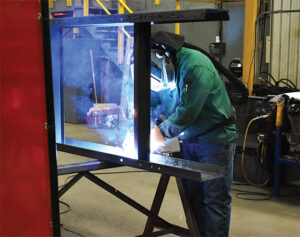
Each machine Aagard creates or retrofits requires an extraordinarily talented team to design, build, test, and refine the new system. Of the company’s 300-plus employees, roughly a third are engineers. They work hand-in-hand with the CNC machinists who make the parts, the assembly team that builds the machines, and the technicians who service them.
To recruit and retain employees, Aagard builds strong connections within the region. Michele Neale, an independent certified advisor with Enterprise Minnesota, who has decades of expertise in employee engagement and talent development, praises Aagard’s multi-pronged approach.
“They sponsor everything from the new community splash pad to a wing at the high school to programs at Alexandria Technical & Community College,” Neale says. “People in the Alexandria area know the company and want to work there.”
Norlien likens the approach to recruiting engineers to baseball’s farm team system. “We have robust internship programs and partnerships with colleges. We have dual training grants through the state of Minnesota that we use to give scholarships to some of our interns and get them exposed to the business,” he says. “We have a very high conversion rate of interns to full-time hires.”
A key aspect of Aagard’s recruiting success is its focus on local and regional talent. The company partners with colleges and communities where Alexandria feels like a big town, with Target, Fleet Farm, Menards, and the lakes area, Norlien says. Recruits from northern Minnesota, the Dakotas, Iowa, and Nebraska tend to look at Alexandria and see amenities their hometowns don’t have, and “they are likely to be very happy and stay here.”
That’s a good thing for Aagard, since the company’s success depends on its people. “Our growth is not constrained by how much we can sell. It’s all about how fast we can recruit, train, and retain key technical talent,” Norlien says.
Return to the Fall 2026 issue of Enterprise Minnesota® magazine.