On a short industrial stretch in Hawley, Minn., (pop. 2,300), Rapat Corp. might seem, at first glance, like a standard manufacturer, with offices in front and a warehouse and production floor tucked behind. But that larger building just keeps stretching on and on down the small-town road, with employee cars parked like it’s a parade route.
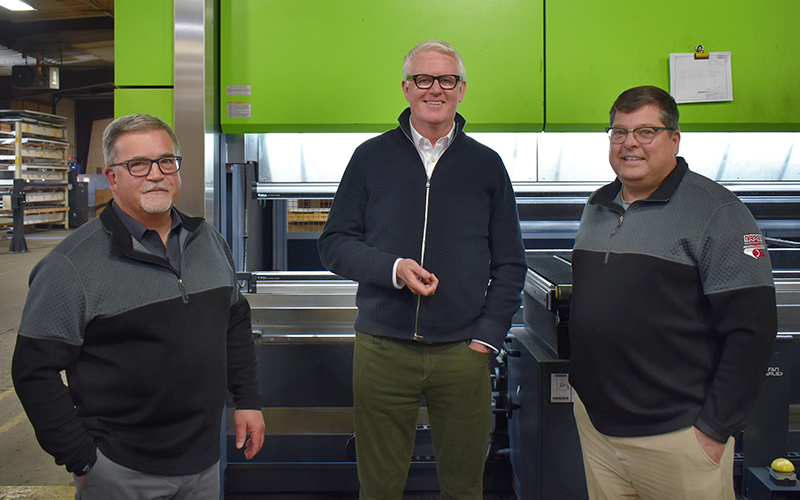
The company utilizes every square foot of that space, and those employees are why it all works, according to Todd Sparrow, Rapat’s president. Down that road, employees are designing and building belt conveyors, bucket elevators, drag conveyors, structural steel trusses, belt feeders, and hoppers for mining and industrial markets.
Celebrating its 51st year, Rapat now has 80 employees. What sets the company apart and drives its growth is a focus on custom work — if a customer needs a support tower, ladder, platform, or non-standard conveyor system, Rapat’s designers and engineers are happy to take on the task.
“Designing and building each system around a customer’s specific needs is our niche in the industry, and it’s an approach that works for us,” says David Kerr, general manager. “Rapat handles everything from drafting and design to manufacturing.”
Like any manufacturer, the company faces challenges, particularly maintaining a skilled workforce, but Sparrow is looking forward to many more anniversaries. “We’ve established a reputation for continuous innovation, and we make sure to invest in our people and our equipment,” he says. “We’ll keep building on that.”
From blacksmithing to material handling
Rapat’s roots extend back to a blacksmith shop in Hitterdal, Minn., in the 1940s, that supplied parts and made repairs for the agriculture industry. In the 1960s, the company was purchased and moved to Hawley by Ray Peschel and Arnold Tingstall (the name Rapat comes from a combination of their names).
In 1975, when there were only two employees, Tom Sparrow, Todd’s father, acquired the company, and almost immediately, Rapat pivoted into custom projects and problem-solving when a large grain company needed to move 50-pound bags of seed and fertilizer into trucks, but existing conveyor systems weren’t working. The success around finding a creative solution led Rapat to shift from producing wrought iron railings and standard ag equipment into customized bulk conveying and material handling, Todd Sparrow says.
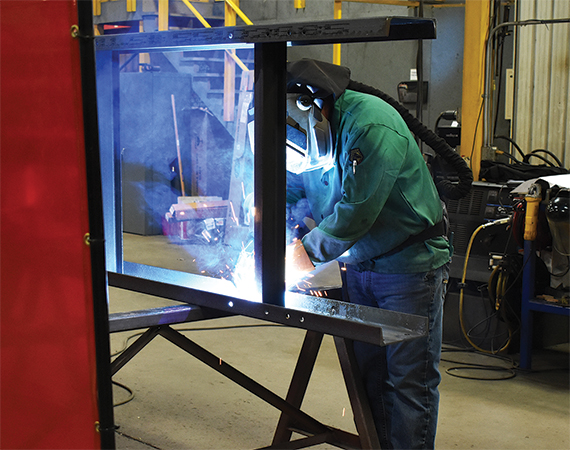
That specialization has fueled growth and allowed the company to build robust, in-house design and manufacturing capabilities. Under the roof of the sprawling building, Rapat employees display a breadth of skills, including engineering, welding, structural steel fabrication, powder coating and sandblasting, assembly, tagging, and logistics.
Customer stories highlight how Rapat and its workforce understand material-handling challenges and apply their decades of experience to develop tailored solutions.
For example, a fracking sand processing facility in Texas needed large conveyor systems along with a drive tower and walkways — and the customer asked for everything on a “right now” basis. (Fracking sand is a highly specialized quartz sand used in hydraulic fracturing.) It took Rapat just seven months from start to finish, allowing the Texas company to go to market faster than competitors could, and become the largest sand producer within the largest shale play in the country.
Not all projects are huge; a malt processing facility in Canada asked Rapat for a way to transfer green malt to a kiln with a standard conveyor, but had very limited space at the location, making off-the-shelf equipment unworkable. Rapat created a custom-built conveyor to fit the area, and, because of its length and the need to regularly wash it down, the company opted for a forge-steel chain and stainless steel fabricated enclosure, with access doors for the wash-down process.
“Our engineers appreciate a challenge, and they work together to come up with material-handling systems that fit our customers’ requirements,” Kerr says.
Maintaining a deep talent pool
Because of its innovative work in the material handling industry, Rapat’s reputation is firmly established, Sparrow says. But being in a rural location and needing such a skilled workforce is tricky, he adds.
“We know we’re not alone in competing for employees,” he says. “Added to that, like many manufacturers, we have an aging workforce, so we’re looking at numerous retirements in the next few years. In the same way that we’re creative with our projects, we have to be that way with recruiting as well.”
Rapat is using several workforce-attraction tactics, including investment in training and skill development so employees can advance within the company in a number of roles, including project management and engineering. The company has established relationships with local high schools and technical colleges as well, says Sparrow.
Rapat’s leaders also use its location as a retention tool. The company’s long-established operation in Hawley means it’s known as a key employer in the area, and the tight-knit employee community tends to inspire loyalty and low turnover.
As the company continues to address challenges from large and small customers across the U.S. and world, Rapat will stay committed to building the best workforce it can and developing employees at every level.
“There’s a reason some people have been working here for decades,” Sparrow says. “There’s an emphasis on making sure everyone at this company, no matter what they do, feels that their job is important, that they’re solving problems and supporting one another along the way.”
Return to the Fall 2026 issue of Enterprise Minnesota® magazine.