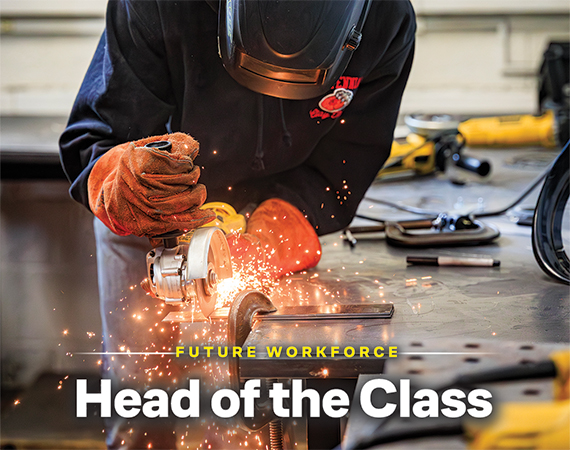
It’s early June, and even before the bell for fourth hour rings at Centennial High School in Circle Pines, students in Joel Depies’ Pathways to Manufacturing class get to work.
They trickle into the expansive shop room and go right to their individual projects. One uses a press brake to shape an anchor she’s making for her family’s boat, while two others begin manually milling a fixture to be used in cutting and shaping a bolt for snowplows.
Other students have fabricated metal fire pits as they develop their skills. They have also built fixtures for the classroom, such as the metal shelf that Cole Skoy built to store up to 2,000 pounds of materials donated by local companies.
“The welds have to be pretty strong to hold up that kind of weight, especially the ones at the bottom,” says Skoy, a senior in that Centennial classroom who hopes to pursue a career in fabrication and welding. “I like working with my hands. I like making things that are useful and work and have their place.”
The manufacturing program at Centennial is only in its fourth year, says Depies, but interest among students is high and growing. Centennial is one of dozens of high schools in Minnesota that are strengthening industrial technology and other skills-based programs to help students find careers in the trades. According to Minnesota Career and Technical Education, a statewide organization that recruits and trains teachers, the number of Minnesota high schools offering programs in trades and industry increased by 9% between the 2023-24 school year and the 2024-25 school year.
In the past two years, Centennial’s shop has gone from what Depies calls a “hodge-podge of stuff” to a place where students have equipment similar to what they might use on the job someday, much of it donated by local companies. The classroom includes several welding booths, a sheet metal shearer, a press brake, CNC machines and lathes, tools for manual milling, and metal for projects. “We could not have done this without our business partners,” Depies says, who has taught for 10 years and joined the staff at Centennial a year ago. “I had not been planning to move here, but when I walked through and saw what they have done, it was amazing.”
Independent School District 12, where Centennial is located, has made growing its manufacturing-focused offerings a funding priority in the past few years, says principal Tom Breuning. Like other high schools around the state, Centennial’s program has found willing partners among local business leaders, who are eager to introduce students to the skills and opportunities in manufacturing. “We have local companies banging down our door to be part of this,” Breuning says.
Giving back
One of Centennial’s partners is Josh Kissick, owner of G&K Machining in East Bethel. A 2003 graduate of Centennial, Kissick didn’t have a chance to learn about manufacturing as a high school student. “When I was there, they had limited shop classes. There were no small engines or metal working,” he recalls. “I didn’t like school, and back then they were pushing everyone to go to college and get a four-year degree.”
Kissick found his way into manufacturing through a work-study program and assistance from his uncle, one of the founders of G&K. “I was in middle school when he started the company. I used to go in on weekends and help him out,” Kissick says. By his last year of high school, Kissick worked part time at the company, making deliveries and cleaning the shop. Over time, he learned the trade, became a machinist, and eventually took the helm of the company. While G&K has diverse services — “If it’s made out of metal, we can make it,” Kissick says — the firm specializes in fabricating metal regulator bodies for industries such as health care and semi-conductors.
“Now as a business owner, I see how manufacturing has not been promoted to kids,” he says. “It’s really hard to find people who even know what machining is or what it does for everybody and all the industries out there that rely on it.”
So when friends told him that his alma mater was looking for equipment and donations to build its programs in the trades, he stepped up. A year and a half ago, G&K donated a CNC lathe that it was replacing. “I know the cost of manufacturing equipment,” he says. “It’s not cheap.” In addition to donating materials and equipment, Kissick gives his time to the program. He’s assisted in classes and invited students to his shop for a field trip so they can see the diverse types of work environments in manufacturing.
While his 20-employee company has not hired anyone from the program yet, building the manufacturing workforce is a clear goal for Kissick. “Even if I don’t get employees out of it,” he says, “it’s still helping the industry.”
Same mission, varied approaches
Of Minnesota’s 329 public school districts, 253 have some kind of program focusing on construction, transportation, or manufacturing. However, the programs’ approaches, even among those dedicated to manufacturing skills, vary widely. What they share is a focus on teaching basic skills to students and introducing them to equipment they might use on the job. Many programs allow students to earn an OSHA-10 certification as part of their coursework.
In the Cambridge-Isanti school district, students can take multiple classes in welding, machining, and computer-aided drafting and design. To give students even more experience, the district launched the Bluejacket Advanced Manufacturing Program (AMP) in 2025, which introduces students to local manufacturing companies and job opportunities. In addition to plant tours and weekly seminars, students can apply for paid internships at local manufacturers to gain experience.
“We wanted a specialized work-based program for manufacturing,” says Katie Soler, career and college coordinator at the district. Funded through a Youth Skills Training grant from the Minnesota Department of Labor and Industry, 22 Cambridge-Isanti students found jobs at 12 businesses in the area during the 2025-26 school year. “My goal was twofold,” says Soler. “I wanted to get the kids on their track, realizing that not all kids are going to go to college and not all should. I also wanted kids to find out they could be contributing members of society, that they could go to work and contribute while still in high school.”
Matching students to companies and teaching them job-seeking skills proved an interesting challenge, Soler says. Because they had to apply for the jobs — something most had not done before — teachers worked with them on job hunting basics, such as writing a resume and making a phone call to set up an interview.
For a generation raised on texting and social media, making a professional phone call and leaving a message was a stretch, Soler says. At the same time, the school sought out companies with a culture that had the flexibility and communication styles younger workers thrive on. “The work ethic is different,” Soler says of younger workers. “It’s not that they don’t want to work. But they have to feel a connection to their work. They want things to be more relevant to them.”
The district’s matchmaking efforts paid off, Soler says. Most of the students who were placed earned $14 to $18 an hour. “Across the board, 100%, students loved working with the companies we partnered with,” she says.
In addition to placing students in jobs, Hutchinson High School created an in-house manufacturing center. Tiger Manufacturing has operated for eight years as a student-run company, doing projects for local manufacturers, according to Gary Koehring, technology teacher at the high school. It’s received more than $4 million in donations of cash and equipment from local partners.
Working at Tiger Manufacturing is the capstone to many students’ high school careers. Students start taking classes in woodworking, welding, drafting, and machine tooling in ninth and 10th grade, Koehring says. In their junior or senior years, they must apply to work with the student-run company. “We want the program to be impactful,” he says. “We want the right kids to be there.”
Student projects range from building gates for the local elementary school to producing laser-cut maps of nearby lakes. They’ve done projects for local manufacturers such as 3M and RD Machine, as well as the city of Hutchinson. In addition, some students are placed in internships at area companies, such as MITGI, a Hutchinson-based manufacturer of precision cutting tools.
The company got approval from OSHA and the Youth Skills Training program to have students work in its production facilities. To become an intern, students go through the same interviewing process as regular applicants, says Katie Bruns, chief human resources officer at MITGI.
Those accepted are trained by skilled MITGI employees and can work three to four hours a day for up to 90 days. “If they enjoyed their time and were a good fit for our company, we would work with them as they furthered their education at the Hutchinson community college,” says Bruns. In the past five years, MITGI has hired more than a dozen students full or part time through the program; some have worked their way up to leadership positions at the company.
“Getting to work with the candidates when they are young allows us to develop in them the culture and work ethic that our team has,” says Bruns. “It helps them with soft skills. If individuals possess good soft skills, everything else is trainable.”
Not all students go on to careers in welding or manufacturing, Koehring says, but no matter what their career choice is, students gain valuable life and work skills. “The main benefit is the students learn job responsibilities,” says Koehring. “They learn to meet deadlines and maintain quality standards, and they know that is important because they are doing work for a real company, a real project.”
Programs similar to the one in Hutchinson are growing in many schools around the state, including St. Francis, Lakeville North, Minneapolis Roosevelt, Bemidji, and St. Cloud. More schools are reviving and expanding trades education as families and educators realize — as Josh Kissick did years ago — that a four-year college is not always the best option or a good financial investment for many students.
Responding to demand
Ten years ago, Westonka High School in Minnetrista formed the Tonkabots, a robotics team that has gone on to win state and regional championships. “When we started looking for mentors for the team, we found them in the manufacturing fields,” says Mark Femrite, assistant superintendent for the school district. “That led to great discussions about the needs those companies have.”
Next year, the high school will complete its first significant remodel since the building opened in 1972. As part of that $93.4 million project, a manufacturing lab will be available to students, including a Haas CNC mill, as well as equipment for manual milling, computer-aided design and computer-aided manufacturing programming, welding, and other skills that machinists need. The machining program is one of three trades-oriented programs the school is introducing in the new building. Along with programs to train students in nursing, emergency medicine, and construction, the manufacturing programs are part of a “recalibrating” of the high school curriculum to reflect industry needs as well as student interest.
More than twice as many students applied for the machining program as slots were available its first year, Femrite says. The nursing and construction programs saw similar levels of interest.
“For us, this was a great opportunity,” says Femrite, “because we needed to remodel the high school and we could move this need into the remodeling process.”
The goal was to give the students exposure to what manufacturing is and what a career pathway in machining would be.
“We know there is a need,” Femrite says. “There are jobs to be filled in these areas.”
As high schools offer more students an introduction to manufacturing, technical colleges are working to create easy transitions from high school to postsecondary educational programs and on to the workplace, says Lori Kloos, president of St. Cloud Technical & Community College (SCTCC) and a member of the Enterprise Minnesota board of directors.
“It’s really exciting,” says Kloos. “There are so many options for students to explore those pathways. Many don’t have any idea of what advanced manufacturing is like. They don’t understand how much automation there is, how creative the work is, and that they can be in great careers.”
While SCTCC consistently fills its welding and construction programs, it has more capacity for students in machining and instrumentation. “The challenge is having students understand what those jobs are and getting students interested earlier,” she says.
To encourage a “seamless transition” to manufacturing jobs, Kloos is working with local school districts and businesses to create a curriculum map showing how students might begin their technical education as early as ninth grade with an introduction to equipment and skills, then moving to advanced programs later in high school, followed by enrollment in one of the technical programs at SCTCC. The college also offers a Rising Stars program to bring middle and high school students to campus to explore career options such as robotics and instrumentation.
Beyond the skills
Trades-centered programs also attract students who might not have considered a technical or manufacturing career without this exposure. Margaret Turgeon, a Centennial senior, signed up for metal shop because of her interest in art. In Depies’ class, she worked on a bouquet of metal flowers, carefully shaping each petal using a metal snip, then welding the blooms to a metal rod for a stem.
“I’ve always enjoyed doing more hands-on stuff,” she says. “I registered late for school and was surprised they had a metal shop. I knew immediately that I wanted to do it. I kind of fell in love with it.”
Through the metal class, she met a fellow student who was involved in Centennial’s robotics club. Now she’s interested in robotics, too.
Nearby, seniors Tim Knott and Indy Jones reworked a fixture they made to hold a bolt during CNC shaping. When the pair first took on the project, they decided to use a 3D-printed plastic fixture, but on the first test run, the fixture cracked. Seeing the problem, they decided to switch to steel, hand-milling a fixture that would give them the same shape but more strength. Learning to troubleshoot problems and solve them is one of the main benefits for students in the class, says Depies.
“Some students just look at things and can figure it out instantly,” says Depies, but most build skills gradually through instruction and trial and error. “It’s like math,” he says. “We start with the lower-level skills. When the machine stops working, they have to troubleshoot.”
Return to the Fall 2026 issue of Enterprise Minnesota® magazine.