Tom Wosepka has spent his career in three very different kinds of companies: a large publicly traded corporation, a large privately held one, and now, for more than two decades, an employee-owned manufacturer in Alexandria, Minn. Of the three, he says employee ownership stands out. “It’s been very rewarding to see, literally, how lives have been changed by our ownership structure,” says Wosepka, the CFO and CEO of Douglas Machine, which designs and manufactures packaging equipment for major food and beverage companies.
It’s also been good business. Douglas has been 100% employee owned through its ESOP (employee stock ownership plan) since 2007. Wosepka says the company’s revenue has grown seven to eight times over that period. That expansion has meant steady jobs and, for many longtime employees, a level of retirement wealth unusual for manufacturing workers. Because company employees live in Alexandria, it’s wealth that has largely stayed in the community rather than flowing to owners elsewhere.
Wosepka is quick to caution that solid company performance is a key part of the success equation. “ESOPs aren’t a magic bullet,” he says. Plenty of employee-owned companies struggle, and some fail outright. A company still has to take care of its customers, maintain quality standards, innovate, and operate efficiently, regardless of structure. But Wosepka says that at Douglas, reaching those goals has been easier because the company is built around employee ownership.
The story of Douglas and what its ESOP culture has meant for the people who work there and for the community they live in offers a window into an ownership model more manufacturers are starting to consider.
Succession planning
Kirsten Kennedy, executive director of the Minnesota Center for Employee Ownership, estimates that more than 52,000 business owners in the state are over age 62 and facing decisions about what happens to their companies next. Most, she says, don’t know about the ESOP option, despite its substantial tax advantages and the ability to keep the company locally owned.
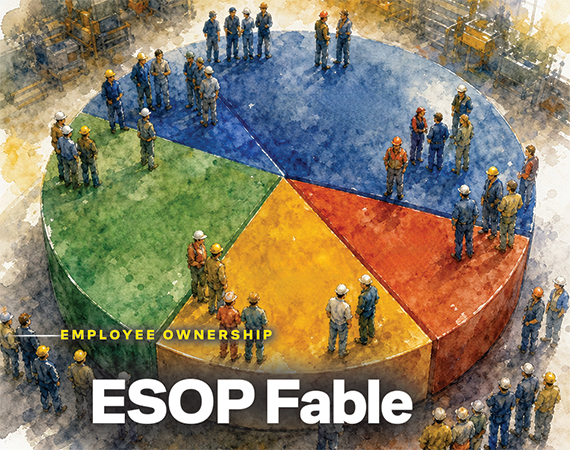
ESOPs are federally regulated corporate structures that allow business owners an avenue to sell part or all of a company to employees, often with significant tax advantages. An ESOP is a separate entity that typically takes out a loan to purchase the company. As the loan is paid down with company profits, shares are allocated to individual employee accounts.
Wosepka explains that with a 401(k), employees can contribute their own dollars, but with the ESOP, “you can’t buy shares, you can only have them given to you.” The employees’ stake in the company grows as they accumulate more shares and as the value of the company rises. When they retire or leave the company, the company buys back the employees’ shares, with the proceeds typically rolled into a retirement account held by the employee.
The appeal of ESOPs as a succession planning option often comes down to legacy. Charlie Sparks, a CPA at Olsen Thielen who works with ESOP transactions, says owners selling to an ESOP tend to have more confidence that the business will continue operating in something like its current form, with its existing culture and its commitment to the community, than owners who sell to a larger outside company. “The business will live on in their image beyond their years of ownership,” Sparks says. In a sale to a large conglomerate, the buyer “folds you under their model.”
At Douglas, the path to employee ownership didn’t begin with a retiring founder looking for a legacy-minded exit. The company was sold to a British publicly traded firm in the mid-1980s, then bought back, roughly 75 percent by a private equity firm and 25 percent by company management.
Then the private equity investor looked for its own exit, which private equity firms almost always do, Wosepka says. For Douglas, which moved to full ESOP ownership over a few years, the goal was to regain control of the company.
Owners don’t have to choose between full control and a full sale. Sparks says partial or gradual ESOP transactions are far from rare. The gradual approach allows an owner to test the model while still holding on to some control and still receiving a portion of available tax advantages.
The first step for any owner considering the option, according to Kennedy, is one many haven’t taken: a proper business valuation. She estimates that 80% of the owners she works with haven’t had one done in the past five years. In her view, that’s the most critical piece of information for owners determining whether an ESOP is a viable option.
Tax advantages
Beyond succession planning, the tax structure of an ESOP sale is often what makes it an attractive option for both the seller and for the employee-owned company moving forward. If an owner files as a C corporation and then sells to an ESOP, Sparks says a provision known as a Section 1042 rollover can defer, or in some cases eliminate, the tax owed on the gain from the sale, depending on how the deal is structured.
After the sale, the ESOP-owned company has an even greater tax advantage, Sparks says. Taxes on profits are exempted based on the proportion of the company owned by the ESOP. So an ESOP that owns 60% of a company as a pass-through entity pays no tax on 60% of its profits. Corporate structure matters, though, Sparks cautions, noting that a C corp owned by an ESOP would still be subject to income tax.
Kennedy credits that freed-up capital with fueling substantial expansion at other Minnesota ESOP companies, citing Plastic Products Company, with operations in Lindstrom and Princeton, and Windings Inc. in New Ulm, as businesses that grew from small local operations into much larger enterprises on the strength of reinvested tax savings.
The tax advantages are critical, since the cost of setting up and maintaining an ESOP is substantial. Sparks says an ESOP often requires a six-figure investment in attorneys and initial compliance work to get started. Once it’s established, the ESOP must complete an annual independent valuation that can run from $15,000 to $30,000 or more for a larger company.
General administration and trustee fees can add another $20,000 to $50,000 annually. Kennedy estimates that for smaller ESOPs, startup costs run as low as $6,000, but she still puts ongoing trustee and reporting costs at roughly $20,000 to $30,000 a year.
Neither Sparks nor Kennedy sets a hard cutoff for company size to make an ESOP worth the cost, but general guidelines can help owners assess the viability of the ESOP option. Kennedy recommends at least 25 employees and around $1 million in profitability before an ESOP makes sense. Below that, the fixed costs of compliance can outweigh the tax benefits an ESOP is designed to deliver.
There are exceptions, she says. AbleNet, a Roseville company that develops, manufactures, and provides assistive technologies for individuals with disabilities across the globe, became an ESOP with 15 employees, but had $7 million in profitability.
“Today the company has $2 million-plus per individual in their ESOP retirement account,” Kennedy says. “Some smaller companies have effectively used ESOPs as a growth strategy.”
Employee engagement
Ask Tom Wosepka what changes when employees are also owners, and he doesn’t speak in abstractions. He tells a story from earlier in his career.
Years ago, working in the auto industry, Wosepka noticed how hourly employees at unionized plants talked about their jobs. Ask who they worked for, he says, and the answer was often the union, not the company.
In that kind of environment, he says, it wouldn’t be unusual for an employee to get injured over the weekend, then, on Monday morning, claim it happened on the job. The coworker standing next to him would know exactly what had really happened and look the other way. “Stick it to the man,” as Wosepka puts it. “Why do I care?”
At Douglas, he says, the same scenario would play out very differently. The coworker still knows the score, but instead of shrugging it off, he pushes back, because a fraudulent claim ultimately costs every employee-owner. “That’s just one example of where you’ve got people who think about the company as something more than just a paycheck transaction,” Wosepka says.
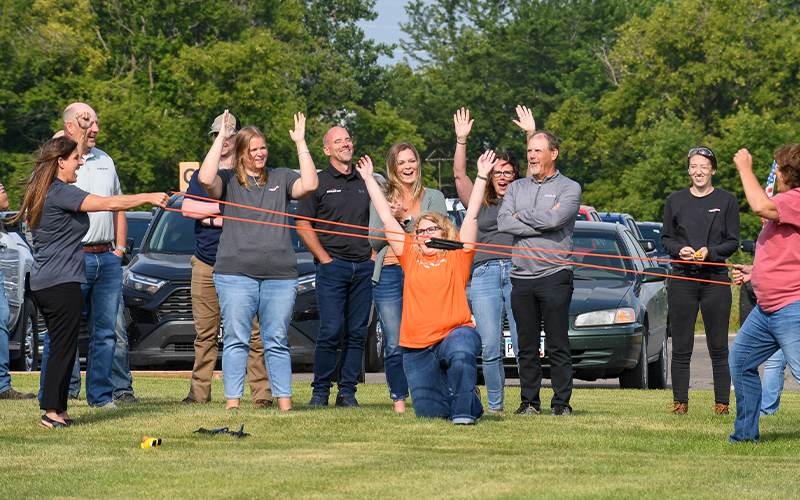
That mindset reflects how the company communicates. Douglas shares its financial results with employees monthly, a level of transparency Wosepka says isn’t required of ESOP companies, but one he believes pays off. “The more we’re transparent, the better off we’re going to be.”
Douglas’s transparent communication strengthens employee engagement. “I’d be naive to say that we’ve got 850 employees who all absolutely think and act like owners, but, actually, the vast majority of them do,” he says.
Clear communication with employee-owners also helps the company weather ups and downs in the industry. “We’re in a lumpy business. We’re selling big-ticket capital equipment, which can get hit harder in downturns,” Wosepka says. When business slows, the company is up-front that overtime may disappear and belts may need tightening.
Employee ownership also shapes how Douglas handles growth. “It’d be easy to just hire a bunch of people, but what about six months from now? What do we do with all those people?” he says.
During Wosepka’s tenure, which has spanned the 2008 recession, the COVID-19 pandemic, and recent tariff and inflation pressures, the company has never had a layoff. “We don’t want our employment levels to be the means by which we manage the ups and downs of our business,” he says.
Those engaged employee-owners tend to stick around, Sparks says. The ESOP model is an effective recruitment and retention tool, a way for employees to share in the upside benefits of business ownership “with a little bit of a safety net.”
Kennedy’s data suggests just how meaningful that upside can be. The average Minnesotan has roughly $75,000 saved for retirement, and half have saved nothing at all. Against that backdrop, she points to Minnesota ESOP employees who’ve built dramatically different futures. She shares a story from Landscape Structures Inc., a playground equipment design company in Delano. One of the company’s custodians wanted to know if he was financially able to retire. He asked the CFO, who suggested he take his ESOP account balance and divide it by his annual wages; 25 times his annual wages would be a good target. The employee caught up with the CFO the next day, excited to tell him his balance was around 60 times his wages.
This doesn’t happen automatically just because a company is employee-owned on the books, Wosepka says. The key at Douglas is how employee ownership shapes the company’s identity. “This isn’t a ‘by the way, we’ve got this retirement thing,’” he says.
Employee ownership is central to the company’s core values, not appended to its benefits package. “If it’s just a ‘by the way,’” Wosepka says, “you’re not going to get the cultural impact.”
Community vitality
For Benya Kraus, president and CEO of the Southern Minnesota Initiative Foundation, the case for local ownership starts with a pattern she sees across rural America: extractive economies, where the people who own the wealth generated by a business don’t live in the community that generates it. “The wealth from that resource doesn’t stay or get recirculated back in our communities,” she says, “but gets taken out elsewhere.”
Employee ownership, in her view, is one of the best avenues to correct that pattern. When the people who own and manage a company’s wealth also belong to the community it operates in, she says, that wealth tends to stay local, reinvested in schools, main streets, and other local businesses, rather than flowing out to far-flung shareholders. It’s a local multiplier effect.
Kraus has seen that dynamic firsthand as a board member of Bevcomm, a regional broadband provider that converted to an ESOP in the past year. In an industry defined by consolidation, where small local providers are frequently acquired by larger outside companies, she says the ESOP model gave Bevcomm’s employees a stake in the company’s future, avoiding an exit to a buyer who might not share the region’s values or priorities.
Douglas’s footprint in Alexandria offers a concrete illustration of the same principle. Wosepka notes that the company is the largest private employer between St. Cloud and Fargo, and its payroll alone represents a significant economic force in the region.
But the effect goes beyond payroll. When Douglas’s employee-owners retire and cash out their shares, Wosepka says, the vast majority of that wealth stays in the Alexandria area, rather than going to a private equity firm in a distant city or to an out-of-state parent company. Local financial advisors, he says, have come to know by name which of their clients are Douglas retirees, evidence, in his view, of just how much wealth the company’s ESOP has generated locally, and how visibly it shows up in the community once it’s spent.
For Kraus, that’s the throughline connecting a single manufacturer in Alexandria to a broader argument about rural economic health. Ownership structures that keep decision-making and wealth close to home don’t just benefit the individual employees who build equity. They help determine whether a community itself has a durable economic future.
A model worth understanding
None of this happens automatically. An ESOP doesn’t replace the fundamentals of running a good business, and it comes with real costs: the setup expenses, the annual valuations, and the ongoing administration that Sparks and Kennedy both describe.
What it changes is who benefits when a company gets those fundamentals right. In a conventional sale, the financial upside of decades of hard work typically flows to whoever buys the business, often an outside investor or a distant corporation with no ties to the community. An ESOP redirects that upside to the employees instead.
At Douglas, that’s meant a business that has grown substantially over two decades as an ESOP-owned company. It’s meant an engaged workforce that has weathered major economic blows, without a single layoff. And it’s meant a hometown that benefits when employees retire with substantial wealth that stays in the community.
Return to the Fall 2026 issue of Enterprise Minnesota® magazine.