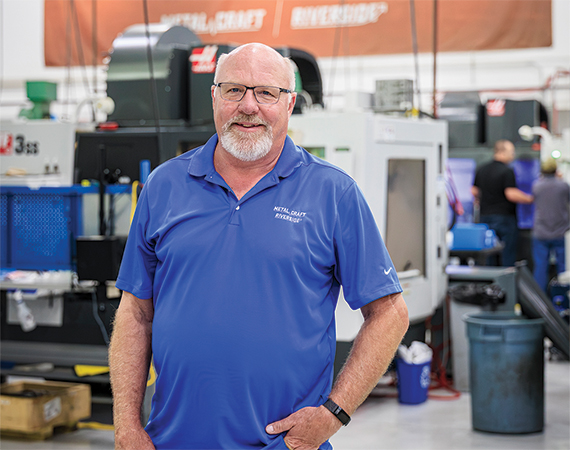
John Bolanda sees manufacturing from two angles. A training specialist at custom precision manufacturing and engineering company Metal Craft & Riverside, Bolanda has decades of experience in manufacturing, first as a machinist and then in quality. (Metal Craft is in Elk River and Riverside is in Eau Claire, Wisc.) He also teaches quality and inspection courses at Anoka Technical College. Active in Elk River schools’ career and technical education (CTE) program and on the advisory committee that connects employers with students, Bolanda believes the industry could be a great source of instructors when technical programs are shorthanded.
How did you become an instructor at Anoka Technical College?
John: I was a machinist for many years, and after I went back to North Hennepin Technical College to learn inspection, the dean wanted to offer me a teaching position because of how I helped my fellow students. But I didn’t have the credentials the state required, so they couldn’t make the offer.
Fast-forward to Metal Craft & Riverside, where I’ve been since 2011 in a variety of quality roles. Through our involvement in the Elk River school district’s CTE program, I met Matt Rogers, a machining instructor at Anoka Technical College, who had started a quality technician program five years ago. He didn’t have enough time to teach all the credits himself and asked if I’d like to help out part time in the evening.
There was no course to teach me how to build a syllabus or create tests, so I spent extra time with Matt to understand those things and basically learned on the job. The state has standards for how instructors qualify, and with 16 years in quality and another 15 as a machinist, but no college degree, it took a while for them to figure out where I fit. But we got there.
Is there a shortage of instructors for technical programs, and does it limit how many students can enter the field?
John: Absolutely, and it’s a real problem. At the collegiate level, instructors are stretched thin, and everybody is trying to figure out how to help students who come with all kinds of challenges. One of my students can’t return because she needs to work more hours to send money home to her family. Those are the realities instructors navigate.
At the high school level, not every school in the Elk River district has a machine shop. And the teachers who run those programs are stretched pretty thin, too. But there are a lot of people in manufacturing, and I see them every day at Metal Craft & Riverside, who have the knowledge and the passion to be excellent instructors. They just don’t know it, and the pathway to get them into a classroom isn’t clear. I’d love to see the industry figure out a way to get those people teaching.
What does demand look like for graduates, and how can employers stand out as they search for qualified workers?
John: We have 100% placement right now, and I don’t see that changing. Employers show up toward the end of the semester looking for quality technicians, and I have to tell them they should have been here a year and a half ago, because other companies have already hired these students. This spring, a recruiter from Los Alamos National Laboratory came up because he couldn’t find a diploma-based quality technician program anywhere else in the country. He offered jobs on the spot to all five of my graduating students. With a security clearance, they could be earning six figures within a year.
Closer to home, Metal Craft & Riverside have hired 38 new employees since last summer and still have 15 openings, including some entry-level positions. The pipeline simply isn’t keeping up. Manufacturing is the second-largest contributor to Minnesota’s economy. Quality, in particular, tends to be an afterthought. Companies will move someone off the production floor into inspection, and it usually doesn’t work well. You wear a different hat in quality. You have to know how to say, “This part doesn’t meet spec” and still maintain a good working relationship with the person who made it. That takes training and real-world practice.
Why do careers in manufacturing make sense for the next-gen workforce?
John: When I bring high school students into Metal Craft & Riverside through the CTE program, they are little sponges. They’re committed and eager to learn. I have one young man who did a “cool jobs” tour here as an eighth-grader, met our recruiter, kept her card all through high school, and is now a college intern studying mechanical engineering]. He’s been with us six years and is already coming up with ideas I never would have thought of.
What we teach is also AI-resistant. You still have to operate equipment, analyze results, and interface with engineers and machinists. Those interpersonal skills aren’t going away. And the industries we serve, medical devices and aerospace, aren’t going away either. People will always need spine surgery and knee replacements. Defense systems will always need to be built and maintained.
I tell every student: When you find work where you look at the clock and think “I need four more hours” instead of “I have four more hours left,” you’ll know you’ve found the right path. Manufacturing can be that for a lot of people. We just need more of them to find out.
Return to the Fall 2026 issue of Enterprise Minnesota® magazine.