Much like thousands of manufacturing employees across Minnesota, Brad makes sure he gets to work in time to set up his workstation, gather materials, assess production goals, and chat with coworkers about the day’s tasks before he begins production — in his case, making blankets for the military.
“I’ve learned about how materials stretch and move, and the need to be precise when working with them,” he says. “More than that, I’ve become more patient and knowledgeable, and I think with the skills I’ve developed from this job, I have the confidence that I can go anywhere and do good work when I leave.”
The difference between Brad and other manufacturing employees is that he’s not considering quitting or switching companies — instead, he’s thinking about what he’ll do after he’s released, since he’s an incarcerated person (IP) at Moose Lake Correctional Facility, a medium-security prison.
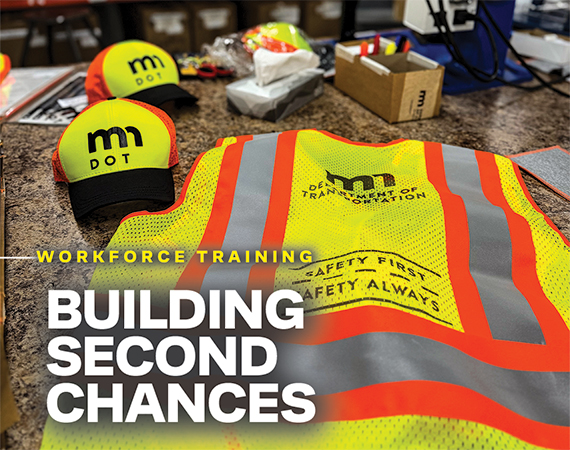
His work is part of MINNCOR, a program of the Minnesota Department of Corrections (DOC), which employs IPs in six facilities to manufacture a breadth of goods, from custom cabinetry and print materials to license plates, clothing including high-visibility safety wear, custodial products, docks, and even mattresses and pillows.
Although, much like any manufacturer, MINNCOR is adapting to market changes — through continuous improvement in processes, expansion of training opportunities, and investment in innovative technology — the mission statement of “Transforming lives for a safer Minnesota” conveys its deeper focus to reduce recidivism by creating pathways to post-incarceration employment. Here are some key facts about the program.
An enduring mission
MINNCOR officially began in 1994, when the DOC consolidated and centralized its individual facility programs into a single statewide entity. But the state’s correctional facilities have operated industrial programs since the late 19th century, beginning with manufacturing twine at Stillwater state correctional facility.
Over time, that initial endeavor expanded into numerous trades, including woodworking, textiles, printing, carpentry, and assembly. Although these efforts help IPs pass time productively, the drive toward transformation has always been the foundation of MINNCOR, according to Jack Taly, who was an account manager and then vice president of business development for MINNCOR for 20 years before retiring this past June.
“Our mission isn’t to make widgets or to provide products and services — those are simply the outcome and output of what we’re really doing,” he says. “We’re helping IPs develop skills that make them employable, so that when they’re released, they have better opportunities. That greatly reduces recidivism, and it adds to our state’s workforce in a meaningful way.”
The numbers back that up: The national rate for recidivism is 24.2% for those working in correctional industries like MINNCOR, compared with 40% for the average incarcerated person.
A significant factor that accounts for this difference is employment that gives a sense of purpose, says Taly — and the majority of former IPs do join the workforce after MINNCOR experience. A report from the Minnesota Department of Management and Budget on adult criminal justice found that nearly 70% of those leaving MINNCOR found employment within three months after release.
Investing in up-to-date skills
MINNCOR understands that technology and innovation are driving today’s manufacturing and production processes, which is why there’s strong investment in precision equipment and continuous improvement.
For example, the textiles floor at Moose Lake doesn’t rely on IPs to measure and cut fabrics, which would be time-consuming and could result in unnecessary waste if measurements are imprecise. Instead, a state-of-the-art intelligent machine is given instructions on which products are needed, and, after creating a plan, uses lasers to make the cuts.
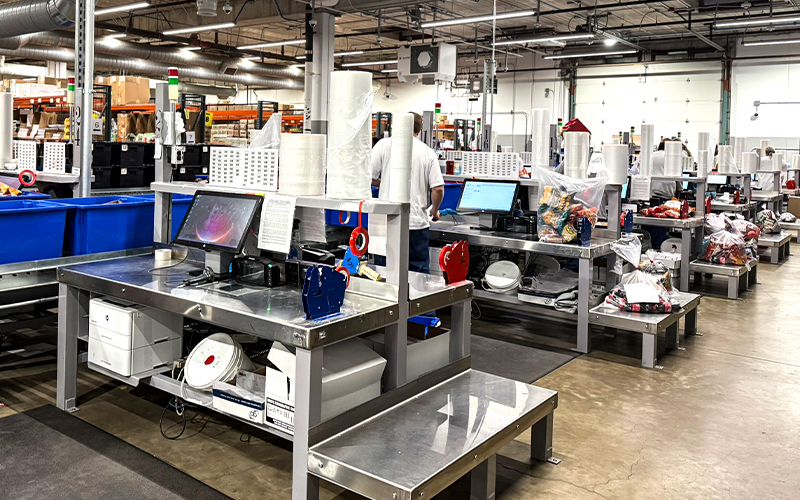
On another part of the floor, IPs are designing signage, brochures, and other printed materials using advanced technology that could be found in any high-end design and production firm. Across the way, the facility has a warehouse space used to fill canteen orders (a store at the facility where IPs purchase goods like snacks, electronics, hygiene products, and art materials) from Moose Lake and other correctional locations, and IPs there rely on an automated system that helps them sort and manage orders quickly. Down the hall, there’s a training space with a bank of computer stations, where IPs can learn skills to land jobs in network cabling, including satellite and ethernet installation.
Outside the main building, there’s the education department’s tiny-home program — an initiative that trains IPs in carpentry, contracting, and installation of electrical, solar, and geothermal systems. While hands-on construction of tiny homes is not part of MINNCOR, programs such as these provide industry-recognized training that connects classroom instruction with meaningful work experience. An IP who completes all seven certifications available in the program will be a valuable addition to any construction crew or could become a contractor on their own, says Kris Rish, warden at Moose Lake.
“There are just under 200 IPs working here, and they do an amazing job,” she says. “More than that, they’re learning skills that transfer to any workplace, such as punctuality, quality control, collaboration, and problem-solving.”
Involved at every level
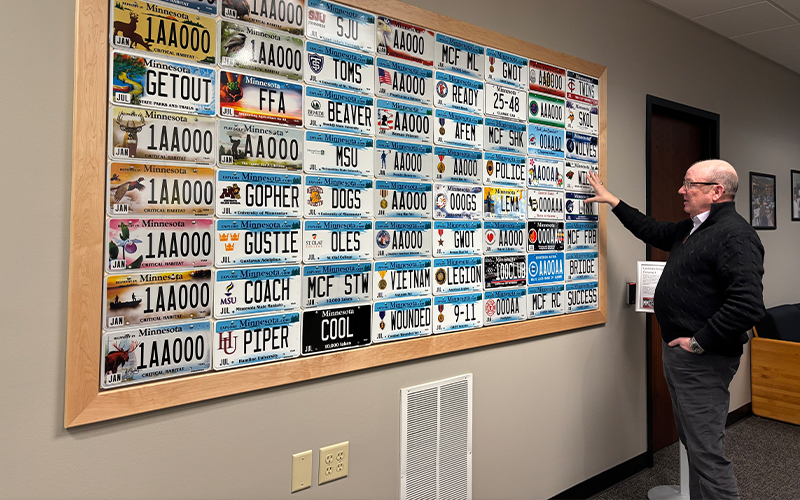
Although IPs do some assembly work, there’s a misconception that MINNCOR is simply a factory-style endeavor, says Taly, adding that many people still tend to think of IPs stamping out license plates. They do make those plates — but they also have a part in designing them. They experience numerous levels of responsibility, including estimating, project management, marketing, production optimization, and more.
“When I decided to apply for the printing shop here, I didn’t have experience in any of the technology needed to design materials,” says Ronald, an IP who’s been working for MINNCOR since 2022. “I thought it would just be something new to learn and a way to keep from getting bored. But it’s given me so much more than I would have thought.” He’s developed technology skills but also feels a sense of teamwork and camaraderie, he says. He now feels more proficient in troubleshooting and being more inventive in finding solutions to printing challenges.
“When I walk out of the print shop every day, I’m just bursting with creativity from what I’ve accomplished,” he says. That’s led him to learn to play the violin, write a novel, and work on poetry, essays, and a screenplay. “It doesn’t seem like my work here would be connected to those efforts, but it really is, because it’s about keeping my mind busy and thinking in new ways.”
Another common misconception is that every IP in a correctional facility is expected to work, which means jobs are mandatory, says Taly. In fact, both the skills-training tracks and the jobs are competitive, requiring applications and interviews, just like any job.
Career-focused education and workforce training programs continue to generate significant interest among incarcerated persons. For example, the program for network cabling and installation has nearly 500 IPs on the waiting list for training — in part, because work is nearly guaranteed once they’re released. That program has 24 company partners that hire directly, with an 87% job placement rate. Spots in the other programs also fill quickly, providing incentive for IPs who didn’t graduate from high school to complete their GEDs, since it’s a requirement to apply, says Rish.
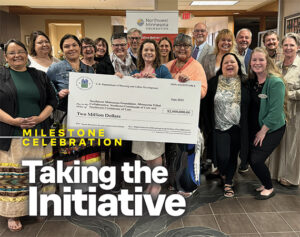
MINNCOR also supports employment opportunities after IPs are released, with job fairs that bring together former IPs and employers. This past February, MINNCOR and the DOC hosted their second Fair Chance Reentry Job Fair at MINNCOR headquarters in Roseville, with 366 job seekers and 19 employers attending. Jobseekers also could receive one-on-one coaching from volunteers on how to discuss their background and interview for open positions.
“This is an excellent example of how we play a role in supporting a skilled workforce in Minnesota,” says Taly. “Many IPs who do work for MINNCOR come out of their sentences feeling motivated and empowered, with training and experience that is valued by employers. That benefits everyone.”
No taxpayer funding
Another common misconception is about use of taxpayer funds for these programs, including IP training, according to Paul Schnell, commissioner of the Minnesota DOC. However, while the DOC itself is funded by the state Legislature with taxpayer money, MINNCOR is a fully self-supporting enterprise with no public funding, he says.
Revenue is generated through the products and services it sells, both to state agencies such as the Department of Transportation and the Department of Natural Resources, as well as to private businesses.
MINNCOR uses the revenue to purchase the technologically advanced machines and pay the wages for IPs, Schnell adds. “In addition to that, you have people who are engaged in what they’re doing every day. We have to understand the reality here; prisons are tough environments. It’s very easy for IPs to become demoralized.”
MINNCOR has been financially self-sufficient since 2003, and any cash reserves go toward education and reentry programs, along with investments in more high-tech equipment. MINNCOR also supports the state’s economy by spending more than $19 million a year for raw materials, goods, and services from Minnesota businesses, Taly says.
In terms of indirect financial benefits, he notes that MINNCOR reduces the taxpayer cost of incarceration by offsetting the need for more IP supervision and alternate programs to keep IPs engaged every day.
Like many correctional programs across the country, MINNCOR faces criticism of IP wages, and the ethics of prison labor in general. Schnell expects this conversation will continue for the foreseeable future.
The notion that IPs are making almost nothing and being exploited for their labor is the No. 1 misperception about IP work at correctional facilities, Schnell says.
“But that simply isn’t true,” he says. “It’s essential to recognize that MINNCOR needs to remain self-supporting, and while wages are on the lower side, there are other benefits to IPs here, including training and job placement services.”
Another vital point, Taly adds, is that MINNCOR doesn’t set the wages for IPs; state and federal laws mandate IP pay.
“When people are working and feel part of a community, that benefits all of us, because they are much less likely to reoffend,” says Schnell.
Ready for more expansion
Although MINNCOR has evolved considerably since its founding, ongoing reinvestment and numerous success stories are fueling more growth. Taly says that areas likely to expand include more industry certifications that will further improve IP employability and increased employer partnerships that can strengthen the release-to-employment pipeline already in place.
Another strong focus will be on keeping up with technological shifts in equipment, so IPs leave knowing the latest machinery, including automation, digital inventory systems, and advanced production technology.
As workforce shortages continue to be a concern across Minnesota, particularly in manufacturing, correctional work programs like MINNCOR may become a model for training and experience development. More than that, the program helps IPs develop “soft skills” like accountability, leadership, responsibility, and confidence that reduce the likelihood of recidivism, while also making correctional facilities safer by reducing idleness and promoting a positive work ethic. These outcomes are an advantage for everyone — not only the IPs who participate, but also employers, taxpayers, and communities, Schnell suggests.
Because of that, MINNCOR’s most important product may not be the neon vests highway workers wear or the IP-produced license plates on thousands of Minnesota vehicles — it’s in the second chances for people like Brad and Ronald, who come to their workstations every weekday, eager to learn more and do more.
“Coming here and doing good work has given me much more confidence about what I can accomplish,” says Brad. “Every day, I feel like I learn something new, both about my specific job, and about myself.”
Return to the Fall 2026 issue of Enterprise Minnesota® magazine.