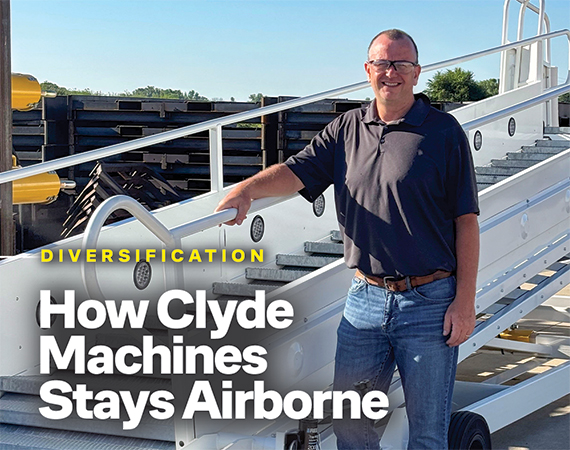
It was February 2020, and Glenwood-based Clyde Machines had just completed construction of a new 100,000-square-foot manufacturing facility. When drawing up plans for the new building that would double the size of its operations, the company had desperately needed the additional space. “We were working on top of each other in the old building,” owner and president Chad Barsness recalls.
Clyde Machines’ business was flying high. Since its founding in 1961, it had become one of the world’s largest manufacturers of ground support equipment for commercial airlines across the globe. Clyde’s customers also include freight shippers such as Amazon, FedEx, and DHL that operate their own aircraft, along with specialists such as Swissport and dnata that provide ground-handling services to commercial carriers.
But when the new building was finished, the company’s high-flying ambitions suddenly plummeted. “As we all know, COVID was coming in hot,” Barsness says. It was a turbulent time for most businesses. For Clyde Machines, the pandemic could have grounded its operations, perhaps for good. “We’re in the airline industry. All our customers put their orders on hold or canceled them because they were all grounded. And I had a shiny new monthly payment — and no work.” Barsness found himself wishing all his company’s revenue eggs weren’t in one basket.
“But we made it through,” he says. “Amazon was one of our big customers through that time, and they were growing like crazy because everyone was shopping from home.” Shipping and logistics company DHL also gave Clyde Machines a large order in support of Amazon. “I knew that was going to buy us enough time to figure out what was going to be next.
“Then the faucet turned back on, and we were way busier than we were pre-COVID.”
Since 2008, Clyde Machines has experienced 971% growth in sales, according to Barsness. Still, Barsness thinks it essential that his company develop a diversification strategy that emphasizes the company’s many strong selling points as it pursues new types of customers. Those selling points are rooted in the company’s commitment to technological innovation.
Tech-driven productivity gains
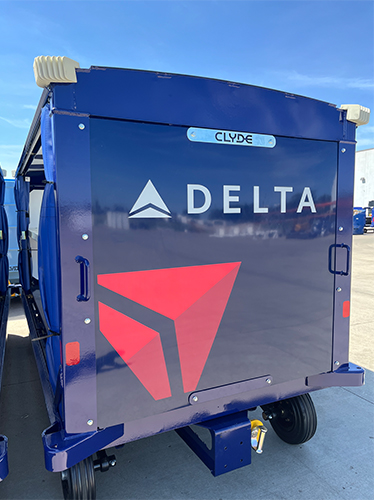
A one-stop shop for airlines, Clyde Machines manufactures aircraft towbars, pallet and container trailers, baggage carts, passenger stairs, and maintenance stands. The manufacturer competes with about eight companies in the U.S. and Canada, but, Barsness says, “Many of them do just one product line. We make everything.”
There’s an even bigger reason Clyde dominates its market: “All the technology in our buildings to produce what we produce,” Barsness says. “That’s driven our costs down — which is always attractive to a customer — while maintaining and improving our quality.”
Barsness became driven to make Clyde Machines’ products more cost-competitive in 2008, when he took over the company’s sales department. Before then, he had worked on the shop floor and was familiar with all the operations. “I knew we had to produce things more efficiently to be cost-competitive,” Barsness says. Optimizing manufacturing processes “would make my sales job easier. So I was a little bit selfish,” he adds with a chuckle.
He started by pushing for production technology in the machining department. The company bought a CNC vertical mill and several CNC lathes. “One of our big steps was our first CNC high-def plasma cutting table,” Barsness says. “That really changed how engineering was able to design components and products.” Clyde would later replace the table with fiber lasers, with even more accuracy and speed.
About four years ago, Clyde Machines acquired a fiber tube laser cutting machine, which has been “another game changer for engineering,” Barsness says. “The welding department loves it just as much as fabrication does because the fit-up is perfect.” Fit-up refers to alignment and positioning of metal components before final welding or joining. With the fiber tube laser’s multiple operational axes, employees can create precise cuts, complex contours, and bevels in metal tubes and pipes.
Barsness soon saw that the machine had an even bigger impact than he first anticipated. “I was hoping for six times faster than our current processes. We ended up at 18 times faster for parts coming off that machine.”
More recently, Clyde added robotic bending, which can run overnight without human supervision; it also acquired a CNC tube bender. Because of their speed and precision, each item “changes the whole game in all our hand railings and maintenance stands,” as well as for other products, Barsness says.
Production technology isn’t the only way Clyde Machines has made itself more efficient. As the company grew, founder Clyde Olson (Barsness’ grandfather) and the family members who succeeded him added on to the original Glenwood facility, ultimately totaling about 100,000 square feet. Even so, by the late 2010s, the company realized it needed that second building.
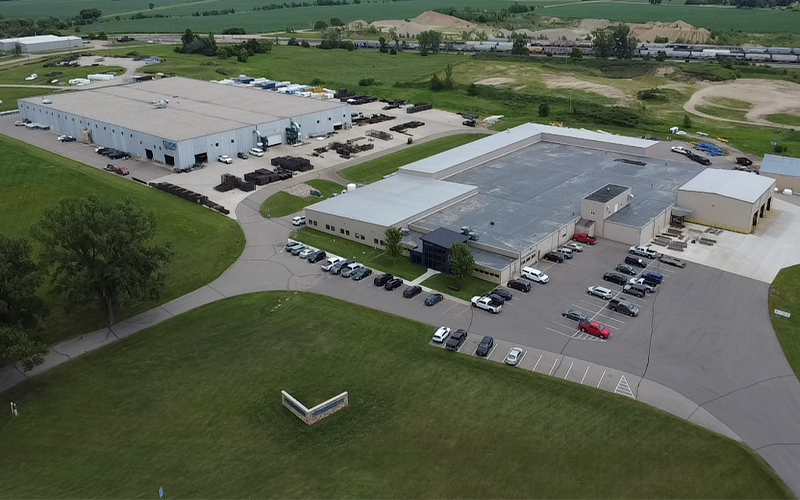
But the new building provided more than extra square footage. “We gained major efficiencies through the layout of the new space,” Barsness says. For instance, “we were able to automate our paint line. We designed that with the building so that the structure in the ceiling carries the entire weight of the paint line.” That means there are no additional support beams disrupting the workflow on the floor.
The newer building houses the welding, painting, and assembly departments. The old building houses the machining, fabrication, and shipping and receiving departments. In pursuing automation strategies for the various operations, “I always try to find the jobs that aren’t glamorous — jobs that are repetitious,” Barsness says. “Those are the easiest to automate.” Case in point: “Not a lot of people love sandblasting. We have robots in the sandblast booth in the new building that completely automate that whole process.”
To Steve Haarstad, a business growth consultant with Enterprise Minnesota specializing in strategic planning and revenue growth, Clyde Machines’ strategy makes perfect sense. Automation, as Clyde Machines’ experience demonstrates, opens up numerous opportunities, he says. It “can allow manufacturers to make their products fully in house, without having to use outside vendors as part of that manufacturing process. They can produce a part or product in a much shorter time. It’s a huge process improvement. It also maximizes the profitability of producing that item.”
Rural site, global reach
The company’s strategic approach to automation and efficiency keeps Clyde Machines at the forefront of its industry. It has also allowed the company to overcome what Barsness calls its biggest challenge: “world events,” particularly 9/11 and COVID. “They’re a challenge for everybody,” he acknowledges. “The whole country suffers together.” Still, global disruptions hit airlines especially hard — think of the spike in the cost of aviation fuel resulting from the Strait of Hormuz crisis.
Clyde Machines’ rural location has not created any difficulties as it serves a global market. “Our customers are in the travel business, so it doesn’t faze them to come for a visit,” Barsness says. “They come to our factory, and they say, ‘Wow, this is modern.’ It’s way nicer than they expect. I get that all the time.”
Nor does shipping pose a problem. Clyde Machines trucks out its products on flatbeds or in shipping containers, which the company loads at its Glenwood campus. Trucks then transport the shipments to rail yards and on to coastal multimodal ports.
In other words, there’s no need to uproot Clyde Machines from Glenwood, a town of about 2,600 a couple of hours northwest of the Twin Cities. Before Clyde Olson launched Clyde Machines, he was an engineer for Melroe Manufacturing, which originally produced the Bobcat skid-steer loader. Olson would take Highway 55 for business trips from Melroe’s headquarters in Gwinner, N.D., into the Twin Cities, and he found himself falling in love with the Glenwood area. When he decided to start his own company, he knew Glenwood was just the place to do it.
Olson timed the start and the location of his entrepreneurial endeavor just about perfectly. His new company tapped into two industries that were booming in the region in the early 1960s. For rural utilities, Clyde Machines manufactured a hydraulic attachment for trucks that tamped down soil after insertion of power poles. And it made equipment for the agriculture sector, including transport vehicles for farmers’ grain drills.
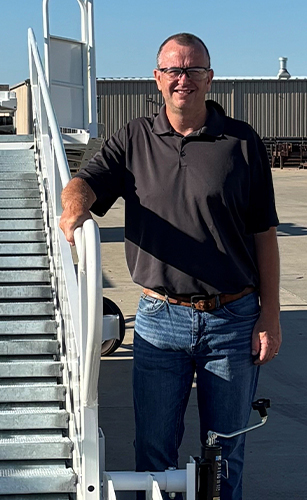
Clyde Machines might have continued down this profitable but earthbound path had it not been for a chance meeting. While flying on a business trip in the mid-1960s, Olson met a Northwest Airlines executive. They fell into conversation, and the executive told Olson that Northwest needed stands for servicing new jet engines. Olson designed and built one — and “that part of the business took off like crazy,” Barsness says. In time, the hydraulic tamper and agricultural business lines disappeared, with Clyde Machines focusing on airline ground equipment. (A tiny part of Clyde’s revenue still comes from machine-shop work it performs for companies in and around Glenwood.)
Olson died before Barsness was born. After his passing in 1971, his daughters (including Barsness’ mother) ran the company. Barsness began working for Clyde Machines in 1995 and became the sales manager in 2008. Ten years later, he became the company’s president and owner. Barsness credits the enormous growth in sales over the past 18 years to outstanding employees, as well as manufacturing process improvements. “We have an amazing team that we’ve worked hard to assemble,” he says. “All our supervisors are homegrown.” What’s more, they’re all in their mid-30s to early 40s. They’ve grown with the company, and they’re young enough so “they will be with us for a long time.”
‘We’ll continue to innovate’
Barsness certainly doesn’t need to replace his durable customer base. But he does want to be prepared should world events put Clyde Machines at risk of crashing.
Though COVID didn’t sicken his company, it provided enough of a scare to push Barsness into exploring diversification. The problem: “It takes months and even years to crack into other industries, not days and weeks when you really need it,” he says. “And it’s hard to focus on that when we’re record-breaking busy like we are now.” Especially if the profit margins of a new market might not be as high.
Still, Barsness and his team carved out time to pursue a foray into a potentially lucrative new market: the trucking industry. “A lot of our products are very similar,” he says. “To work on an aircraft, you need a maintenance platform. To work on a reefer [refrigerated truck], you need the same type of platforms and safety stands.” For trucking applications, Clyde needs to engineer some significant modifications, but the components and materials are very similar. “We wouldn’t have to retool anything. It’s just a matter of different shapes and sizes.”
To give some sense of the potential: In 2025, the U.S. trucking industry generated $940 billion in revenue. That’s not far behind the $1 trillion that the global airline sector posted. Barsness believes that trucking could become an even larger market than aviation for the types of equipment Clyde Machine manufactures.
As part of its effort to enter this new market, Clyde has been working with one of its vendors that also supplies the trucking industry. “We’ve given them lots of prototypes,” Barsness says. “And it sounds like there’s some excitement in that world.”
One of his company’s selling points, Barsness says, “is the durability of our products. They have to be super-robust because they have to be on the ramp of the aircraft.” Those products are more expensive than most of what is available to truckers, but Barsness believes that Clyde’s equipment is safer and sturdier. “We’ve had a few sales,” he says. “But we’re at the infant stage of laying this out.”
Whatever opportunities and changes the future brings, Barsness says the company will continue to innovate and automate wherever possible. One of the drivers is that Barsness is a big proponent of doing things in-house — “controlling our destiny as much as possible.”
Some outside vendors are absolutely crucial, such as suppliers of tires and castors. But there are other types of equipment on Barsness’ wish list that he sees as crucial to improving quality and efficiency.
“I’d like to get more into robotic painting,” Barsness says. “I’m just trying to be patient and waiting for AI to catch up to that industry so that the programming isn’t so heavily dependent upon humans to program the different components that are coming through.”
He foresees a future where “you’ll be able to scan a part on the paint line and AI will figure out the best tool path for the paint gun to coat that part.” He says this is being done on a small scale right now. “I need it to be done on an automobile-size scale. But that’s just a matter of time.”
Mention AI and many people conjure images of pink slips. But Barsness says his employees are “just as excited as I am when we bring a new piece of equipment into the building.” That’s because these technology innovations automate the boring, repetitive jobs, he says. “We still need good-quality employees, but they’re able to use their brains more than their brawn.”
In fact, the number of employees hasn’t changed all that much. Clyde’s headcount is currently 116, compared to 136 pre-COVID. “But we’re probably getting 30 to 40% more out the door,” Barsness says. “We have openings now that we’re trying to fill on assembly. It’s hard to automate assembly on a short-run scale.”
Barsness will keep looking for places where Clyde Machines can both boost production and trim costs — and keep flying high.
Return to the Fall 2026 issue of Enterprise Minnesota® magazine.