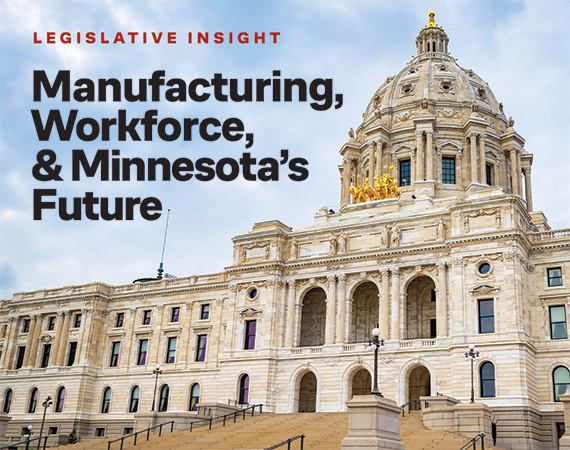
Despite an off year in the Minnesota state budgeting cycle, lawmakers had their hands full during the 2026 legislative session. Among the key outcomes of this session for manufacturers include the Senate Jobs and Economic Development Committee approving $2 million for Enterprise Minnesota, a critical decision given future federal funding that supports work with manufacturers remains unclear. The bill was still moving through the legislative process as this magazine went into production. Still, inclusion in the bill signals recognition by key lawmakers of the value Enterprise Minnesota brings to manufacturers and their employees across the state.
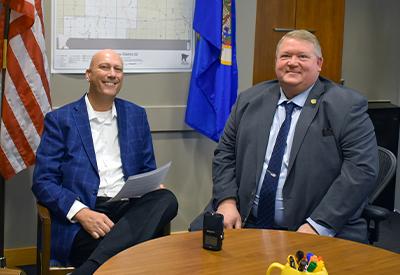
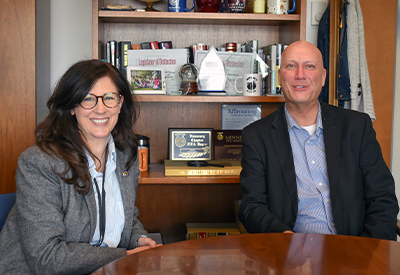
In the midst of the busy session, Marty Seifert, a lobbyist who works on behalf of Enterprise Minnesota, sat down with two leaders of the Senate Jobs and Economic Development Committee, Sen. Rich Draheim (R-22) and Sen. Heather Gustafson (DFL-36), to discuss manufacturing, its promises, and its challenges, and how lawmakers can improve the climate for manufacturers across Minnesota.
Marty Seifert: As leaders on the jobs committee, you know how critical manufacturing is to economic growth in our state. But seeing manufacturing in action offers a whole different perspective. When you’ve toured manufacturing facilities, what have you learned from those experiences?
Sen. Rich Draheim: I’ve had quite a few opportunities over the years, and I genuinely love trying to understand how things are built. I grew up around the John Deere industry, so seeing things being made is in my blood. What’s remarkable is the range — you can walk into a Medtronic facility and see highly technical production where engineers with advanced degrees are building life-saving devices, and then drive an hour out of the metro and find a shop putting out precision agricultural components where guys with deep practical knowledge are doing extraordinary work.
Sen. Heather Gustafson: What really struck me on my tours was all the consideration that goes into the process before the final product even exists — the research and development, the quality assurance, the way facilities are actually run. You can tell when a manufacturer is putting employees first. There’s a genuine sense that they don’t just want workers to show up. They want them to buy in.
Sen. Draheim: Without manufacturing, we would have lost both World War I and World War II. I’ve often questioned what would happen if we had another incident like that — where we needed to bring manufacturing home quickly. And honestly, I don’t believe we have the capacity. We don’t have the skilled workforce, and we don’t have the square footage to build what we would need to compete.
Sen. Gustafson: My husband has been in manufacturing for many years, and he is still excited about it. He’s proud of what they’ve accomplished. Every time a new contract comes in, that means he’s doing his job the right way. There’s also something really meaningful about the team atmosphere. It is so project-based. You have to complete a project, and if it isn’t good, it won’t sell. They want it to be good, and that takes the whole team.
The buildings themselves are also part of the story. You drive by these places every day and they just look like warehouses. There’s a small plaque, maybe a loading dock. You have no idea what’s happening inside until you walk in and see there’s a full paint shop, precision machining, and a team of people producing something remarkable.
Seifert: Let’s talk about what the legislature can do to support those businesses. What policies would make the most difference for manufacturers, especially the smaller ones across Greater Minnesota?
Sen. Draheim: The idea I keep coming back to is what I’d call a national defense tax break at the state level. Minnesota should be doing its part to ensure we have domestic production capacity in the sectors that matter most — health care, medicine, transportation, agriculture, food science. Look at COVID and how we got caught with our pants down a little bit with medical supplies and some of the basic food items and toiletries. That shouldn’t happen. The federal government already recognizes these sectors as critical, and I think the state should layer additional incentives on top of that to make Minnesota a destination for exactly that kind of manufacturing.
On the smaller end, something modeled around investment incentives, allowing businesses to immediately expense equipment purchases, combined with better financing support for technology upgrades, would make a real day-to-day difference for the folks who aren’t giant corporations with armies of lobbyists.
Sen. Gustafson: I think about flexibility a lot when it comes to this question. One of the things manufacturers have told me is their inability to be nimble when a competitive contract opportunity becomes available. Whether it means adjusting rulemaking or giving DEED [Minnesota Department of Employment and Economic Development] the ability to maintain a more responsive fund for competitive opportunities, that kind of nimbleness is something we can actually build into the system. I will add that sometimes government just needs to stay out of the way. That’s maybe surprising coming from a legislator, but sometimes it’s the truest thing I can say.
Sen. Draheim: There’s an accumulated weight of regulation when you combine earned sick and safe time, paid family and medical leave, and OSHA restrictions. Each one might sound reasonable in isolation but stacked together they create a climate where businesses don’t want to expand here, and in some cases they’re actively leaving. You look at our neighboring states and the ease there of permitting to start a facility or expand a facility. I represent a border district, so I see this directly. All of the states around have less regulation and lower taxes. We’re not even in the same conversation in some cases.
Sen. Gustafson: Balance is important, and I think there are absolutely places where the right government support makes a genuine difference — particularly around competitive federal grants and funding gaps. Our bill establishes an appropriation to try to address some of that. But we’re also realistic; Minnesota is never going to be able to fully backfill what’s been pulled at the federal level. That’s why we need our federal representatives to make the case right alongside us. It really does feel like an all-hands-on-deck moment. And I do think we need to explore more private-public partnerships than we currently do.
Sen. Draheim: You have to look at the spending side too. We’re addicted to spending money here in Minnesota — all the elected officials are — so we have a spending problem, which means a taxing problem. That makes life unaffordable for workers. You’ve also seen a lot of corporations leave the state. A lot of expansions have not happened here that have happened in other states. And I think it will take someone at the top — a new governor — to instill a different corporate culture that genuinely values all jobs and understands that without these manufacturers and other blue-collar work, we wouldn’t have much of a tax base. That tax base is what pays for everything.
Seifert: The workforce pipeline is arguably the most urgent challenge manufacturers face right now. Minnesota used to have a sterling reputation for its workforce. Where do we stand today, and what needs to change?
Sen. Gustafson: I was a high school history teacher before the legislature, and I know students often think they only have two choices: get a job or go to the University of Minnesota. There are a thousand things in the middle. And as a teacher, I was talking about those paths all the time, because the last thing you want to do is leave a student without hope for a future. There are really good, dependable jobs in manufacturing that can’t be replaced by AI. And for every dollar that gets invested in manufacturing, $2.69 goes back into Minnesota communities.
Sen. Draheim: When I was younger and traveled for business, people across the country were genuinely jealous of Minnesota. We had a highly trained workforce that was very motivated, and that was a real competitive advantage. Now you look at our education standings compared to the rest of the country and they’re falling rapidly. It’s very disappointing.
Sen. Gustafson: The economic case really is just bread and butter when you lay it out plainly. Manufacturing wages in this state are significantly higher than the average wage. If we can expand that base, purchasing a home stops being a far-off dream, and sending kids to college with minimal debt becomes realistic rather than a fantasy. It’s not complicated. People aren’t looking for anything fancy. They’re not looking for a handout. They just want a good job, a house, a dog, some paid benefits.
Sen. Draheim: Both of my grandfathers worked in factories their entire lives. They had a good life. They provided for their families, got their kids through college. We’ve lost that framing somewhere along the way. We started treating manufacturing jobs as something to escape rather than something to pursue, and we need to reevaluate how we talk about career paths to young people. All jobs are honorable. But we should be focusing on jobs that can actually provide for a family. And a lot of manufacturing jobs do exactly that.
Seifert: What about the systems we use to develop that workforce — the training programs, the schools, the technical colleges? What needs to structurally change?
Sen. Gustafson: High schools are doing more than people realize, and I want to give them credit. Centennial High School in my district recently created a welding program that is genuinely substantial and impressive. I bring that up not just to praise the program, but to make a broader point: It isn’t just about training students in a trade. It also opens them up to the idea of a whole new world of employment. Manufacturing is one of those routes. And when a student discovers that pathway through hands-on experience, that changes their entire horizon.
Sen. Draheim: Exposure is everything at that age. To me, government should be in the business of preparing kids for a career path. We try to push kids in certain directions when we should really be pushing them in all directions. The goal should be simple — find a career path where you can provide for your family. Manufacturing does that across this state, no matter where you are.
Sen. Gustafson: The exposure piece really does start on a floor somewhere. You take a young person on a tour of a real facility, show them what’s actually being made, introduce them to the people doing the work. That makes it concrete and real in a way that a conversation with a career counselor cannot. Jobs that can’t be replaced by AI, jobs where you’re part of a team completing a real project — there’s something deeply satisfying about that, and young people respond to it when they see it.
Sen. Draheim: When a young person can stand on that floor and say, “I can help build that”— that’s a spark that lasts a long time. We just have to create those moments more deliberately and more systematically across the state.
Sen. Draheim: When it comes to education, we have 65 state-run campuses across Minnesota and hardly any programs left for agriculture or practical technical skills. I will be dropping a bill to have M State decide which campuses to close. That won’t make me popular on the way out the door, but we can’t afford to keep going the way we are. And on workforce development funding, I have a bill that would move a significant portion of what DEED does in that space over to M State. I also want to let corporations take some of the money they essentially pay in and use it to train their own employees. If they have a worker who needs a new skill and they want to invest in that person, we should give them a tax break for that uptraining.
Seifert: With significant deficits on the horizon, organizations like Enterprise Minnesota face real budget pressure. How do you think legislators will view that investment going forward, and how do we make the case?
Sen. Draheim: I’ll be direct. I think you’ve got your hands full in the coming years. I say that not because the work isn’t valuable. It clearly is. But I don’t think most elected officials understand business. Not that their career choices are bad, but I get frustrated when colleagues don’t understand that you need a balanced economy, and part of that good balanced economy is manufacturing. They will be looking at anything they can quickly save a few dollars on, and they will slash without understanding the impact across the state.
When Enterprise Minnesota goes into a small manufacturer and does consulting, helps them improve workflow, adopt technology, and identify efficiencies, the downstream effect is jobs retained, productivity increased, and tax revenue generated. But that’s a diffuse benefit. It doesn’t appear neatly on a spreadsheet the way a line-item cut does.
Sen. Gustafson: I think the solution is telling very specific, very human stories. This work has opened my eyes to a lot of possibilities precisely because the economic arguments become so much more powerful when you ground them in real examples. Manufacturing is the largest industry in Lino Lakes; it employs around 1,600 people in just one of my nine cities. When you put a number like that in front of a legislator and connect it to schools being funded, youth sports being sponsored, communities functioning, that’s when the abstract becomes tangible and the vote becomes easier to defend.
Sen. Draheim: The tours do that work better than any policy brief ever will. A lot of them have the perception that you need more white-collar jobs than blue-collar jobs, and they don’t understand that manufacturing can be very technical, with people with fancy degrees working alongside people with no degrees, all building something together. Sen. Bobby Joe Champion toured a glass company and a drum manufacturer in his district — two completely different operations — and came away with a fundamentally different understanding of what manufacturing requires and what it contributes. You cannot replicate that experience with a report.
Sen. Gustafson: We also have to make the fiscal argument more aggressively. We always want to take care of people, especially those who are underserved. I wonder if we’re missing an opportunity to create an economy where people can simply get back to basics: a wage you can afford to live on, a stable job, a path forward. That’s something manufacturing can actually provide. And if we expand that base, we’re not just boosting the economy in the abstract, we’re boosting it for middle-class families specifically, which ripples outward into every other part of the state budget conversation.
Sen. Draheim: And the retirements happening in the legislature right now are significant. A lot of the members who understood manufacturing, who had long relationships with businesses in their districts, and had been on those floors — they’re leaving. A lot of friends of manufacturing are retiring. The incoming class will need to be educated essentially from scratch. That’s not a distant challenge; it’s immediate. So, the education work, the tours, the storytelling, that has to start right now with the people coming in.
Seifert: As you both look ahead — whether toward future sessions or the longer arc of where Minnesota is heading — are you optimistic about this state as a place to build and grow a manufacturing business?
Sen. Gustafson: I am optimistic, genuinely. There are always budget discussions, and next year will be a full budget year, but I think there’s a growing recognition that you don’t have to choose between cutting spending and raising taxes if you’re actively growing the economy. Manufacturing is a core part of that argument. And I want to see more private-public partnerships than we have now. It is really another way forward that we’re going to have to explore more seriously. Especially with larger manufacturers, there is a huge desire on their part to contribute to the communities they work in. They do it already without any prompting. If we can find ways to formalize and build on that, why wouldn’t we?
Sen. Draheim: I’d be dishonest if I said the current environment was encouraging. The neighboring states are less regulated and they’re competing aggressively. We’re losing expansions that should happen here. But here’s what keeps me from being entirely pessimistic — the people are still here. I’ve stood in facilities where guys are welding in 25-degree buildings all day, doing hard physical work, and they’re proud of it. They’re not asking for much. They just want to be left alone to run their business and raise their family. That spirit is alive in Minnesota, especially in Greater Minnesota. Manufacturers in small towns are the lifeblood of those communities. They pay for the local school. They donate to the Little League team and the basketball team. Their employees’ kids are in the church and the school.
Sen. Gustafson: That’s ultimately the message we need to carry into every budget conversation, every session, every tour we do with incoming legislators. This isn’t just an economic argument. It’s a community argument. It’s an argument about what kind of state we want to be.
Seifert: Sen. Draheim, you will be retiring after this session. Do you have any parting advice for manufacturers?
Sen. Draheim: We can turn this around. But it’s going to take an attitude change, a willingness to invest long-term rather than make short-term budget calculations, and leadership that values all work. That’s the Minnesota I believe in. And to Enterprise Minnesota specifically — keep doing what you’re doing. Keep bringing legislators to the production floor, keep telling the stories, keep making the case. Don’t assume anyone understands the stakes. Assume they need to be shown. Because these businesses need advocates, and so do the people who work in them.
Return to the Summer 2026 issue of Enterprise Minnesota® magazine.