The well-loved adage from Field of Dreams that “if you build it, they will come” may sound heartwarming and inspiring in the midst of a movie, but in the real world, that’s not always how it works — as Infinity Mattz is discovering.

The Warroad-based brand has developed a product so innovative it could be a game changer for several industries, including construction and mining. But first it needs to implement a go-to-market strategy that gives it significant traction. They’ve built it, but how do they get customers to come knocking?
Infinity’s experience offers a case study in four distinct challenges — and solutions — for companies that develop market-changing products. Here’s a look at what Infinity’s leaders are facing, what they’ve done, and the lessons they’re learning about getting started that may feel familiar to any innovation-based manufacturing firm.
Challenge: Offering an alternative to an industry standard
Getting heavy equipment to a job site and operating those machines effectively requires ample stability on the ground. After all, heavy trucks, bulldozers, cranes, and other equipment could easily get stuck in muddy terrain without support, and that’s where wood mats have come in. Often created from a mixture of hardwoods, these mats offer a solid foundation that allow machines to roll over them, serving as portable roadways or a basis for construction trailers and storage.
The problem is that wood breaks down, particularly when incredibly heavy machines traverse over it multiple times per day, for weeks at a time. They need frequent replacement and for some jobs, they might only last for that project.
“Unfortunately, this is not a sustainable approach,” says Mark Karl, CEO of HEATMOR Manufacturing, owner of the Infinity Mattz brand. “No one likes the wood mats because it feels wasteful and you have to keep replacing them and discarding the old ones. But it’s a very well-established idea that this is the only solution because they’ve been used for so long.”
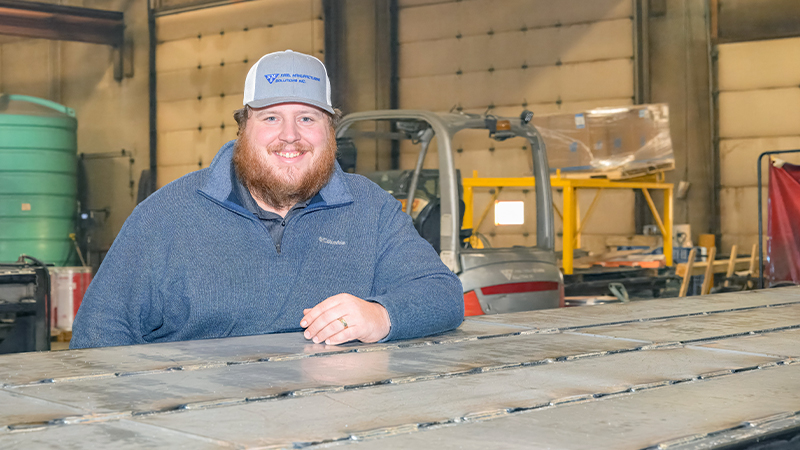
Except that now wood mats are not the only option because Infinity Mattz has created what many in the industrial arena have longed to see: a durable, non-slip, reusable, long-term product that can be brought from one project to another without any breakdown in quality or stability. Infinity’s mats are made from steel and are the brainchild of an oil pipeline employee who was frustrated that wooden mats deteriorate so quickly.
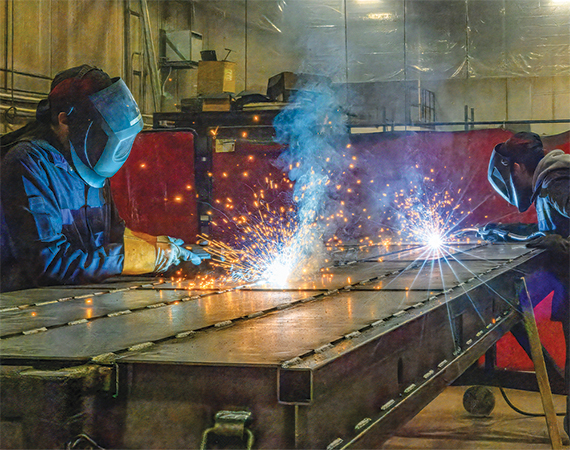
He brought the idea to HEATMOR — a fabrication company that makes outdoor stoves, safes, side-by-side toppers, and offers welding services — which is when Mark got involved and looped in his son, Ryan, to bring the concept to life. From there, the manufacturing process was spun off into a separate brand, Infinity Mattz, in 2021 to focus exclusively on getting customers for the new endeavor.
But convincing potential customers that a mat will last for 10 to 20 years — depending on the intensity of usage — versus a few months or a year like wooden mats do has been tough. The company did make an initial large sale to an oil and natural gas company in North Dakota. Building on that initial success is where the challenge lies.
“Potential customers are excited about a new option because they don’t like the old solution, but at the same time, there’s no familiarity with a product like this,” Mark explains. “Plus, we don’t have customers who have been using these for decades because we haven’t been around that long.”
Solution: Compare Infinity Mattz to familiar products, and show the mats in action
One approach that’s helping to get some traction is to compare the mats to a product like reusable steel crates that are used to ship larger pieces of machinery. Before his current role, Mark was general manager of North American Off-Road Operations for the Polaris plant in Roseau, and the company often focused on innovation in its packaging and shipping processes, he says.
With Infinity customers, he draws on that experience, as well as the use of reusable shipping crates made out of steel that can be utilized over and over. “Comparing the mats to something like a reusable crate is helpful, because it gives people a point of reference,” Mark says. “They can understand the value of using something that durable and long-lasting compared to a one-time-use option like a wooden crate.”
Another major step has been development of a website that features videos showing the mats in construction settings, adds Amy Hubler, an Enterprise Minnesota business growth consultant who’s working with the company on its go-to-market strategies.
“What potential customers want to see most is how these would be used, and having those images and videos are a powerful way to do that,” she says. “The website also clearly states the benefits in terms of lifespan, design, sustainability, and safety improvements.”
Challenge: Addressing sticker shock
Even when customers understand the value Infinity Mattz provides, the next major hurdle is the price tag, according to Ryan Karl. Because they’re made from steel instead of wood, and because they’re designed to last 10 times longer than wood mats, the cost of an Infinity Mattz product is much higher.
“Price is obviously a big challenge here, and there’s sticker shock to some degree,” says Ryan. “Even when people acknowledge that it will cost more for wood mats in the long run because of how often you need to replace them, they have to get over that initial hurdle on putting this into the budget.”
In many cases, an Infinity Mattz steel mat can be eight to 10 times more expensive than an existing wood mat, Mark says. Even though the company has basically “built a better mouse trap,” customers tend to go with what they’ve used even when they don’t like that option because it’s the “mouse trap” they know, at a price they can predict.
He adds that it’s particularly tricky because a fair amount of potential customers are used to the mat portion of a project being a one-time cost, versus amortizing it across multiple projects. That means they need to convince customers to change their way of looking at mats, from a “consumable” cost to an asset instead, similar to their equipment.
Solution: Developing an ROI calculator and focusing on short-term leasing
Simply saying that the steel mats will last 10, 20, even 30 times longer than wood mats isn’t enough, admits Mark. Seeing a side-by-side cost comparison is more effective, so the company is developing a simple calculator that will be put on the Infinity Mattz website early in 2026.
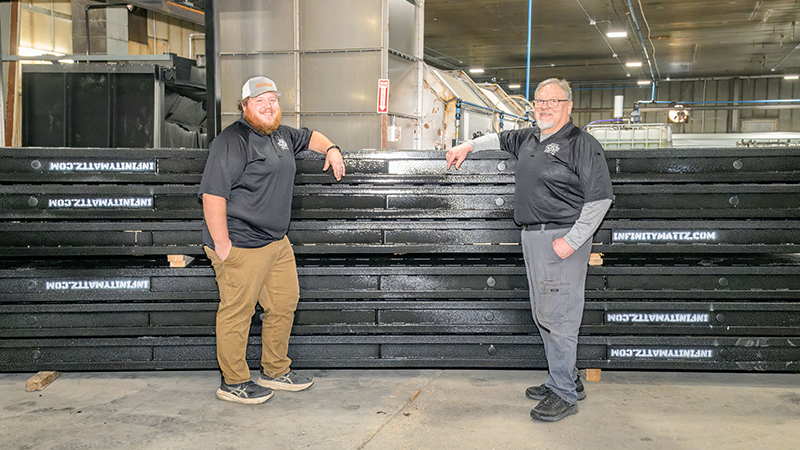
“This will be particularly useful for sales calls,” says Hubler. “They just need to ask the prospect to pull up the website, use the calculator, and see the results for themselves. For example, if you see that a wooden mat needs replacement every two or three years, you can understand what that will cost over 15 years, versus getting one steel mat to last that entire time.”
Another aspect of boosting customer comfort on price is leasing instead of selling, Mark adds. Not only does that give a wider customer base experience with the product — with the extra benefit of creating more word-of-mouth buzz — but leasing also takes some of the sting out of that initial cost, he says.
“It’s a way to try it out, where you can lease the mats for 60 days, and that lease payment goes toward the purchase price if you want to keep them,” Mark says. “If not, you only have to pay for the number of days you use them. We’re hoping that gives people a strong option for removing the risk that comes with a large investment in a newer product type.”
Challenge: Identifying a larger target audience
Any robust go-to-market strategy has identification of a target audience as a key component. According to Harvard Business School, this includes analyzing purchasing patterns and customer motivations around convenience and value. Infinity Mattz is already aware that construction is a major industry worth targeting, but there are many more where the mats can be used, says Ryan.
“Any industry where you need to traverse and work on different types of terrain safely can be a customer for us,” he notes. “We’re trying to focus on our core customer group first and expand from there.”
Expansion industries could include oil and gas pipeline installation and operation, wind turbine and solar power array implementation, mining development, logging, and utilities such as powerline installation. But getting a foothold in those industries requires specialized knowledge of how they operate, their unique needs, and what considerations go into their purchasing, adds Mark.
Solution: Attending trade shows and articulating key features
One way to reach a wider array of industry players is to be in a place where all these different companies come together — and for Infinity Mattz, that means trade shows. For example, Infinity Mattz will have a booth at the Conexpo-Con/Agg trade show in 2026, held every March in Las Vegas.
Touted as the largest construction show in North America, the show represents companies in concrete, mining, utilities, and many others. With over 2,000 exhibitors, it’s tough to stand out from all the noise — quite literally, when it comes to the Las Vegas Convention Center — but Mark feels it will be a good first step to establish a presence beyond Minnesota and the Midwest with national and even international exposure.
“Trade shows can feel promising because people seem really interested and really excited while you’re talking to them, but then when you circle back after the show, it’s radio silence,” he says. “However, you don’t know when someone might come back around, or if what you’ve talked about will impact their project decisions in the future.”
Trade shows offer the added advantage of giving sales representatives the experience of pitching the advantages of the mats dozens of times per day over a short period of time. That repetition provides a kind of sales-based muscle memory that can be utilized during cold calling and following up on sales leads.
Infinity Mattz is also trying to reach more industries by describing key features of the mat on its website, including factors like engineering, safety, and environmental impact.
For example, the company notes that the steel mats have a high-load capacity that’s capable of supporting up to 25,000 pounds per axle, an appealing attribute for industries that utilize heavy equipment transported down temporary roads created by the mats. Another engineering feature highlighted on the site is the mats’ performance in wet and waterlogged conditions, such as rivers, marshes, or muddy job sites. This is likely to draw the interest of companies working in areas with unstable, wet terrain.
Challenge: Developing the right sales team
Although Infinity Mattz is working to get its mats onto the job sites of more customers, the company is also aware that it needs to grow in a way that’s sustainable, says Ryan. For example, ramping up a large sales staff and setting up a dealer network would be possible — and may boost growth in the short-term — but it would also require a large investment that could put the company at risk if sales take too long to materialize, he says.
“We want to grow incrementally, but not bite off more than we can chew, and that’s a tricky balance,” Ryan says. “We see so much opportunity, especially with all these different industries and geographies that we can expand into, but we also want to ensure we can scale properly.”
With a couple of local customers and the North Dakota oil and gas company, Infinity Mattz is getting more interest and inquiries than it has in the past, so there is a feeling of momentum, he adds. But that grassroots approach can only take a company so far — especially if there are limited resources for capitalizing on that interest through focused sales efforts.
“In the past, we were letting the product speak for itself, but word of mouth takes time and doesn’t always translate to customers,” says Ryan. “That’s why we’re looking at meaningful ways to grow in this next stage.”
Solution: Strategic hiring and staying open to what’s next
Because every potential industry has distinctive needs, getting the right sales representatives is crucial, but also a key challenge given the company’s location in Warroad. However, Mark suggests the geographic and professional limitations can be addressed by building a sales team that operates from different locations around the country. He envisions this team staffed by people who have worked for decades in different industries and have either just retired or are on the brink of that transition.
“These are the type of sales reps who advocate for a product like ours because they know its value, not because it’s their job,” he says. “They know the ins and outs of their specific industry and all the nuances that come along with that, and because of their experience, they bring a certain amount of respect and clout. That opens doors right away. It’s not easy to build a team like that, but we’re working on it.”
Through the insight they’re gaining from Enterprise Minnesota, Infinity Mattz is progressing toward a meaningful go-to-market strategy that has some of the same components as the mats themselves: sustainability, durability, and adaptability. As the company looks ahead, the executives are careful to build their sales and marketing in incremental ways rather than pouring all available funds into those efforts. They also recognize the areas of potential growth that could lead them forward.
For example, they continue to innovate, with four variations on the initial steel mat design. They also recognize that there are many more trade shows to attend, partnerships to consider, and manufacturing capacity to expand if needed.
“Even though HEATMOR has been in business since 1984, and the Infinity Mattz product had its first prototypes made four years ago, we do consider ourselves to be in the early stages of developing a more robust sales process. At the same time, we believe we have so many strengths that will carry us forward,” says Ryan. “We’re building this in a way that’s designed to last, and that’s exciting.”
Return to the Spring 2026 issue of Enterprise Minnesota® magazine.