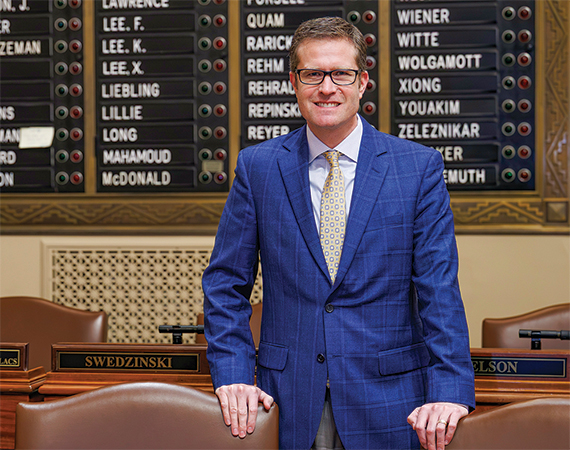
Tom Dippel is a Minnesota business owner and legislator who brings manufacturing experience to public service. He’s the founder and owner of Minnesota Dental Lab, an advanced manufacturing company in Newport that specializes in guided surgery and implant restoration. He currently represents District 41B in the Minnesota House of Representatives and is running to represent Senate District 41 in 2026.
How did you get your start in manufacturing?
Tom: My parents have a business that’s similar to mine, and they were integral when I took a big risk and invested in a lot of new technology, including providing space at their office so I could purchase CAD/CAM equipment and start building accounts. God blessed that effort, and it continued to grow. Now I have my own commercial space and 20 employees. Our manufacturing process is very fast and very efficient. Instead of taking an industry average of two to three weeks to produce a surgical guide, we aim for delivery in three days. A large part of our sales comes from the five-state region, but we also have large accounts in other parts of the country, including Arizona and Texas. Our growth has been entirely referral based.
How does your experience in manufacturing influence your work as a legislator?
Tom: Manufacturing is the foundation of much of the state’s economy and produces great jobs, but many legislators don’t understand that. Almost none of the representatives and senators on the other side of the aisle are business owners. They were taught theoretical economics from a certain perspective in college but never had to see if those theories worked in real life. This came out in many committee hearings when they tried to paper over something that wasn’t working with more of the same thing, just a different twist.
More regulatory burdens on a manufacturer makes it more difficult for a business to start. Bringing a product to market involves a whole bunch of steps a business must take before making a single sale. Understanding these processes helps me serve my manufacturing constituents, and non-constituents, better.
Why does the legislature need to take steps to improve the business climate for manufacturers?
Tom: Requirements like paid leave and sick and safe time may sound good, but for small businesses and startups they can be devastating. A business might only have the owner and one or two other employees. If they lose a critical employee when they have a big order come in and they can’t fulfill that order, their business could just go under.
On top of that, Minnesota has the second highest business tax rate in the country — only New Jersey taxes companies more. When government takes more off the top, businesses can’t reinvest as much or increase hiring. And if a business isn’t reinvesting, they aren’t contributing elsewhere to the economy. Cutting into profits through overtaxation is where the economics start to break down.
Surrounding states have far more attractive business climates. If a business owner is looking to start or move into Minnesota, they’re likely going to see the state has the second highest business tax rate. It also has two of the highest-cost social mandate programs for businesses: sick and safe time and paid leave requirements.
Business owners can look at surrounding states and see how they have made their business environments much more appealing. And they’re going to say, “We could do half the business in those states and potentially have an even higher profit margin.”
There are states that have very strong economies, and states that have weak economies, and voters need to know that different parties and ideologies are driving those differences. Then they can make the connections between good policies and who they vote for. These regulations that hinder business could be moderated if more legislators have a better understanding of economics, business operations, and employment.
But for that change to happen, you have to be able to communicate the message in one or two sentences. For example, when talking about moderating paid leave laws, if you can’t explain the positive impact in a sentence or two, it’s hard to win the issue politically.
What can manufacturers do to encourage more balanced state policies?
Tom: Manufacturers need to do everything they can to influence their elected officials. They should call, email, and show up to the legislature to talk to their representatives and senators.
They should also make sure they support candidates who understand the issues and who clearly communicate to them that they are going to try to re-level the playing field for businesses and manufacturing in Minnesota. And if those elected representatives don’t support those changes, manufacturers shouldn’t support them, and they should try to tell at least 10 people that they don’t support business in Minnesota.
Manufacturers thinking about running for office should do it. We need more business owners in the legislature. We need people who have had to make payroll and felt the heat, whether they have one employee or 50 employees. They care about their employees and want them to succeed. They should bring that to the Capitol and sound the message that manufacturing is the backbone of our economy.
Return to the Spring 2026 issue of Enterprise Minnesota® magazine.