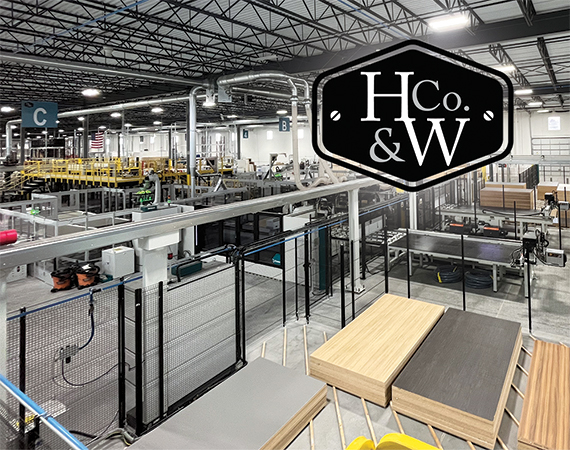
Factory of the Future
Robots and automation help Hansen & Co. Woodworks increase sales and raise wages.
April 20, 2026
12 min readDuring a two-week, 3,000-mile journey through the back country of Xiamen, China in the mid-2010s, Adam Hansen came to the realization that manufacturers in the United States were going to lose — badly. Hansen, founder and president of St. Joseph-based cabinet-maker Hansen & Co. Woodworks (HCo), had visited several granite quarries and processing plants in China.
“I was just blown away by the sheer number of human beings they had working there,” he says. “On the way back home, I realized there was simply no way to compete against that — against a people-heavy, low-cost workforce on that scale. The only path forward was to make American manufacturing something people would genuinely want to do — careers worth having, supported by real wages. And the only way to get there was through increased productivity by way of automation.”
The China trip was part of nearly 200 factory tours Hansen took in the past 10 years to learn how to better automate processes for making the cabinets and architectural millworks his company sells. He visited plants in the United States run by diverse companies, such as Ford and Adobe, as well as manufacturers in Europe where automation has been used more in cabinetry and woodworks.
The result of his fascination with how to use automation to compete better came online in February 2026 — a 92,000-square-foot facility that will increase his company’s manufacturing capacity by 400% with only a small increase in its current workforce of 55. It will allow HCo to produce custom, built-to-order cabinets for its commercial customers with most of the work done by machines and robots. Hansen broke ground in June 2024 and began a 20-month process encompassing construction, equipment installation, and commissioning. The company is expecting to reach full production capacity by mid-2026. It cost about $25 million and will replace two smaller plants HCo operates outside of St. Joseph, Minn.
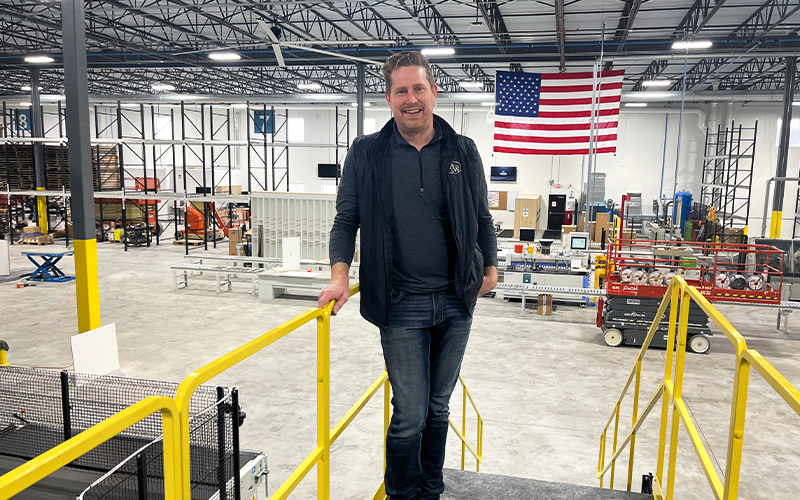
Hansen believes it is the most fully automated frameless cabinet line in North America. Because of the automation and related technology used in the plant, workers will need skills in industrial engineering, robotics, process engineering, and technical manufacturing. To accommodate the demand for highly skilled employees in its new facility, HCo has invested in a training partnership with nearby St. Cloud Technical & Community College.
“My priority isn’t adding jobs for the sake of headcount,” Hansen says. “I care about the people we have. How do they make more money? How do we take the stuff that is redundant and make that automated? And leave human beings doing what they are best at — that is, reasoning, intellect, observation, seeing things that are anomalies. So, you elevate the human experience.
“I don’t want a human being putting a door on a bumper,” he says. “We’re better than that.”
Automation answers hiring dilemmas
Like other manufacturers, Hansen understands the difficulties of hiring in today’s market and knows younger workers are less willing to stick with jobs that may be repetitive or dull. They also tend to have different skills than long-time workers in the field. “Workers are nimbler now,” he says. In that environment, employers need to challenge their employees, help them develop high-level skills, and give them as much job satisfaction as they can. “I’d like to keep someone 20 or 30 years, but we know they might move on. We still need to have a business that scales. We can get that with automation,” he says.
While the HCo plant is more automated than many manufacturers, more companies are turning to technology to improve wages and skills for workers as well as increasing productivity, says Rani Bhattacharyya, a University of Minnesota extension professor who studies workforce issues. A research project Bhattacharyya conducted in 2022 looked at why and how manufacturers introduced automation at seven facilities around Minnesota. Most manufacturers added automation as a response to worker shortages, the study found. “Employers are looking to augment their workforces, not replace them,” Bhattacharyya says.
Enterprise Minnesota Business Growth Consultant Ryan Steinert says increased demand often forces manufacturers to make a choice. “You can meet growth with muscle or with finesse,” Steinert says. “Muscle is hiring more people. Finesse comes from employees improving the process so the business can scale more effectively. Hansen’s automation strategy is a perfect example of thinking about the whole manufacturing process from start to finish, driving out waste within the operations, and adding automation where it makes sense.”
According to Steinert, eliminating waste allows team members to focus more on where the value is created for the customer.
Besides elevating wages and scaling his business, Hansen’s goal in automating is to produce cabinets that are 97% fabricated in-house. “These two directives — expand wages and keep fabrication in house — are the lenses we look through when making decisions,” he says. Unlike many cabinet manufacturers who purchase components like doors and drawer boxes from outside suppliers, HCo fabricates what it produces. Keeping manufacturing in-house was a point of principle for Hansen, not just an operational choice.
Hansen’s new factory allows the company to produce a wide variety of cabinet sizes and colors. Most American cabinet manufacturers produce large numbers of cabinets but with low variety. The HCo cabinets are designed for high levels of durability because most of them end up in high-use spaces, such as multi-family housing, healthcare facilities, and student housing. The new plant has certifications from both the Kitchen Cabinet Manufacturers Association and the Architectural Woodwork Institute, a selling point with the property managers and developers who are its customers.
From board to cabinet
While robotlike automation has been used in manufacturing since the 1960s, developments in data processing, artificial intelligence, and digital technologies have created new and more advanced ways to implement automation. The technologies that Hansen uses in the new plant were not available when he first began thinking about adding more automation less than 10 years ago.
“Everything would have needed to be custom made,” he says, “which would have doubled the price.” The majority of the automation and robotics were developed by two key partners: Italy-based Biesse, a global leader in woodworking technology, and Quebec-based Automatech Robotik, which specializes in robotic automation for the woodworking industry. Its robots can move and process multiple parts at a time, read and process CNC programs, and identify specific parts by QR code — capabilities that are central to the precision and flow of HCo’s batch-one production line. Other equipment came from suppliers in Germany.
The process begins in the automatic storage and retrieval area, where up to 5,000 thermally fused laminate (TFL) panels are housed. The panels come in 5-by-12-foot sheets in up to 400 colors and have a texture that gives them a high-quality appearance. Each panel is weighed, measured, and checked against the company’s database for accuracy. When it’s needed, each panel is transferred to the router, where it is cut, flipped, and drilled with a CNC machine. The robots are programmed to cut the largest number of parts possible from each panel, a process that has reduced waste significantly.
The panels are lifted and moved automatically, and a sheet can be cut and drilled every 2.5 minutes. Along the way, the part is labeled with its QR code, which will identify it throughout the process. A robot takes a photo of the part and checks the database to ensure it is the correct size and material. The part is nested with other parts (which may or may not belong to the same cabinet), sorted, and moved farther down the line where an edge is added and hardware installed.
Edge banding — that strip of laminate or veneer that covers the raw material on the sides of cabinets — was one of the first areas where Hansen moved into more automated processes. The new system can band up to 11 edges per minute. The company adheres the edges using a PUR glue, which creates a bond that is resistant to heat and water. “It’s trickier to use but provides a really good product for the consumer,” Hansen says. The edge bander reads the code on each part, then applies the correct color and thickness of edge.
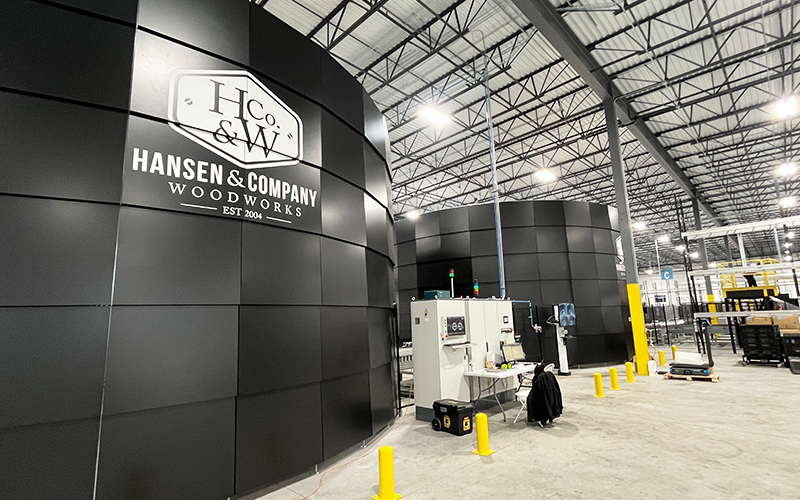
After edge banding, the parts are scanned again and moved into one of two large silo-like containers called the library. “The libraries were our Kryptonite,” Hansen says. “We could not figure out how to bring in parts that are all cut chaotically and nested on sheets for best yields, then bring them all together and bring them out as a cabinet.”
Hansen saw the libraries at an industry show. The round interior of the libraries is able to store thousands of cut parts, which are placed in slots by robots operating inside of the library. They are held there until it is time to assemble a cabinet. The library robot then pulls the parts that make up a cabinet and sends them down the line in the precise order they will be needed for assembly — end panel first, then tops and bottoms, then shelves and faces.
Down the line, drawer slides and hinge plates are installed by more robots. Glue and dowels are inserted automatically as needed, then a worker assembles the five panels of the box of the cabinet. This is the first time a worker touches the box. When the line is working at full speed, cabinets will move through it at a rate of one per minute. Once assembled, it moves down the line where it is then compacted by a machine to ensure it is square and the parts are firmly attached. Backs are stapled to the box, then the cabinet moves down the line farther, where it is eventually wrapped individually and wrapped again on pallets for shipping or storage in HCo’s warehouse area.
“The most challenging part of commissioning a system like this is the flow of part data from one automation center to the next,” Hansen says. Each machine in the line needs to know exactly what part is coming, in what sequence, and what to do with it. “Getting that data handoff to work seamlessly across every transition is where the complexity lives,” Hansen says. “As that communication tightens up, the line accelerates.” At full production, HCo expects to produce up to 500 cabinets a day, more than triple its current output of about 140.
Everything in the HCo plant is designed to ensure a clean and efficient assembly line. An advanced vacuum system removes dust from the building to reduce any problems that might affect equipment performance. The walls and machinery are mostly painted bright white to enhance visibility, and most of the robots can be viewed from the floor. “You don’t see that level of foresight often with automation,” says Steinert. “Hansen has set it up so that problems are easily identifiable, allowing team members to become more effective problem solvers so the automation can continue to do its job.”
A natural entrepreneur
Outside of three weeks working in sales, Hansen has always been his own boss. In 2004 at 21, he began making fireplace surrounds for a local developer who was building apartments in central Minnesota. Hansen had never worked with wood, but his father worked in the construction business and had a shop at home — and Hansen needed a job. He enjoyed building the surrounds and soon, he was making kitchen cabinets for condominiums, as well.
Then called A-Cab Custom Woodworking, the business grew until the recession of 2008. As residential building slumped, Hansen took on two investors to keep the company afloat and pivoted to building cabinetry for extended stay hotels housing oil workers in Bakken, N.D., often spending six days a week in the area. The hotel business kept the company going through the recession and gave Hansen insight into which customers could provide stability and help grow the business over the long term. In 2017, the company moved completely to commercial work, building cabinets for multi-family housing projects, schools, offices, and medical facilities as well as creating architectural millwork, such as decorative walls, nurse stations, and reception desks. Eventually, Hansen bought out his two investors and is currently sole owner of the company.
“I just fell in love with manufacturing,” Hansen says. Because he’s learned so much from visiting other manufacturers, Hansen opens his plant up to tours whenever he can. The company also participates in Experience MFG, a program that brings high school students into manufacturing facilities to give them a sense of what manufacturing jobs are like. The company currently sends kits and videos to local industrial technology classes to give students a chance to build something on their own.
“We want kids to see that manufacturing is a great career,” he says. “We want them to go home and tell mom and dad, because sometimes they are the hardest to convince that manufacturing is not some dirty, grungy job.”
Hansen encourages students to keep an open mind about career choices. Many students imagine that they have to find a job they love when they are 18 and that they’ll know what they want to do the rest of their lives. “That was not my experience,” he says. “You find a career that you thrive in by investing in the activities that you are doing. That’s how you build that passion for it. I think knowledge creates passion and passion sells. When I advise younger people, I tell them that sometimes you have to just stick with it, and you get momentum. Sometimes you have to decide that this is what you like to do, and do it.”
With the plant just coming online, Hansen is excited about his company’s growth possibilities. Currently, its products are sold “mountains to mountains” from Kansas to Minnesota, Wisconsin to Montana, but it’s working on finding more customers in the South where shipping costs would not be prohibitive.
“This has always been about two things,” he says, “to bring modern manufacturing back to America, and to build a system productive enough to give people a real opportunity to achieve their potential. The vision fuels the journey. The grind gets you there.”