Building AI’s Home
Why data centers need components, power, and more — and fast.
January 21, 2026
12 min readIf you ask Microsoft Copilot, ChatGPT, or any of the other artificial intelligence-driven chatbots, “What are the opportunities and challenges for Minnesota manufacturers in the data center build out?” you’ll get a decent answer. The bot will mention the growing need for components and infrastructure, especially for electrical equipment, cooling systems, enclosures, fabricated metals, sensors, and automation hardware. It will note the growth to the local construction economy and the possibility of innovation in collaborations with tech giants such as Google, Microsoft, Amazon, and Meta. On the challenge side, it will mention concerns about the potential overload of the electrical grid and the shortage of electricians and HVAC technicians.
What it doesn’t mention is the urgency with which data centers are being built and the demands vendor companies may face when working with the hyperscalers, the cloud services providers behind large data center projects. They include companies such as Azure, Google Cloud, and Amazon Web Services. It also won’t mention how much money a manufacturer could make if it found a niche in the world of data centers. The truth is the companies that invested about $300 billion in AI in 2025 alone need components, and they need them yesterday.
“If they need something, it becomes the very first thing that you get done, and you get it to them when they want it,” says Greg Hunsaker, a business growth consultant with Enterprise Minnesota. Hunsaker has worked with companies supplying data centers, including one that met its revenue growth targets three years ahead of schedule solely because of data center projects. “It might mean sacrificing some of your long-term customers who get pushed back to make room for the data center project. But that’s where the money is.”
Why the rush to build data centers?
Data centers have been around for decades. There are about 2,700 of them in the United States today. In the past, data centers simply stored digital data, such as photos and documents, and moved it around as users needed it. They did not require a huge amount of computing power or electricity. New data centers are being built to handle AI — and that vastly increases the power requirements and computing power needed.
The new data centers are large ecosystems made up of 5,000 or so servers, storage devices, networking equipment, and power supplies, all needed to run calculations every second to feed the large language models that run programs like Microsoft Copilot, ChatGPT, and Google Gemini, as well as machine learning systems and other AI applications. Take, for example, the question about data centers and Minnesota manufacturers. To answer it, the large language models did millions, maybe billions, of calculations as they trolled the internet for relevant details on the topic and arranged the words in a digestible manner. Answering that question probably consumed a few drops of water to cool the computers and required less energy than a microwave would need to heat up a donut. It was, however, one of about 10 billion questions AI models wrestled with that day.
According to a McKinsey & Company analysis, a $6.7 trillion investment in data centers worldwide will be needed by 2030 to keep up with the demand for computer power, with 70% of that computing power needed for AI applications.
The systems require security throughout, such as encryption and intrusion protection systems as well as biometric security to ensure only approved workers enter. Managing the heat generated continuously by the computers inside them requires massive HVAC systems.
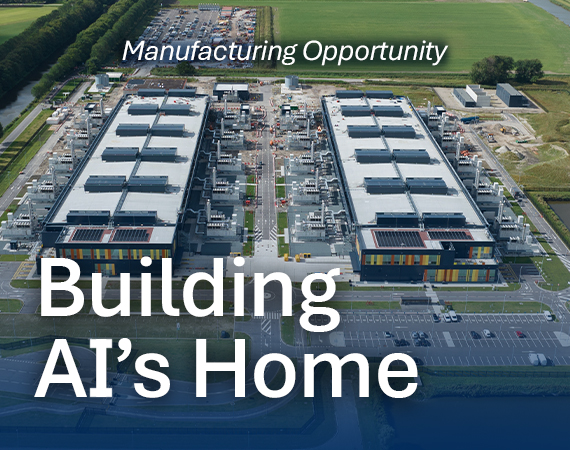
According to the Federal Reserve Bank of Minneapolis, 12 data center projects have been proposed for Minnesota as of October 2025. So far, only the Rosemount Data Center, an $800 million project by Meta, the parent company of Facebook and Instagram, is under construction. That 715,000-square-foot site is being built on 280 acres at the former site of UMore Park. It’s being built using an artificial-intelligence focused design developed by Meta, will be powered entirely by renewable energy, and is likely to create 1,000 construction jobs and 100 permanent jobs. CloudHQ, a global developer of wholesale data centers, is awaiting final city approvals in Chaska for a data center campus that would cover about 1.4 million square feet and require up to 200 megawatts of power.
Overall, Minnesota is a small player in the data center buildout, in part due to a slower permitting process and distance from population centers. As land for building data centers has become less available, though, hyperscalers are looking to the Midwest for new centers. North Dakota has seen five open since 2022.
‘It’s just massive’
Intek Plastics, a Hastings-based manufacturer of extrusion and injection molded products, began supplying data centers when one of its customers was acquired by a large data center integrator, a firm that builds the IT systems inside data centers. Paul Pedersen, vice president of strategy and market development at Intek, can’t say which integrator — confidentiality is a big part of working with data centers and their suppliers — but integrators include companies like Schneider Electric, Vertiv, Eaton, and Legrand. Currently, data centers make up about 10% of Intek’s business, Pedersen says, but the growth potential is huge, and the company is preparing for it.
“Plastics play a small role in the scheme of things,” Pedersen says. “There is so much more spent on the computers themselves and the metal racking and all sorts of other things. But even playing a small role, it’s massive. It’s just massive.”
Intek supplies electrical insulating materials for some of the busbars and racks in data centers. It also provides components for air flow management to assist with cooling. Several innovations in liquid cooling are being developed to manage the large heat load generated by the chips, and Intek has been providing components used in those systems as well. “If you are a flexible company and you can support innovations, you’re going to do very well,” Pedersen says.
Already some Minnesota companies have experienced significant growth due to data center buildouts. For example, in June 2025, Rolls-Royce Solutions announced a $24 million investment to double production at its Mankato plant, which manufactures the company’s mtu Series 4000 generator sets. These are used extensively in data centers. The company is building a 250,000-square-foot plant in Mankato as part of the expansion.
Elsewhere, States Manufacturing received $2.8 million in state financing from the Minnesota Department of Employment and Economic Development (DEED) to expand its facilities in Dayton and Champlin. States manufactures power distribution equipment, including large equipment enclosures similar to those used in data centers.
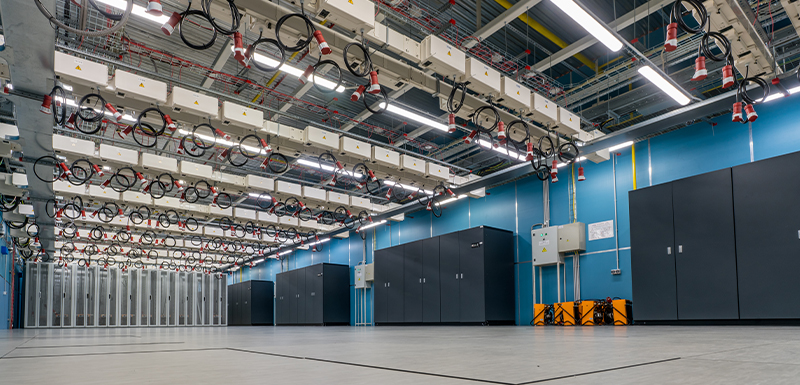
The types of components needed for data centers run the gamut of Minnesota manufacturing, says Hunsaker. During the construction phase, data centers need precast concrete, structural steel, building panels, steel framing, modular walls, metal enclosures, and panels. The servers inside the building require racks, cable trays, and modular enclosures. Data centers include massive amounts of HVAC equipment to keep them cool, including chillers, cooling towers, plate exchangers, pumps, and manifolds. Finally, power is one of the biggest needs of data centers, creating a market for transformer housings, switchgear enclosures, busbars, and cabling trays.
Power problems
Finding and accessing the power to run data centers may be the biggest challenge for hyperscalers. The five data centers built in North Dakota came there in part because of access to abundant and inexpensive energy from wind power generated in the state. The Rosemount Data Center will require around 700 megawatts of power to run its facilities, about the amount needed to power 300,000 to 600,000 homes. Beyond the power itself, data centers need to be close to high-voltage transmission lines and require multiple transformers to deliver the correct voltage. Most data centers also need backup generation within the center to address any gaps in service.
With the amount of power they need and the speed with which they want it, some hyperscalers are seeking direct access to power by building near existing utilities. Two companies have proposed data center sites in Monticello, home to an Xcel Energy power plant. In southwestern Minnesota, Geronimo Power recently proposed a data center project in Nobles County to use the wind and solar power generated there.
“I think most are going to go the vertically integrated route,” says John Pollock, CEO of Jordan Transformer, a 50-year-old Jordan company that rebuilds transformers and mobile substations, including for hyperscalers on the East Coast. “They’re going to say, ‘I can’t get power from existing places, so I’m just going to go get my own.’” For example, xAI has installed about 35 gas turbine generators outside of its data center in Memphis. Microsoft has made a deal with a Pennsylvania utility to restart the Three Mile Island nuclear reactor to power a nearby data center. Despite issues with the power grid, data centers are attractive customers for utilities, Pollock says.
“Data centers are constantly going, like a casino,” Pollock says. “They’re a steady draw and utilities love that because they can figure out pricing without having to deal with peak and off-peak pricing.”
However, the lead time for building a transformer or substation is currently about four years, much longer than the lead time for building a data center, which has led to a huge backlog in orders and a shortage of parts, Pollock says. Some data centers are using mobile substations to bridge gaps in power. Others are paying more to put their order ahead of others.
“Many cities have asked us to build transformers, but we can’t do them all,” says Pollock. “It’s becoming like toilet paper during COVID. We can design and build them but the lead time for parts has doubled, if not tripled.”
The shortage of parts has led Jordan Transformer to look for suppliers in Europe, though that may require changes in their product design.
‘Don’t mess up’
Working with data center hyperscalers and integrators can be extremely profitable, but landing the opportunity isn’t easy. Hunsaker recommends manufacturers interested in supplying this segment should determine which supply chain node their firm can serve. Is it civil site construction? Structural enclosures? Mechanical cooling? Or somewhere on the power supply chain? Maybe maintenance and spare parts, which will be an opportunity since the computers in data centers need to be replaced every four or five years.
“One of the biggest barriers to entry is that if they have a supplier, they don’t want to go find another one,” Pedersen says. “Speed of delivery and meeting quality parameters are the most important requirements, with price secondary.” You don’t want to mess up, “because they’ll just find another supplier.”
To become one of those suppliers, Pedersen suggests manufacturers immerse themselves in the world of data centers. There are publications, such as Data Center Frontier, that carry industry specific information on data centers. In addition, several national trade shows are held each year including Data Center World in Washington, D.C., the Open Compute Project in California, and SuperComputing, scheduled to be held in Chicago in November 2026.
“All the people who supply data centers show off everything at those shows,” says Pedersen, whose firm is actively seeking more data center work. “They’ll tell you what they are innovating. That’s how you tap into it.
“I would encourage people who haven’t been in it to go to the shows and look for parts that they could make and then start talking about what they are doing to innovate,” Pedersen continues.
On a local level, Hunsaker suggests manufacturers stay up-to-date on state permitting and regulatory[KP1] changes. They should also attend city council and other public information meetings where data centers are being proposed and make a connection with the companies that are building them. “The biggest thing is that timing matters,” he says. “You have to get in on it early. Pre-permitting you want to make relationships with the hyperscalers. If they are at the permitting stage and they have a general contractor, then you want to get in front of them.”
Because so many of the components that data centers need involve electrical enclosures, Hunsaker recommends manufacturers obtain UL 50 certification, a standard by Underwriters Laboratory for electrical enclosures in non-hazardous locations. And, be ready to act fast. “The rate of speed they are going with these things is unbelievable,” he says.
Hunsaker and Pedersen both recommend manufacturers begin using AI, if they are not already, to understand the ultimate product and to understand the industry. “If you learn to use AI well, it’s amazing what you can extract about data centers,” Pedersen says.
How long the data center build out will last is uncertain, and there’s no consensus among industry observers. Hunsaker expects that most of the build out will be done in three to five years. For suppliers, the short-term payoff is huge, and it may also lead to an increase in capabilities, which would pay off over the long term.
Pedersen and Pollock see a much longer timeline for the build out of data centers, particularly to bring enough energy online to power them. Use of AI is growing exponentially and new applications are being developed. “I don’t think we’re even scratching the surface of what’s going to be needed,” says Pedersen. “It’s going to be a long while. And, if it isn’t, let’s jump on it now.”