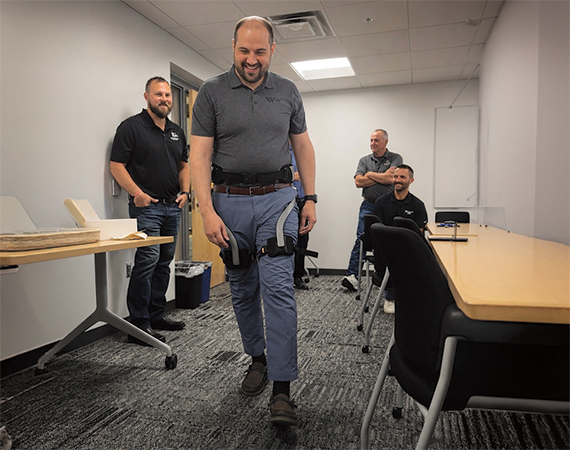
Jason Esch took a few small, slow steps at first, just to get a feel for the Hypershell X exoskeleton around his legs. Something in his movement felt a bit different. But then he took a few long, quick strides.
“Oh, yeah,” says Esch, global vice president of punching operations at Wilson Tool in White Bear Lake.
“Now it really wants to go. Wow.”
The AI-powered wearable was designed to boost leg power and enhance mobility. It was one of several exoskeletons Ryan Fernholz, CEO of The Exoskeleton Store, brought to a recent Enterprise Minnesota Peer Council meeting in North Mankato to demonstrate technologies that can reduce the physical toll of work in manufacturing and other industries.
Greg Hunsaker, an Enterprise Minnesota business growth consultant, invited Fernholz to the meeting after Peer Council members asked about tools that could help experienced employees remain healthy and productive longer, which is a growing concern.
About 26.1% of Minnesota’s manufacturing workforce is 55 or older, according to the Minnesota Department of Employment and Economic Development (DEED). The wearables sold by The Exoskeleton Store aim to ensure an aging workforce remains healthy for years to come.
Filling a Need
Greg Galarneau founded The Exoskeleton Store in Farwell, near Alexandria, in 2024. The idea grew from his years performing physically demanding work on dairy farms and in warehouses and servicing industrial automation equipment.
Galarneau first encountered exoskeleton technology overseas and saw an opportunity to make it accessible to American workers. He tapped Fernholz, who has experience in engineering, industrial sales, and e-commerce, to serve as CEO about a year after starting the company.
The Exoskeleton Store doesn’t manufacture wearables, but sells products from several manufacturers, primarily from Europe and Asia, along with a handful from the United States. “We don’t want to represent every exoskeleton suit that exists. We just want the best,” Fernholz says.
A Spectrum of Options
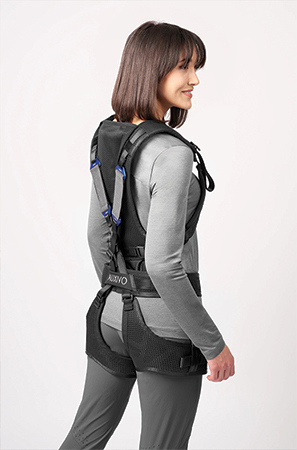
The technology is designed to fit a range of body sizes and address particular needs. Some devices support the shoulders during overhead work. Others assist the back during repetitive bending, help support the neck when workers must look up or down for extended periods, or strengthen the user’s grip when using tools.
The company’s bestselling occupational product is a lightweight back-support unit that weighs about 2 pounds and costs $1,695. It supports a worker’s back and hips for repetitive lifting and bending.
Fernholz says passive devices — which use springs, elastic bands, or flexible rods rather than motors and range from $999 to $5,200 — are currently the most practical option for many manufacturers because they are relatively light and mobile. The technology is particularly well-suited for jobs involving repetitive motion, moderate loads, or prolonged work in awkward positions.
Fernholz showed the Peer Council a robotic glove equipped with artificial tendons and small motors ($11,495). Pressure sensors detect when the user begins to grip an object, and the glove assists with completing or maintaining that motion.
Fernholz also demonstrated neck-support technology that can be attached to a welding helmet, baseball cap, or other headwear. The device, which costs $295, provides gentle upward tension for employees who spend much of the day looking down or holding their head in a fixed position.
He became a believer after trying one while ice fishing, when hours of watching the hole left his neck and back sore.
“It was an absolute game changer for me,” he says.
Comfort Is King
An effective device provides little value if employees refuse to wear it, making comfort critical, Fernholz says. The Exoskeleton Store evaluates whether products fit a wide variety of body sizes and whether workers can realistically wear them throughout a shift.
Heat is also a concern, particularly in foundries, steel plants, outdoor jobs, and other warm environments. Exoskeletons add material and weight to the body, potentially increasing heat stress. “Heat stress can ultimately mitigate any benefit you’re getting from any exoskeleton,” Fernholz says, noting his company also offers cooling apparel.
To help manufacturers decide how the technology might help their workforce, The Exoskeleton Store conducts on-site assessments and reviews videos of employees performing specific tasks. AI-powered ergonomic analysis software can map a worker’s movements and flag areas of elevated risk.
Fernholz says the company encourages manufacturers to begin with a limited trial rather than buying equipment for an entire workforce. “We don’t want you to buy 10 and then regret it because nobody’s going to wear it,” he says.
Sales grew about 500% between the company’s first and second years, and Fernholz expects revenue will double again in its third year. The company’s rapid growth reflects increasing awareness of the technology.
Fernholz and Galarneau expect future growth to come from powered technology. Motors are becoming smaller, more powerful, and less expensive, opening the possibility of lighter devices that can assist with walking, standing, squatting, and lifting.
Exoskeletons won’t replace sound ergonomics, automation, lifting equipment, or proper training. But as companies look for ways to protect workers, retain experienced employees, and make physically demanding jobs more sustainable, wearable support gives them one more tool to tackle those challenges.
“The need was always there,” Fernholz says. “Now the technology is available.”
Return to the Winter 2026 issue of Enterprise Minnesota® magazine.