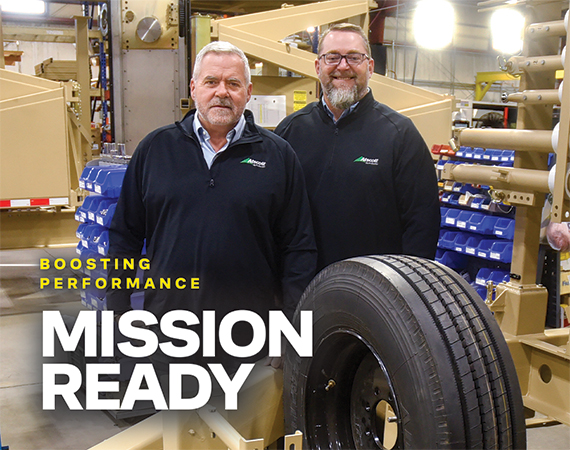
You could say that for these two U.S. Army veterans, taking charge of a Minnesota manufacturer is a new mission.
On Jan. 1, Steve Birch became CEO of Atscott Manufacturing, a contract machine shop that has called Pine City home since its founding in 1963. In April, Atscott made another crucial hire: Scott Sikkink, whose title is chief operating officer.
Working together, they’re applying the skills they learned in the Army and in the private sector to ensure that a long-established manufacturer can meet the big challenges of an ever-changing, more demanding marketplace.
An Unexpected Opportunity
What’s remarkable about Birch’s hiring is that he didn’t have a background in manufacturing.
Birch retired from the Army as a colonel in 2014 after a 31-year career in which he specialized in communications and IT organizational strategy. Upon retiring, he moved to his wife’s home state of Minnesota. He spent 10 years working for Minnetonka-based travel company CWT (now American Express Global Business Travel), where he held management positions in data and analytics.
Birch might not have known much about manufacturing, but he did know John Norris, Atscott’s longtime owner and the founder of Mendota Heights-headquartered Tower Solutions, Atscott’s sister company. The latter company markets self-erecting towers primarily for military applications, as well as for lighting, surveillance, and communications.
In the mid-2010s, a mutual friend introduced Birch to Norris and his businesses. In 2016, Norris asked Birch to join the Tower board of directors to help identify opportunities to improve marketing to the Department of Defense. Four years later, Norris combined Tower and Atscott under a holding company called ATS, and Birch became an ATS director. Back then, “I had no idea — no idea! — that I would sitting where I am now,” he says.
Birch enjoyed his work at CWT. “It was a wonderful job,” he says. But when Norris asked Birch to become Atscott’s CEO, “I felt an obligation or a sense of duty to say yes,” Birch says. “Honestly, there’s not a person I respect more than John in terms of being a good role model and an ethical business leader. He cares about his employees, and he cares about Pine City.”
He also responded to what he saw as a “great opportunity to do work that is important in the last five to seven years of my working life. If you believe that it’s important to keep jobs in small-town America, you have an obligation to respond.”
Birch acknowledges that he doesn’t know a lot about manufacturing, at least not yet. “Everyone in the plant knows that I don’t know it. I do know the difference between a mill and a lathe now. I know it because these guys will teach me what I need to know about the machining part,” he says.
That noted, he adds, “I do know a lot about organizational change. I do know a lot about computer systems — the heart and soul of a company is often the automation systems it uses.”
Another strength, based on his Army experience, is leadership: coaching, teaching, training, and planning.
Besides serving as Atscott’s CEO, Birch is CEO of ATS Holdings, which owns both Atscott and Tower Solutions. The two companies are tightly intertwined: About half of Atscott’s business is devoted to manufacturing the products that Tower Solutions designs, engineers, and sells.
“I work to keep both companies in sync with each other,” says Birch, who is ATS’s only employee. He spends one day a week in Mendota Heights to keep the two businesses aligned in terms of schedules and delivery. Tower Solutions has its own CEO, David Kensinger, and employs about 20.
Most of Atscott’s non-Tower work involves assembly and components machining for defense and aerospace businesses, and it provides contract component machining for a variety of industrial and medical customers. Its products include parts for aircraft subassemblies and optical sights for laser and radar systems.
Atscott currently employs over 70. “We’ve had a good year,” Birch says. “We’ve added 17 new hires in 2026.” The company’s 2025 sales were more than $16 million, a 23% increase from 2024. Atscott expects to approach $20 million in sales in 2026. And the company is preparing itself for continued growth in the coming year.
Meeting of Minds
Birch knows Atscott can’t rest on its laurels if it’s going to continue to be one of Pine City’s premier employers. And in Scott Sikkink, Birch has a right-hand man with the expertise to help him engineer the changes the company needs to continue thriving.
After graduating from high school in Minnesota, Sikkink joined the U.S. Army, where he served in Special Operations in locations including South America and the Middle East. After seven years, wishing to spend more time at home with his growing family, he became a police officer in the Fayetteville, N.C., area near the Army base where he had been stationed.
A few years later, he switched careers again, returning to Minnesota to earn a degree in mechanical engineering at the University of Minnesota. Upon graduation, Sikkink worked for a Minnesota construction equipment manufacturer, moved to Detroit to work for Ford, then came home again to become an engineering manager and a business development manager for vehicle maker Polaris.
In 2024, with its businesses under stress, Polaris began laying off about 500 of its senior managers worldwide, and Sikkink would be one of them. He was considering retirement when a chance meeting at a Cambridge shopping mall changed everything. While buying a present for his son at a game store, Sikkink discovered that the mall was hosting a career fair. Atscott had a booth there, and a mutual friend introduced him to a recruiter at the company, who encouraged Sikkink to send his resume. This began what Sikkink describes as a “gentle, patient courtship.” In early 2026, Atscott offered him the COO position.
“The Army taught me leadership and discipline,” Sikkink says. “Law enforcement gave me the perspective of understanding cause and effect. Engineering strengthened my analytic and problem-solving skills.” Add his product development experience, and he’d built a varied career that “prepared me for the broad operational responsibility that I carry as a COO.”
As Atscott’s COO, Sikkink manages day-to-day plant operations, including safety oversight, quality management, performance monitoring, resource allocation, and equipment maintenance. A key aspect of his work is communication with his production team, which he believes is essential to success. “People have to feel ownership,” he says. “People have to be rewarded with the ability to contribute and be decisionmakers.”
On a broader level, “I serve as Steve’s execution partner,” Sikkink adds. “I focus less on external vision and positioning and more on making sure the organization is functioning smoothly and effectively from within — guiding that internal vision and positioning.”
The two newcomers’ partnership seems to be gelling. “Working with Steve has been one of my greatest pleasures,” Sikkink says. “I’ve never experienced such synergy. It’s crazy how identical our thoughts are on approaches and strategies.”
For his part, Birch talks about Sikkink’s diverse background in engineering and manufacturing. “He does a lot of things I can’t,” Birch says. In addition, “we also have a great longtime staff.”
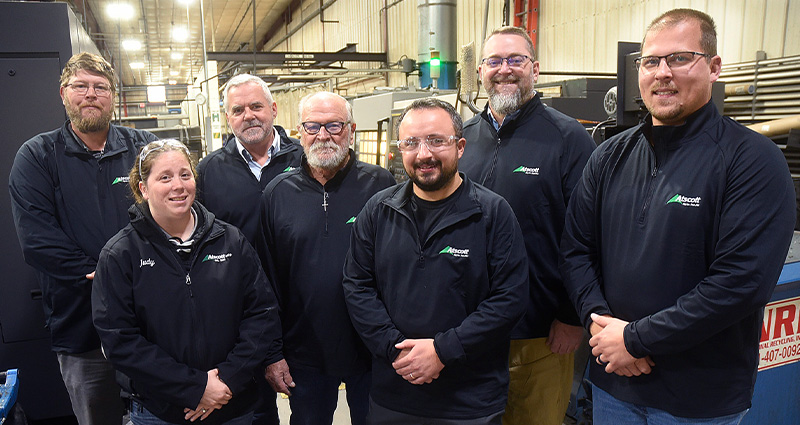
That includes Joe Plasek, an employee of more than 40 years who is head of machining. “He’s the backbone of the company’s manufacturing operations,” Birch says. “In addition to Plasek, we have Kristy Reiser managing the front office and financial operations.
The longtime staff has kept things moving along while I’ve learned and figured things out. For that, I am eternally grateful.”
Now the two Army veterans — one focused on broader organizational change, the other on internal process improvement — are looking to build on the solid foundation that John Norris has put in place.
Building the Future
That positioning focuses Atscott on growth opportunities in defense and aerospace.
The company has earned AS9100 certification, an internationally recognized quality management standard for the aviation, space, and defense industries. In addition, Atscott has achieved the U.S. Department of Defense’s Cybersecurity Maturity Model Certification (CMMC), which verifies that the company has established online protocols to protect sensitive defense-contract information. “Since we’ve spent the money, we want to harvest the opportunities that come in those markets,” Birch says.
One way that Atscott is preparing to take advantage of those opportunities is by transitioning to a new ERP system. “An ERP platform is the main operating system of a company,” Birch says. “It’s how we inflow work, it’s how we process work, it’s how we outflow work. It doesn’t run a machine, but all the business runs off that system.”
Atscott’s previous system had been in place for about 45 years, and it lacked the capability to provide information for quick decisions. For instance, the old platform didn’t allow management to easily visualize production schedules. It also couldn’t fully accommodate cybersecurity protocols. Birch says the new system enables managers to see where the production stands by reading a few screens instead of “trying to guess off of a printed sheet.”
Quick decision-making is critical to Atscott’s drive to build its defense and aerospace business. The company wants to be able to respond more quickly to requests for quotes (RFQ). “We have a good process of looking at quotes, but it’s not timely,” Birch says. “We’re trying to improve the ability we have to talk to the companies that give us the RFQ and ask us questions.”
Sikkink says data he’s seen suggests that the first business that responds to an RFQ wins the contract about 70% of the time. The challenges for Atscott, he adds, are “making sure that Atscott’s responses are accurate as well as timely, ensuring that our margins are maintained, and that we’re incorporating all the different operations, quality checks, and print callouts that the RFQ is demanding.”
Not only was Atscott’s RFQ response system slow, Sikkink says, it wasn’t good at data analytics. It couldn’t tell Atscott what types of quotes the company was winning, or not winning. The system also wasn’t tracking what kinds of RFQs the company wasn’t quoting at all.
Recently, he has found a solution that will help Atscott determine where it can add production capabilities to win projects promising good margins. This data-driven tracking also will help Sikkink make informed proposals for acquiring new equipment that would provide enough growth to pay off in a reasonably short period.
To generate that growth, Birch wants Atscott to machine higher-tolerance, higher-value components, which would allow the company to compete and stay in that marketplace, he says. He cites a California customer that’s willing to sign a long-term contract for Atscott to do this more advanced type of manufacturing. To accommodate customers like this, Birch and Sikkink are adding new equipment that can handle those types of projects. Atscott is currently constructing a 12,000-square-foot assembly building, which will give the manufacturer space for new machines in its main facility.
Some of that new equipment began arriving this fall. One is a Swiss machine that performs CNC milling at high speeds while machining parts at the very tight tolerances — as close as .0003 inches — that aerospace companies specify. Atscott also has acquired a laser welder that can make cleaner, faster welds with better penetration. Sikkink is currently putting together the business case for purchasing a mill turn, which would allow a CNC machinist to perform multiple operations simultaneously to efficiently construct parts with very complex geometries.
What’s more, Atscott has incorporated new software designed to reduce tooling costs. “Tooling in the machining world is expensive,”
Sikkink says. There were situations where operators setting up a job would grab a new cutting tool because they don’t want to risk ruining the job with an older one, even if an older tool might still have been functional.
Atscott is addressing this by acquiring tool crib maintenance software that incorporates RFID technology to indicate how much a tool has been used, its life expectancy, and whether it’s more cost-effective to repair or replace the tool. This allows Atscott to do just-in-time tooling, resulting in greater efficiency and lower equipment costs.
Most of the company’s machines, whether new or not, require specialized servicing. But service calls can sometimes take three weeks to complete, and “that means I have a machine that’s either not operating properly or not operating at all,” Sikkink says. Atscott has purchased software that alerts managers when tools and equipment need repair, maintenance, upgrading, or replacement. The company also has hired a facilities manager focused on safety and maintenance.
John Norris is pleased with his company’s new leadership. A couple of years ago, at age 74, he decided he needed to step back from running Atscott and ATS day to day. While it’s hard for a longtime entrepreneurial leader to loosen his hold on the reins, Norris has had no qualms. “I knew Steve, I trusted him,” he says. “And his vision is identical to mine.”
Norris knew that for Atscott to keep growing, it had to be positioned to pursue new opportunities in defense and aerospace. Birch’s positivity and military background were two key reasons Norris asked him to be CEO. And Birch “has a gift for leadership,” Norris says. “He’s a great communicator and a great listener.”
In addition, “we needed a manufacturing management structure for growth,” Norris says. In hiring Sikkink, Atscott has a COO with the background and insight to identify the reorganization and technology strategies required to build that structure.
Staying Agile
As Birch and Sikkink continue to pursue Atscott’s more automated, higher-value future, they’ll be seeking ways to address one potentially daunting challenge.
Atscott has had the good fortune to find the skilled, hard-working people it needs as it grows. But what about 10 years from now? That’s one of Birch’s biggest worries, and he knows that as a manufacturer in a smaller town outside of the Twin Cities, he’s far from alone. “One, it’s a demographic issue — we don’t have as many young people [in the Pine City region],” he notes. “Two is the disinclination of kids to work in manufacturing.”
Investing in automation and technology can draw young people to manufacturing, Birch believes. He praises the training programs at nearby Pine Technical and Community College, hoping that they will continue to prepare students with the skills to run automated machinery. These future employees also need to develop “the patience to run the machines to produce consistently high-quality work.”
Birch also is contemplating an internal program that would encourage experienced machinists to provide mentoring to the next generation.
“The skilled trades positions are getting harder to staff,” Sikkink agrees. “That makes it increasingly important as leadership to think carefully about recruiting, professional development and training, retention, and creating opportunities for rewarding growth to the people who also grow our organization.”
To meet whatever challenges the future brings, Sikkink believes it’s important for Atscott to remain agile and continually improve. “The opportunity,” he says, “is to build our capabilities, invest in and build our people, and invest in and build our systems.” That’s how Birch and Sikkink plan to fulfill the mission.
Return to the Winter 2026 issue of Enterprise Minnesota® magazine.