The eight focus groups conducted in conjunction with the State of Manufacturing® survey provide real-world context to how manufacturing leaders see economic and industry trends impacting their businesses. Following is an edited sample of responses from focus groups held virtually, as well as in Alexandria, Bemidji, Duluth, Golden Valley, Roseville, and St. Cloud in September and October.
Enterprise Minnesota: How do you feel about 2027 for your business and for the economy as a whole?
- The stock market’s been pretty good for a long time, and I worry about a bubble. I think the political situation both nationally and locally is unsettling. I think although next year looks pretty good, if I look a little further out, I wonder where we’re going.
- I see it being very resilient right now. The stock market is up. Our customers are generally busy. I’m not overly worried about the economy next year.
- We’re expecting to be flat in revenue, but for our construction revenue, we’re expecting to be down 30%.
- We have quite a bit of defense work. … We’ve heard a lot more from our defense customers that everything’s going to ramp up and it’s really busy and really good, but I have to get the people there to do it.
- We have a number of agriculture customers, and every one of them is down significantly. … It’s just one thing after another in the ag sector.
- We have a projection for next year, and we’re already 62% there. So we’re hoping by the end of the first quarter of 2027, we’ll have our annual revenue for the year, which is unheard of.
- The pipeline is definitely full. Our backlog is the biggest we’ve seen it in probably 25 years, so I feel good about things.
- I’m not worried in the next few years. I think, though, around 2030, early 2030s, our debt can’t just keep climbing on a national level. It just can’t.
- I think it rains where it’s wet. People have money and they’re making more. There’s a divide, though. We can see that in our workforce at what we’ll call the lower tier of income. It’s a struggle.
How are material costs, supply issues and tariffs affecting your ability to plan?
- Inflation may not be that bad right now, but it doesn’t seem like the price of any sort of raw materials is coming down.
- We carry a far higher volume of inventory of raw material than we ever have.
- We have to order the material today, especially something like aluminum, because that’s the price that we’re giving our customer. So we’re sitting on raw stock in our facility for six weeks, eight weeks, because if we don’t, it might cost us 20% more when the time comes to purchase it.
- Regular steel, whether it be 16 gauge, 14 gauge, those common thicknesses that might be out there for a lot of different companies like us, are just simply not available within a week or sometimes even two weeks …so we’re adding probably two to sometimes three weeks to our lead times.
- Tariffs have definitely made an impact on us, even though we normally buy domestic material. When the price goes way up for import material, people look at domestic, which raises the price of that as well. Some of our nickel alloys and titanium — those prices have probably doubled since the beginning of the year.
- We’ll get in a batch of stock lengths for aluminum, open the first one, and reject the whole thing.
- The Canadian tariffs that have just been proposed here and are going through, that’s beneficial for us.
- The steel prices per ton are skyrocketing … If 50% of your billables are material related, it’s awful.
- Energy costs are affecting us the most right now with the cost of diesel fuel. … Our suppliers have absorbed it up to this point, but they’ve reached their breaking point now. They’re starting to raise pricing.
- On the plastic we purchase, we’ve seen surcharges over 30% through the summer. It’s been really difficult.
- Our lead times for our couple of primary suppliers have doubled. It’s now upwards of 90 days for steel fabrication.
- Our biggest challenge right now is parts and supply and suppliers doing what they said they’re going to do … I bet you half of our products are stuck on the shop floor right now because of parts.
Are you planning to invest in equipment and automation next year?
- We’re investing probably more than we ever have. We’re having to do some machine replacement, but I’d say on average probably 80% of it’s going towards automating because we can’t count on the workforce.
- We have a strategic initiative to spend 5% of our yearly revenue on capital. So that’s not going to change.
- I would say 2027 will be a substantially bigger spending year for us on automation and improvements …We think we can substantially increase our output without any more people, but it’s going to mean a lot more high-dollar equipment and automation.
- The last two years I pulled back drastically on capital investment.
- We’re automating more of our equipment, getting more energy efficient equipment, and looking at that kind of smaller capital expenditure as a way to reduce other costs.
- We’re doing it with our own cash. I don’t want to borrow money for cap-ex. I think interest rates are too high right now.
- We bought our first robotic loaded mill in 2012, and one of the older guys told me at the time it was a waste of money. But I was standing there during break while the other machines finished their cycles, and this one kept chugging away. Now we have five robot mills. … What human would want to load a part every 13 seconds?
- I can now put a machine in there to help offset [the labor shortage], but now I need to hire a skilled person to run these four machines just to make sure they’re going. You’ve solved this problem but created another one.
How do your employees react to automation?
- Most shop floor guys see it as an opportunity. They see that we’re investing in the company … We’ve even found it easier to hire some people, especially the younger generation. They want the more automated piece of equipment.
- I just got a robot, and they’re already asking me for the second one because they love the idea. They like working on it, they think it’s exciting, and those jobs are not fun.
- One of the first things our team asked was: Why would I help automate and improve the efficiency of our work environment when it’s going to mean I lose my job?
What impact do you expect AI to have on your business, and do you have a plan for using it?
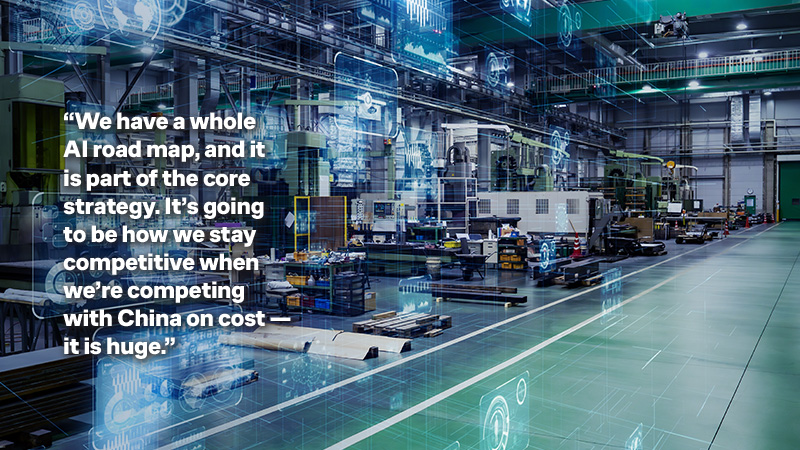
- We have a whole AI road map and it is part of the core strategy. It’s going to be how we stay competitive when we’re competing with China on cost — it is huge.
- I would just say three years ago we had a pretty negative outlook on it. … But in the last year, we’ve found a few great things with it. It’s helping us go through documents faster, so there’s less paperwork, and more time on the floor with people. We put it into some cameras and some testing. It can actually watch heat on bearings and machinery and identify smoke. So safety-wise that’s amazing. …We’re slowly finding ways it can make things better.
- We’ll run the schematic through AI along with our questions that we would ask as part of our QC process. It’s catching things that our engineers aren’t catching.
- I’m a little nervous about it. We’re conservative with how we introduce anything new into the business specifically because 90% of our customers have very stringent NDAs that we sign with them.
- Some of our estimators would spend two, three days just going through a bid package. Now we have an AI tool that consumes it and spits it back out with their to-do list and even does some of the takeoffs. So we’ve gone from eight estimators to four, and we didn’t lay anybody off.
- AI is not free. We’re using it for receivables and payables. The cost to run that software is equivalent to about $10 an hour for an employee.
- I’m getting contracts that are now building in clauses for AI and prohibiting the use of it. … We knew that our government customers wouldn’t let us.
- Do we have a real plan? I wouldn’t say that we do right now. It’s formulating.
- There are machine programming AI tools that may not get you 100% there, but they may program 80% of your part. … It has to be the right fit.
Is it easier or harder than a year ago to find and keep qualified employees, and how much does your company’s culture help?
- Our biggest constraint is labor right now. And I would say if I could hire who I needed to hire in the next three to six months, I could have a fabulous 2027.
- We might be a little better off. We’ve done some hiring of some younger people. We’re doing some training with them. It seems like there’s a little better availability than there was, but that’s a pretty small gain.
- Skilled CNC machinists are hard to come by. We’ve had a lot of people retire, and not many young people are going into the industry. We have a technical college right here, and I believe last year they graduated five or six people from the program.
- The days of having somebody that’s going to work in a manufacturing environment for a 30-year career, I’m convinced it’s no longer going to be the case.
- We’re finding good employees from other manufacturers because they’re overworked, they’re stressed, they have to save the world every day inside the factory they’re working.
- We could probably hire 10 people, but it takes us a year to hire one good one.
- We’ve increased our entry-level wage substantially. There’s not a position around here that doesn’t make 23, 24 bucks an hour. Three years ago, it was 15, 16.
- Our turnover rate was north of 50%. That’s not sustainable. … We’re at roughly 12% right now.
- After the interview, if there’s interest, we’ll say, ’Come on in and spend a day with us.’ We’ll pay them for their time… I would say our success rate with that is about 90%.
- I bet you I’ve had a maintenance technician position open 15 of the last 17 years.
Does your business have a plan or a strategy around succession or exit planning?
- We’ve actually started that a couple of years ago, and it’s very much in place now. We’ve added positions literally for second-tier leadership development. … We kind of know who the next person up is at this point.
- This last two years, in almost every key position we’ve had somebody retire, either from the shop floor or senior person. So we’re feeling it, and it’s been a little rough. We had a pretty good plan, but even so it wasn’t enough.
- Over half of my employees are in their mid-50s or older. I’d like to say we’ve got a great plan behind it, but we just know what the problem is. We don’t know how to fix it.
- We have probably a third of our company that are going to retire in the next 10 years. We have a huge knowledge base that we have to figure out how to effectively replace in a relatively short period of time.
- We have none, and I’m embarrassed to say that. I wish we did. We just don’t have the resources in house to spend time, effort, or energy on that. And so we fight a fire when someone leaves.
- Not really. I just plan on working till I’m 80.
- We had no succession plan, and we started the ESOP journey in January. We just made a big transition to 100% ESOP, and now half of everybody is on their way out … I do wish we would have thought about it.
If you had to do it all over again, would you start your business today? And the second part of that is, would you do it in Minnesota? If no, why not?
- I would absolutely start a business again, but would I do it in the fifth highest-tax state in the union? No.
- I would say there was a time that it would have been a no-brainer, absolutely yes. I would start it and start it here, but with the direction we’ve taken the last, I’d say four years or so, I would consider other options.
- The last, I’ll say five to seven years, I think we’ve taken a bad turn.
- I feel that the priority right now is scary as to what the government thinks of us. We’re just a polluter to them.
- I’m not sure if it would be Minnesota or not. I know we have had calls from other states about locations and economic growth and opportunities.
- Border towns make leaving so easy. You don’t have to move your house or your family and you can stay in the same school district.
- I probably would’ve done it in Wisconsin.
- Tax differences alone can make or break. For some companies with low margins, 9% is a big deal.
- 100% no. There’s not enough business-friendliness here.
- No, because of Minnesota paid leave, and because it doesn’t feel like we have a quality employee base.
- Going back to 1984, I would start the company. Today, definitely not in Minnesota. There are far better places to do industrial manufacturing.
- In some cases I’m the dumbest guy in the world because I just did a major expansion in Minnesota, and the data said I shouldn’t have.
- I would definitely do it again. It’s been a very good life for me. … It is getting more difficult to be in Minnesota with the taxes, although we’re in medical, and the Twin Cities are a hot spot for medical, so being here is a big deal.
- If I could just afford to pick up every punch press and press brake and laser we have and move it over, we would do that. It’s just not feasible.
- I would say Minnesota is good, could be better, but I still think we’re good because I’ve seen worse.
- I probably would not do it in Minnesota, because we’re a border town with South Dakota and Iowa, and the taxation is quite a difference. … South Dakota is trying to woo people all the time, and there are some real advantages.
- Businesses in our town have moved to South Dakota, and it’s the tax advantages. We’re only eight miles from Iowa. … There are advantages and disadvantages, but we’re here and we’re doing it.
Return to the Winter 2026 issue of Enterprise Minnesota® magazine.