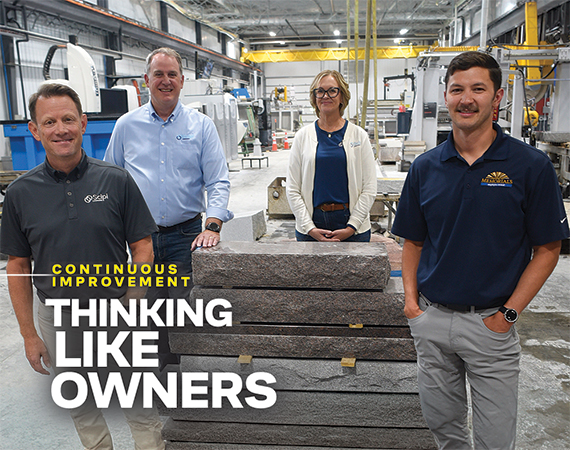
Sunburst Memorials’ new 42,000-square-foot manufacturing facility in St. Cloud is more than twice the size of the nearby plant the firm has occupied since 1917. Inside the new building, material flows efficiently from raw granite at one end to finished memorials at the other. But the building’s most distinctive feature isn’t its size: It’s that the people who work there helped design it.
Before a single shovel broke ground, Dylan Gertken, Sunburst’s director of operations, led his team through four Kaizen events to imagine how each segment of the plant should function. “We leaned on them,” Gertken says. “They’re the subject matter experts.”
That bottom-up, team-driven commitment to continuous improvement has become a defining characteristic of Scipi, Sunburst’s parent company, which is also based in St. Cloud. More than an operational strategy, it conveys a culture built over five decades around a simple, powerful belief: that when employees think and behave like owners — especially because they are owners — many challenging obstacles in business begin to solve themselves.
Surprising Scope
That philosophy extends across Scipi’s unusually diverse portfolio. On its face, it can look like a puzzling collection of businesses. Its holdings include North Central Bus Sales and North Central Upfitting, which sell school and commercial buses and customize light- and medium-duty fleet, commercial, and public safety vehicles; Parts Midwest and Vehicle Personalization of Canada, which sell and distribute OEM vehicle accessories; and Sunburst Memorials, which manufactures and sells granite cemetery monuments. CEO Matt Gaffy, who has been with the company for 33 years, has a practiced way of describing Scipi’s collection of companies: He leads with the transportation and automotive companies, where there’s an obvious thread. He saves the memorials business for last. “That typically raises an eyebrow,” he says.
The tissue that connects Scipi isn’t product. It’s structure. All five companies operate as subsidiaries. Scipi provides shared services in finance, HR, IT, and marketing. Each company has its own president who reports to Jason Klinefelter, Scipi’s COO. And every employee across all of them — bus technicians, granite carvers, warehouse workers, and office staff — is an owner.
Scipi became employee-owned in February 1975, one of the first ESOPs formed in Minnesota after federal legislation created the legal framework. The shift came from then-CEO Don Schiffler, who recognized the opportunity when one of the founding partners retired. It became 100% employee-owned in 2014. With roughly 300 employees, Scipi is among the oldest continuously operating ESOPs in the country.
“It’s been a wonderful thing for people at Scipi for 50 years,” Gaffy says.
The business was founded in 1959 by Ken Gross and Earl Butweiler — “Uncle Earl” to longtime employees — who pooled $500 each to start Earl’s Welding Supply. From that start, Scipi has grown roughly tenfold since Gaffy arrived in the early ’90s, buying and selling companies along the way. The most meaningful acquisition was Sunburst Memorials in 1990, which Gertken estimates comprises about a tenth of Scipi’s overall revenue, but roughly a third of its profitability — a function of its unusual degree of vertical integration.
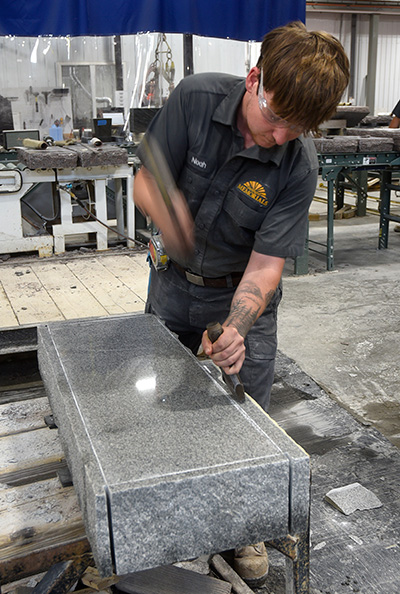
“We’re pretty unique in the industry,” Gertken says. Sunburst controls almost every step of its operation, from sourcing raw stone in quarries across North America, Norway, India, and China, through cutting, polishing, sandblasting, and carving in St. Cloud to 25 company-owned retail stores and 15 installation crews operating across six Midwestern states. “We don’t sell blank headstones,” Gertken says. “Everything gets carved and lettered.” That level of control over product and customer experience is rare in the industry, and it shows in the margins.
Sunburst’s growth strategy sets it apart from other Scipi companies: It acquires family-owned memorial businesses across the Midwest that have been in their communities for generations but lack succession plans. After an acquisition, production consolidates in St. Cloud while the retail operation continues operating under its local name. Gertken says Sunburst aims to add two or three stores per year.
“The plan is that we’re going to be in this facility for another one hundred years, just like the last one,” he says.
Lessons in Lean
With companies separated by geography and market, leaders knew they could benefit from a companywide lean effort. Employees were always invested in the company’s success, but leaders wanted to give them the tools for improvement through lean and continuous improvement.
By the time Klinefelter became Scipi’s COO about two years ago, the company had already learned some hard lessons about implementing lean principles. He had joined Scipi in 2021 after selling the family-owned law enforcement products business he had led for two decades. Years earlier, Scipi had launched a companywide lean initiative, but the effort never gained lasting traction. Different companies got different implementations, buy-in was inconsistent, and momentum faded.
“We didn’t do it strategically,” Gaffy says. “It was just like, let’s do this thing.”
Klinefelter admits he repeated a version of that same mistake early in his tenure. In search of a visible win, he pushed to implement 5S before building support on the shop floor.
“There wasn’t buy-in,” he recalls today. “It didn’t need to come from me. It needed to start from the ground level and work its way up.”
Those experiences reshaped Scipi’s approach. Rather than rolling out an expansive lean transformation, the company distilled lean into practical concepts that apply whether employees work in the granite shop, the bus fabrication shop, or the accounting office. Today, every Scipi employee receives Lean 101 training on the eight forms of waste, 5S, and the fundamentals of process flow. Klinefelter’s goal is to create a common language across the company. “When we speak of waste or efficiency,” he says, “we want everyone thinking about it in the same way.”
From that shared foundation, teams progress into value stream mapping, the cross-departmental exercises in which employees trace how work actually flows, counting every handoff, every redundancy, every step that doesn’t add value. Kaizen events, facilitated with support from Enterprise Minnesota, transform those findings into real-time action. “Without that structure,” Klinefelter says, “it can be a whole slew of talking points that never really get realized.”
Gaffy recalls asking two veteran employees — 50 years at the company between them — to assess a recent round of Kaizens. He expected ambivalence. Instead, “We should have done this years ago. This is amazing.” He pauses at the memory. “It felt good that they were included in the discussion.”
The lean journey has been especially visible at Sunburst. Gertken, who in nine years has worked his way from estimator to director of operations, holds a Lean green belt, a significant achievement in Six Sigma development. The Kaizen process became the mechanism for designing the new plant from scratch rather than simply replicating what had been done for a century. “We didn’t want to duplicate something we were already doing,” Gertken says.
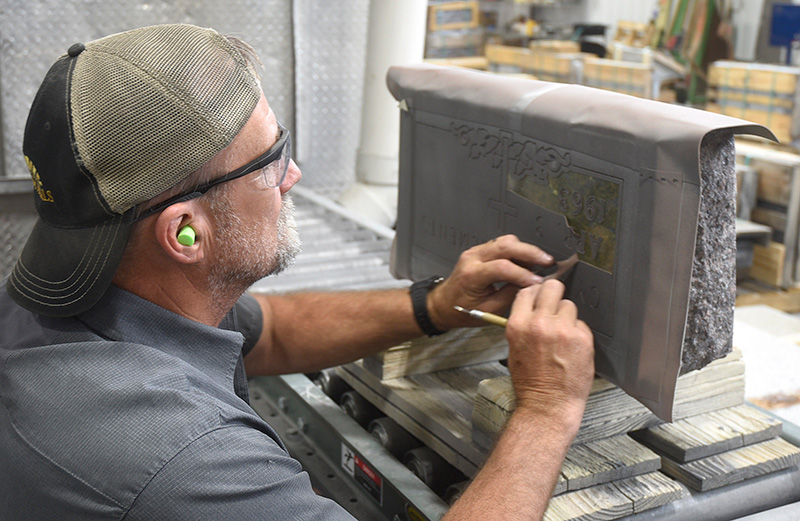
It’s working. Last year, relying on common sense more than technology, Sunburst reduced its shipping lead time by roughly 40%. Instead of waiting to fill a truck before booking a shipment, they extended routes and added more stops, getting products to families faster.
“Our goal is to get the product into the family’s hands as fast as we can,” Gertken says. The company also switched from stacking products directly on truck decks, which required cranes. Instead, they use pallets on a Moffett trailer, allowing faster loading and delivery without crane access. And the new facility’s Kaizen-inspired layout moves material through the plant without unnecessary cross-floor travel.
Gertken is clear-eyed about the value of those improvements. “We knew when we moved in here that we’d be 25% wrong,” he says. A warehouse section that made sense on paper, for example, turned out to obstruct crane access in practice. The team is already planning to move it, with an upcoming Kaizen event planned with Enterprise Minnesota.
The ESOP Changes the Equation
Outsiders might be tempted to conclude that an ESOP makes the road on a lean journey easier to travel. Employees with a personal interest in boosting their company’s bottom line will eagerly address profit-enhancing efficiencies, right? Not automatically, Gaffy says. Successful ESOPs understand the value of building a culture of ownership. It doesn’t arrive automatically. But when it is built, the alignment between ownership thinking and continuous improvement can be powerful.
“If we want our people to think and behave like owners,” Gaffy says, “we have to treat them like owners by empowering them in the position they’re in as much as we can and trust them with confidential information.”
Scipi puts that philosophy into practice. Team members see high-level financials for their divisions monthly; enterprisewide strategic updates circulate quarterly.
At Sunburst, Gertken frames the connection simply. “Lean has two pillars: respect for people and continuous improvement,” he says. “It’s symmetrical with what we already valued as a company before lean. It just helped us live that a little better.”
Newer employees often need time to appreciate the value of Scipi’s ESOP culture.
“People start to get it when they see their first ESOP statement and see the funds put in there at no cost to them. And then they watch it grow,” Gertken says. “It’s not just this mysterious thing. It’s real.”
Klinefelter regularly asks employees to “put on their owner hats” and evaluate processes through the lens of cost and value. At Sunburst, that exercise has a particular texture, since every order is tracked by families served, not as units of production. The company will serve more than 7,000 families this year, he says, most of them in the middle of a loss. “Every stone is going to somebody,” he says. “It will be there forever, representing someone’s life for all eternity. It underscores the level of care we put into our work.”
Building the Team
Scipi’s lean initiative runs alongside a parallel investment in its people. Jen Matzke joined the company three years ago as chief human resources officer after three decades in higher education — most recently as dean of students at St. Cloud State University. She was hired to build something that didn’t exist: visible career pathways, structured development, and a learning culture that employees would value.
The centerpiece is Scipi University, a learning management system with more than 20,000 modules that covers topics from Excel basics to customer service to respectful workplace relationships. Compliance and safety training runs at about 90% completion. Supervisors use a development platform to document performance and build career paths for employees.
Matzke joined Scipi, she says, because she wanted to be part of an organization willing to “break the rules when it made sense” and to make people a priority in decisions. After years of navigating six unions at a university, the contrast is illuminating. “This is wonderful,” she says.
The ESOP philosophy also shapes how Scipi recruits, she says. The company screens for what Matzke calls an “ownership mindset” — the inclination to face challenges by taking ownership of what you can control, rather than blaming external factors. Current employees are among the most successful recruiters, she says, because they understand how the wrong hire can undermine the ownership culture.
“They bring people to the table through referrals who they already know have an owner mindset,” Matzke says.
External validation also helps, she says. Scipi has been named one of the top 200 workplaces in Minnesota by the Star Tribune and last year won the Employer of Choice Award from Greater St. Cloud, both earned through employee feedback, not marketing. “We lead with culture when we’re recruiting,” Matzke says. “And that helps us fill our seats.”
What Comes Next
Scipi’s owner-employees are well aware of the company’s internal goal of a fourfold increase in the ESOP share by the end of 2033. They plan to get there through internal growth and acquisitions. Sunburst has already acquired two companies this year, and Klinefelter says the company is actively searching for a “significant acquisition,” potentially in an entirely new industry.
Lean will play a role. To Gertken, the connection is incremental improvement. “We’re managing cost,” he says, gesturing around the new plant. “That’s why we’re doing all this lean work.”
But there’s more to it than cost management, and everyone at Scipi seems to understand that. Lean, ESOP transparency, Scipi University, and the company’s ownership culture are all expressions of the same belief: that when people understand the mission, trust their leaders, and share in the rewards, they’ll continuously improve the business in ways no top-down initiative ever could. They’ll find and eliminate the waste that others simply walk past. After 50 years as an employee-owned company, Scipi has every reason to believe it’s a bet worth making.
“When we do that well,” Klinefelter says, “many of the other things take care of themselves.”
Return to the Winter 2026 issue of Enterprise Minnesota® magazine.