Minnesota manufacturers’ pessimism about the state business climate continues its march, as business leaders face multiple challenges. Yet even as leaders confront rising health care costs, inflation, and new government regulations, they feel confident about steering their own businesses to success, according to the 2026 State of Manufacturing® (SOM) survey.
Enterprise Minnesota’s 18th annual survey finds leaders statewide navigating their companies through choppy waters. They are calling on their innate innovation, experience with tough times, and perseverance to find a way forward.
Challenges facing manufacturers are coming from predictable places and those that are less familiar. On top of rising health care costs and new benefits requirements, manufacturers are contending with economic and global uncertainty related to the Iran war, taxes, and inflation, especially in energy and raw materials.
“In addition to the consistent, historic headwinds they’ve had in the past — access to labor, the tax situation in Minnesota, some of the legislative mandates around family and medical leave — now you also have market-level uncertainty coming out of the Gulf that is affecting material prices. It makes it challenging for them to plan,” says Mark O’Leary, president and CEO of Enterprise Minnesota.
Still, manufacturing leaders made it clear that they “feel good about their companies’ ability to perform in 2027 and that they felt better about their prospects compared to this year,” O’Leary said. There are still a lot of obstacles, “but manufacturers are exceptional in the way they manage to navigate through them. It’s incredibly impressive,” he says.
Pollster Rob Autry, founder of award-winning Meeting Street Insights, has conducted the SOM survey of 400 manufacturing executives across Minnesota since it began in 2008. Respondents represent a diverse mix of companies by annual revenue, region, and employee count. The SOM captures the pain and the promise of manufacturing in Minnesota, assessing the current sentiment in areas like economic confidence, growth, supply chain, and workforce.
A random sample of executives participated in the telephone survey, including owners, CEOs, COOs, CFOs, vice presidents, and managing officers. The SOM also completes an oversampling of 50 leaders in each of the six McKnight Initiative Foundation regions. The survey has a margin of error of ±4.9%. Enterprise Minnesota paired this year’s polling research with eight focus groups conducted around the state, where manufacturing leaders provide context and a deeper understanding of their views on their industry.
The survey informs decision makers in government, business, economic development, and education about the industry’s health, opportunities, and obstacles to growth. It also provides a bullhorn for manufacturers — one that leaders should listen to, says Lynn Shelton, Enterprise Minnesota vice president of marketing and external affairs. Manufacturing is a growth engine for the Minnesota economy, contributing $50 billion annually and providing high-wage, stable careers.
“You can’t manage what you don’t measure. For 18 years we have given Minnesota’s small and medium-sized manufacturers a voice. It’s not a guess — it’s real data from the people making payroll and products every day,” Shelton says. “When hundreds of manufacturing executives echo the same theme year after year, it’s pretty powerful.”
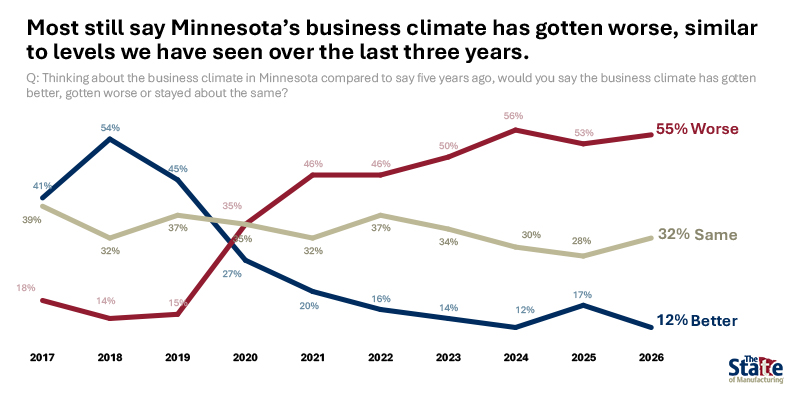
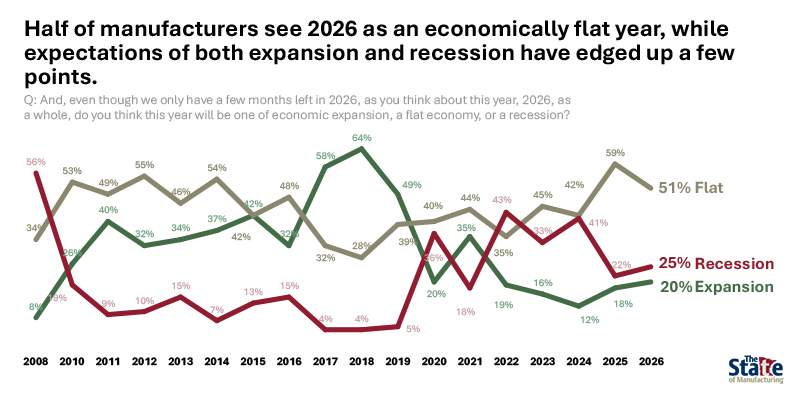
This year, the SOM found that 55% of respondents believe the Minnesota business climate has gotten worse, up two points from last year. A shrinking number of manufacturers think that the state’s business climate is getting better, dropping to 12% in 2026 compared to 17% last year. This year, 32% find the business climate the same, four points more than last year. The number of manufacturers who believe that the economy will be flat shifted in 2026 to 51%, down from 59% last year. One-quarter expect a recession in 2026, while 20% anticipate economic expansion. Both metrics are up slightly from the 2025 survey, when 22% predicted a recession, and 18% anticipated a year of economic expansion. Respondents are feeling even better about 2027: 31% predict that the economy will be in expansion mode, 36% think it will be flat, and 25% still anticipate a recession.
Individual confidence rises
Despite pessimism about the state’s business climate, manufacturers feel confident about their own businesses. This year, 88% are confident in the future of their companies. Manufacturers’ strong assurance in their firms has been a consistent aspect of the SOM during its 18-year history, says Autry.
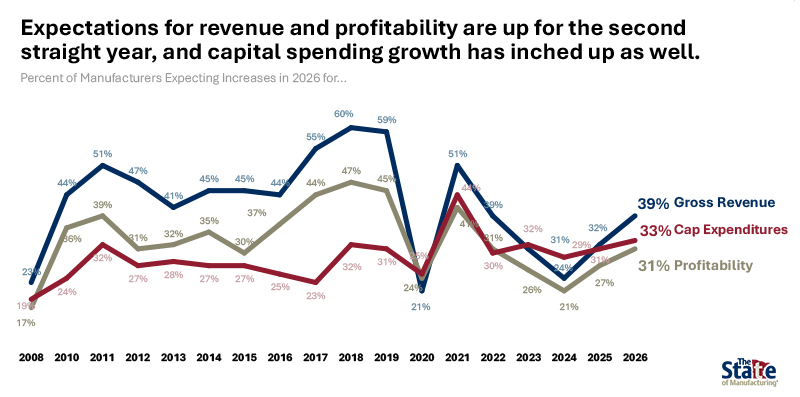
Autry notes that despite economic pressures, manufacturers anticipate jumps in gross revenue and profit. That’s an indication that they have learned to adjust to inflation, tariffs, and rising health care costs — all consistent problems in recent years. “These issues aren’t new to them,” Autry says. “Despite the choppy waters, manufacturers seem to feel like they have a pretty good handle on it.”
Respondents are bullish on their own companies’ prospects for more revenue and profitability this year, including 39% who expect revenue growth. Two years ago, just 24% predicted revenue growth, so 2026 metrics represent a 15-point jump. Expectations for profitability grew 10 points, from 21% in 2024 to 31% in 2026. As for plans for capital spending, 33% anticipate an increase compared to 29% two years ago.
Other encouraging signs have emerged. Fewer manufacturers expect revenue decreases in 2026 than at any time since early 2020, dropping from 48% in 2020 to 17% this year. “There is more optimism and less pessimism,” Autry says. “In 2025, just as many people thought they would see an increase as a decrease. This year, by a 22-point margin, more expect to see an increase.”
Large manufacturers are driving that confidence, with 61% feeling upbeat about their potential to grow revenue, compared to smaller companies at 35%. Similarly, 43% of larger companies are confident that their profits will increase, compared to 28% for smaller companies.
Tariffs are one consistent challenge that manufacturers nonetheless feel they can meet successfully. Across the state and among manufacturers of all sizes, 82% are confident, including 38% who are very confident, about handling the current tariff and trade environment. Currently, 60% are passing on tariff-related costs to customers, and 52% are increasing their sourcing from domestic suppliers. Some manufacturers are even benefitting from other companies’ reshoring efforts, O’Leary says.
Regulatory pain
Manufacturers are still reeling from paid leave laws that went into effect in 2024 and 2026. Eight in 10 businesses agree that the mandates have impacted them. Regarding family and medical leave, 85% say that the policy negatively affected their business. Of those respondents, 38% report that it had a major impact, while 47% note a minor impact. A total of 80% indicate that the new sick and safe time policy affected their companies, split evenly at 40% between a major and minor effect. Three-fourths of respondents report that the new benefits policies make Minnesota a less attractive place to do business, including 51% who call it much less attractive; in Greater Minnesota, 82% of manufacturers think the requirements make Minnesota less attractive.
These laws are a prime example of the “death by 1,000 cuts” that state leaders are inflicting on the industry, making it difficult for manufacturers to thrive, Shelton says. Adding insult to injury, manufacturers believe that legislators don’t consult enough with the industry on how such changes will affect them.
“Every new mandate that is passed by the Legislature is a headwind challenge for manufacturers and an invitation to other states that are trying to attract our companies,” she says. “There is well-meaning policy, but they aren’t getting input from manufacturers about them.
Inflation and hiring woes
The top two challenges to growth that manufacturers cited last year remain the same: the increasing cost of materials and attracting and retaining a qualified workforce. The unfavorable business climate and health care costs ranked third and fourth again. Small and medium-sized manufacturers feel the pain of price spikes in materials the most. Manufacturers with more than $5 million in revenue are most impacted by employee hiring and retention struggles.
However, respondents did note less concern about workforce issues than in years past. In 2026, 41% report challenges with hiring and 33% with retention. Hiring difficulties have remained relatively steady, while retention saw a five-point increase in concern compared to last year. Hiring overall has edged up slightly in 2026, with 49% actively hiring compared to 47% in 2025. But most manufacturers have only a small number of jobs open, at 1 to 5% of positions.
Autry highlights another indicator in hiring: The share of employers who find it very difficult to attract and hire staff (32%) has declined 23 points from 2021 to 2026. Still, 81% of respondents found it difficult to staff their businesses.
Adopting automation and AI tools isn’t top of mind for many manufacturers. This year, 42% are not considering adding automation technology. High up-front investment is the main barrier to integrating automation at their businesses (38%) followed by a lack of internal technical expertise (21%) and the difficulty of integrating new technology into their existing systems (20%). Overall, 69% are concerned about adopting AI, mainly due to worries about privacy, cybersecurity, and data governance issues (36%).
Autry says interest in adding AI or automation may have stalled this year because smaller companies don’t have the bandwidth or expertise to experiment with new technologies.
Return to the Winter 2026 issue of Enterprise Minnesota® magazine.