Minnesota’s small and mid-sized manufacturers share an election-year frustration: They often don’t know where candidates actually stand on issues that could affect the prosperity of their companies and their employees’ jobs.
This fall, Enterprise Minnesota is trying to close that gap. The organization is asking candidates for the Minnesota Legislature, governor, and Congress to respond to a manufacturing-specific questionnaire and go on the record about the economy, workforce, taxes, regulation, and the skilled-trades pipeline that keeps the state’s manufacturers running.
The 16-question document doesn’t ask candidates to endorse any particular policy position. It asks something more basic: What do you actually believe, and will you put it in writing?
Lynn Shelton, Enterprise Minnesota’s vice president of marketing and external relations, says many manufacturers have learned in recent years that they don’t have the luxury of guessing how deeply elected officials understand their industry. Before joining Enterprise Minnesota, Shelton spent years working at the senior-staff level in state and federal policy and politics. She knows firsthand that the gap between campaign rhetoric and legislative behavior can be significant.
“Campaign flyers invariably claim that candidates are ‘pro-business,’ pledging support for ‘a strong economy’ or ‘good jobs,’” she says. “That’s not information a manufacturer can use. We’re asking for specifics: How do you feel about the state’s competitiveness on energy costs? Do you think Minnesota’s new paid leave law recognizes that a machinist can’t just log in from home when they’re out? Will you talk to manufacturers in your district before you vote on something that changes their cost structure overnight? Those are relevant questions, and manufacturers deserve answers.”
Why a Questionnaire?
The timing is not accidental. Manufacturers are now operating under Minnesota’s Paid Leave program, which took effect in January. The questionnaire asks candidates directly about its financial, administrative, and scheduling impact on small manufacturers, which often cannot redistribute production work, allow an employee to work from home, or quickly replace a skilled welder or machinist mid-shift.
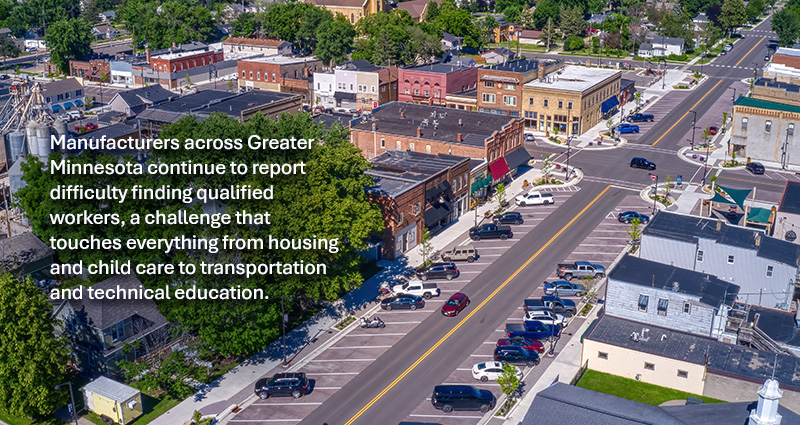
At the same time, manufacturers across Greater Minnesota continue to report difficulty finding qualified workers, a challenge that touches everything from housing and child care to transportation and technical education.
Enterprise Minnesota’s questionnaire treats those two realities — a new employer requirement and a persistent labor shortage — as part of the broader question of whether Minnesota is becoming more or less competitive as a place to make things. It asks candidates to identify the two or three state policies they believe would most encourage manufacturers to expand in Minnesota rather than elsewhere. It also asks them to consider tax, regulatory, energy, infrastructure, and workforce policies as an interconnected system rather than a collection of unrelated issues.
The questionnaire also asks whether Minnesota’s K-12 schools give students enough exposure to manufacturing and skilled-trades careers, and whether the education system has placed too much emphasis on four-year degrees while giving too little attention to apprenticeships, technical colleges, and industry credentials.
“This isn’t a gotcha exercise,” Shelton says.
“We’re not trying to trap anybody or manufacture a controversy. What tends to happen, honestly, is that a lot of candidates haven’t been asked these questions in this level of detail. Their answers can be clarifying for them, too. That’s a different exercise than talking about jobs in the abstract.”
In her 25 years at Enterprise Minnesota, Shelton has helped manage nearly 500 tours that bring legislators into manufacturing facilities in their districts. She says she is frequently surprised by how much elected officials learn during those visits — and “how grateful they can be for new insights.”
Beyond the questionnaire itself, Enterprise Minnesota is asking candidates to sign a set of 10 commitments. They include meeting regularly with a manufacturing advisory group in their district, visiting local manufacturing facilities, seeking input from small employers before voting on legislation that imposes new costs or mandates, and supporting reviews of major employment legislation after it takes effect to identify unintended consequences. Candidates are also encouraged to attend one of Enterprise Minnesota’s State of Manufacturing® events, scheduled across the state in November and December.
How Enterprise Minnesota Will Handle the Answers
As a nonprofit corporation, Enterprise Minnesota does not endorse political candidates. Instead, it plans to use the questionnaire as a transparency tool so voters — and manufacturers in particular — can see where candidates stand in their own words.
“Our job isn’t to tell anyone how to vote. It’s to make sure the information exists in the first place,” Shelton says. “These responses are a good way for a plant manager in Greater Minnesota to know which candidates understand what it takes to run a production floor or to market goods in increasingly complicated international markets. We’ll circulate the answers to manufacturers so that they can read a candidate’s own words on paid leave, on workforce policy, on tax competitiveness, side by side.
“We’ll also use the information in aggregate. If we get responses back from candidates across the state and see, say, that housing availability keeps coming up as the barrier candidates most want to address, that tells us something important about where the Legislature’s attention might actually be next session.”
Enterprise Minnesota has also built accountability into the process beyond Election Day. The commitments candidates are asked to make — regular manufacturing company visits, consultation with a district manufacturing advisory group, and reviews of legislation for unintended consequences — would give manufacturers a set of benchmarks they can revisit after the votes are counted.
How Manufacturers Should Handle the Answers
For manufacturers, Shelton is direct about the ask: Read the answers, and use them.
“The responses are only as useful as what manufacturers do with them,” she says. “That starts with something simple — actually reading what your own legislative candidates said, not just the ones running statewide.
“Share it with your leadership team. Talk about it at your next chamber meeting or manufacturing roundtable. If a candidate is committed to visiting local facilities or consulting a manufacturing advisory group, invite them. And candidates who don’t respond to our questions are also providing valuable information.”
Shelton says the questionnaire is a starting point for relationships that manufacturers can build independently of the election calendar. A candidate who commits to visiting manufacturers in the district, she notes, is opening the door to an invitation that can be acted on immediately — giving that candidate an opportunity to see a shop floor firsthand rather than encountering the industry only through committee testimony.
“The questionnaire is a modest attempt to change the dynamic for an industry that spends most election seasons on the receiving end of policy rather than at the table shaping it,” Shelton says.
“Manufacturers tell us they frequently feel invisible in these conversations, even though they’re the ones creating the jobs and paying the taxes that fund the things everybody’s debating,” Shelton says. “This is one way of making sure we’ll have their answers on the record — and so will every manufacturer in their district.”
Enterprise Minnesota also plans to use the questionnaire results to add context to discussions at this fall’s State of Manufacturing® events.
Return to the Winter 2026 issue of Enterprise Minnesota® magazine.