Bob Kill, president of Enterprise Minnesota for the last 18 years, suspects the late Rudy Perpich wouldn’t recognize the offspring of the lottery-funded agency the former governor created to support rural Minnesota businesses. Today’s Enterprise Minnesota, a lean and focused organization that helps manufacturers improve specific areas of operation to grow profitably, grew from the remnants of the Greater Minnesota Corporation, shuttered in the wake of scandal in the late 1980s.
Originally called Minnesota Technology and then rebranded as Enterprise Minnesota, the early years presented a turnaround challenge for the ages as the agency lost funding and drastically cut staff. The organization pivoted by both narrowing its focus to manufacturing companies and broadening its geographic reach to include the Twin Cities Metro area.
Kill is quick to give credit to others for Enterprise Minnesota’s revival, noting that three of the organization’s leaders — John Connelly, Lynn Shelton, and Pat Vasatka — were already on staff and working on the rebirth when he arrived. Still, he led the charge. Early on, he knew that Enterprise Minnesota shouldn’t limit its role to providing top notch consulting services, though that was a top priority. He also wanted Enterprise Minnesota to increase manufacturing’s visibility and to connect manufacturers with each other and with what he calls the “manufacturing ecosystem,” including community and technical colleges, policymakers, economic development organizations, and professionals such as CPAs and attorneys.
As he prepares to hand over leadership of Enterprise Minnesota to its second president, Kill took some time to reflect on the organization, manufacturing’s importance to Minnesota, and his hopes for its future.
What were the first steps in the transformation of Enterprise Minnesota when you took over as president?
Kill: We needed to change our image and increase visibility. One of the first things we did was change the name, “Minnesota Technology.” Tom Mason [long-time Enterprise Minnesota magazine editor and consultant to the organization] said we needed to blow up the name Minnesota Technology. I was only a board member at that time, but that’s what we did.
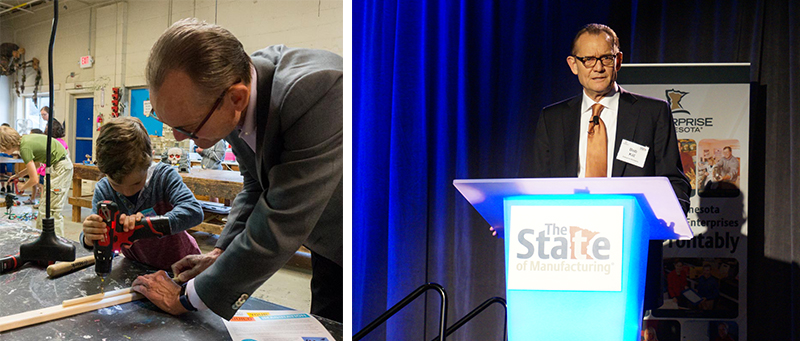
The State of Manufacturing® survey [Enterprise Minnesota’s annual survey of the state’s manufacturing industry, highlighting the trends, conditions, and outlook of executives from around the state] was important early on because it was designed to build a wider recognition, understanding, and support for the value of manufacturing to the state. Most people outside of manufacturing didn’t recognize it as the job creator that it is. That was really the goal — to shine a light on manufacturing. Secondarily, it was to position us as the voice that helps bring visibility to manufacturing and to connect manufacturers with each other and those organizations that support them.
I don’t think we knew how much impact the survey would have, and how important it would become over the years. It really has exceeded our expectations. Right away we realized that people wanted to come to the event, and manufacturers wanted to be heard in focus groups.
Why did manufacturing warrant a separate survey?
People don’t know as much about manufacturing as they think they do. They don’t understand the economic value of it. Minnesota has about 7,300 manufacturers; 50% of them have fewer than 10 employees, 85% have under 50.
Fourteen percent of the wages in Minnesota come from manufacturing. The industry pays an average of almost $79,000 a year, well above the statewide average.
Manufacturing doesn’t just provide good jobs. It creates very positive ripple effects across the economy. The National Association of Manufacturers estimates that every dollar spent in manufacturing generates another $2.70 in economic activity.
Those facts aren’t widely known. Even now, when I present them, I watch people scribble them down because they’ve never heard them before.
Manufacturers tend to disappear into their nondescript buildings scattered across the state, but what they’re doing is critical to us all. So, when the survey shows the challenges and opportunities that confront manufacturers every year, it implicitly reveals the real value of manufacturing.
How has the survey maintained such a strong reputation through 17 years? How does it not get old?
A big part of that is that we just keep improving it. We realized early on that regionalizing the data increased its value. Our pollster oversamples in the six regions covered by the Minnesota Initiative Foundations [six independent regional foundations established by the McKnight Foundation to strengthen economies and communities across Greater Minnesota] so we can see how manufacturers’ concerns break down along geographic lines.
That gave us richer data, and it also enabled us to attract stronger partners. We quickly found that the majority of the Initiative Foundations wanted to partner with us, and they have been with us for years.
We also track trends over time, which is enormously valuable. You can now look back over 17 years of data, with regional breakouts. People look forward to seeing how national and global events have affected some sectors of manufacturing and not others because different industries cluster in different parts of the state. This year, for example, you could see how tariffs impacted some areas, and barely touched others.
A big reason the State of Manufacturing has retained — and grown — its credibility is that we hold strict standards. This is not a fly-by-night phone-in poll. From the beginning, we’ve worked with Rob Autry, whose firm Meeting Street Insights, based in Charleston, S.C., is among the nation’s top pollsters. He’s been with us the whole time. He and his team are meticulous about reaching a statistically accurate cross-section of manufacturers.
And it won’t surprise anyone that a survey comes with a hefty price tag — far beyond anything we could underwrite on our own. That’s why we’re so grateful to the many sponsors who have been with us for the long haul. And we get way more than their money. Our sponsors interact with manufacturers at our rollout events and play a significant role in shaping the questionnaire each year, which keeps it relevant.
How has the survey helped build connections among manufacturers and between manufacturers and the organizations and professionals that support their companies?
The in-person events — a big data release in November, the regional rollouts, and the focus groups — bring manufacturers together in a way nothing else really does.
These events have been critical to building a community of manufacturers. We realized early on the value of giving manufacturers the space to actually talk to each other.
Manufacturers now look forward to these events as a chance to reconnect and make new connections. There’s real energy in the room. Two manufacturers might strike up a conversation and discover that one makes a part the other needs. Or one has experience taking over a family business and can share that insight. Another might meet an economic development professional who has a grant that turns out to be a good fit.
Manufacturers also seem to enjoy participating in our focus groups. We usually have six each year in different parts of the state. They are confidential, and their comments are reported anonymously, but I’m still amazed at how candid the participants are with each other. It gives them a clearer sense of what others in manufacturing are concerned about — and how they’re handling the same challenges.
How has the consulting side of Enterprise Minnesota changed over time?
Originally — back under the Greater Minnesota Corporation — consulting was offered at no cost to clients. The organization was already transitioning to a fee-based model before I got here, based on the belief that companies need some skin in the game. I give credit to the people who started that transition by initiating those first steps when it was called Minnesota Technology.
Some of the employees left because they didn’t like the move from free to fee-based services. And around that time, they became an MEP center, which provided some federal funds. [MEP, the Manufacturing Extension Partnership, is a national program that helps small- and medium-sized manufacturers access customized services, expertise, and resources to help them improve productivity, grow, and innovate.]
When I arrived, our services were pretty basic. We focused mostly on continuous improvement — value-stream mapping, 5S — and had one employee who specialized in helping companies get ISO certified.
Since then, we’ve added a wide range of services, including strategy and revenue growth, and we launched our peer councils. But I think the most important improvement isn’t in what we offer but how all of our consulting is based on an appreciation for people. Early on, lean and continuous improvement were treated as tools. They are much more than that, and it’s not just about cutting costs. They represent a culture shift. They’re more about making organizational resiliency a core part of profitable growth.
Manufacturers can talk about new revenue and new customers, solid metrics, continuous improvement, and lean principles — but what’s critical is engaging people. Lean was designed so that the person closest to a problem becomes part of the solution. That means everything we do has to be about culture.
Does the State of Manufacturing survey help shape the specific consulting services offered?
Our focus groups always ask what manufacturers should be doing. So, if manufacturers are looking for new suppliers, we’ll ask what those suppliers need to do to get their business. We share that information with our clients, and our consultants can offer services that help them meet those requirements.
Training is a good example. As an organization, we’ve shifted from training to skills development. Training is individual, and every company has some of it. But we focus on skills development — showing manufacturers how to help their employees build capabilities that help make the whole operation better.
And when we bring lean into an organization, we emphasize problem-solving skills. Employees learn how to approach a situation with a different mindset. They aren’t just learning to repeat the same tasks more efficiently; they’re learning how to think differently about the work.
You often praise the relationship between the technical and community colleges and manufacturers but point out it hasn’t always been that rosy. Did Enterprise Minnesota play a role in connecting them?
Twenty years ago, people who should have known better were saying manufacturing was dying. Technical colleges were worried about whether they could even keep their manufacturing programs alive. The assumption was that everything was going overseas, and that kind of talk hit the colleges hard. Many of those programs were barely hanging on.
At that same time, technical colleges and manufacturers seemed to be talking past one another. The colleges would say that manufacturers didn’t appreciate them, and manufacturers would say that the colleges weren’t providing the training they needed.
Then two things changed the conversation. Politicians started talking about the importance of manufacturing and bringing manufacturing back to the U.S. And parents started to realize that four-year degrees weren’t necessarily getting their kids out of the basement.
I like to think we played a small part in bringing the colleges and manufacturers together in Minnesota and helping them see they needed to work together to educate the next generation of employees and help the industry grow. The State of Manufacturing® survey brought visibility to the colleges because they sponsored events and hosted focus groups.
The situation today is completely different. Because technical colleges now work closely with their manufacturers, they’ve built stronger curricula and their students and graduates are landing good manufacturing jobs.
Communities, including parents — and now high school teachers and counselors — have started to embrace it, too. They’re realizing that their local technical college gives young people a better chance of staying close to home, employed in rewarding, well-paying careers with real, long-term potential.
It also matters that we’ve had some great technical college presidents along the way, and that’s made a big difference. We win new friends one at a time, and not everyone has patience for that. But these presidents are good at building connections, listening to manufacturers and what they need, and it’s paying off.
There seems to be a growing positive feeling about manufacturing jobs. What’s behind that trend?
Manufacturers have lived through several swings. Right now we’re in the middle of a surge in manufacturing investment and a growing awareness that manufacturing jobs are good jobs.
Part of that is a shift in how people perceive manufacturing jobs. For a long time manufacturing was considered boring, repetitive, and dangerous. People pictured poorly lit, dirty buildings where employees sat at the same machines and made the same parts until they retired.
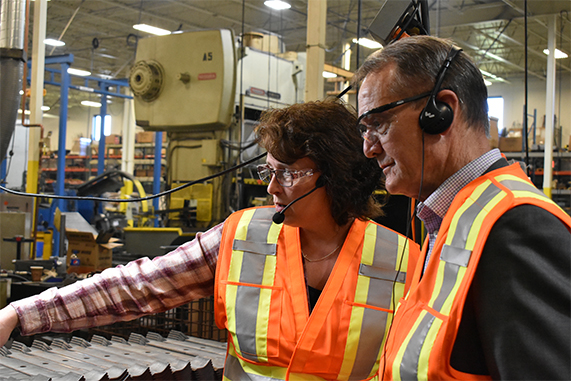
I think we have played a part in dispelling this myth in Minnesota by shining a light on what really happens inside these facilities. Manufacturers have worked with us to host hundreds of tours for elected officials and community leaders, and they are always very willing to be featured in this magazine. They want to show that they operate clean, well-lit, and modern facilities.

Another important change is that manufacturers are giving their employees more and more authority to assess situations and solve problems. Leaders are realizing that when they empower their workers, their businesses operate more efficiently and profitably. For employees, the opportunity to tackle those new challenges each day makes their jobs exciting and meaningful.
I always say that a good company is one that employees brag about at family gatherings. That happens at a lot of our manufacturing companies — and they end up hiring a lot of family members because of it.
And finally, people are beginning to understand that the first job in manufacturing doesn’t have to be the end of the journey. When manufacturers hire a young person who is really good at it, they want to keep that person energized, so they give them more responsibility or help pay for additional classes. Employees understand that there is opportunity to grow.
I have to say, if I were 40 and lost my job in an office today, I would think about what I could study at a technical college so I could get back into the workforce — in manufacturing.
How will technology impact the future of manufacturing jobs?
Manufacturers realize that automation keeps workers longer. It doesn’t replace people; it replaces repetitive or unsafe tasks. Yes, there are jobs that you may not need anymore. But in manufacturing, automation is attracting a new breed of young person, someone who looks around and says, this isn’t what my grandpa told me about manufacturing.
Employees will start realizing that when new technology is introduced thoughtfully, they will find opportunities to grow and get better within their organization.
And to take this back to the topic of technical education, I think that shift is drifting down into middle and high schools.
We have a number of new high schools in the state where local manufacturers played a big part in designing the new building. The first one was in Alexandria, about 11 years ago. You can’t get through the front door without seeing the advanced manufacturing area. And they promised to keep it current by updating the equipment every two years.
There are now similar new high schools. It’s taken time, but everyone is working together because they understand that the technology needs to be current, and instructors need to understand not just how a machine works, but how it solves problems.
What do you think the future holds for Minnesota manufacturers?
There was a time when manufacturers could just make things. Today, running a manufacturing business is more exciting — and a lot more complex. They don’t just make products anymore. Competition is everywhere: They have to be marketers and leaders. They have to embrace technology.
But I also think there’s less fear among manufacturers today than there was 20 years ago. We build quality products here. The reputation of U.S. manufacturing is sterling, especially in the Midwest. There’s an appreciation for it. I think manufacturing’s in a better position today than it was two decades ago.
Back when people were saying manufacturing was going to leave the U.S., we didn’t distinguish low-volume precision parts from high volume, non-value add parts. We just lumped all manufacturing together. And things went overseas that shouldn’t have. Today, we’re much more thoughtful about that. When it comes to low-volume, high-precision work, we want to make those parts closer to home.
We’re starting to think about how to manufacture locally because if something goes wrong, you can control it better when it’s a few hours’, or even a two-day, drive away, rather than a flight halfway around the world. That’s a different kind of manufacturing, and there’s a lot about it that attracts young, smart people.
The younger people we have in our peer councils are dynamic executives, and I think they’re going to be very successful. They’re willing to try things that the generation before them maybe wasn’t.
Minnesotans are sometimes reluctant to say when something’s successful. But in this case, the State of Manufacturing and the magazine have helped manufacturers realize that there’s a lot of interest in what they do. I think it’s brought some pride back to manufacturing and it will be stronger in the future because of that.
Return to the Spring 2026 issue of Enterprise Minnesota® magazine.