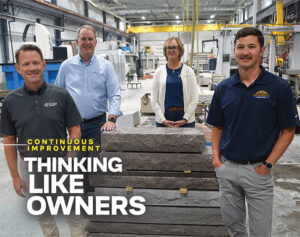
Born from the waste of a company that made municipal skateparks, Duluth-based Loll Designs has figured out how to even out the swoops and downturns inherent in the outdoor furniture business. They’ve done it by moving into steadier commercial markets, building their sales force and managing manufacturing processes and workforce for greater efficiency.
Formed in 2006, Loll’s founders designed and built municipal skate parks using high-density polyethylene (HDPE) from recycled milk jugs. They had a lot of No. 2 plastic waste and from it created extremely durable outdoor chairs. “We joke that not only are we in the land of 10,000 lakes, it’s the land of 10 million Adirondack chairs,” says Eric Swanson, Loll president, who joined the firm in 2021 when it was acquired by Michigan-based Landscape Forms, Inc., a manufacturer of outdoor furniture, lighting, and decor.
The acquisition came at a turning point for Loll, a startup that emphasized fun design, sustainability, and custom manufacturing of its tables, couches, seasonal decor, and other items. Its name came from “lollygagger,” expressing the firm’s creative energy. “We were really good at the front end of the business — design, sales, marketing,” says Nate Heydt, vice president of sales, an original Loll employee. “Landscape Forms provided the resources and know-how to help us move from a made-to-order business to a shipping-from-inventory business.”
Going Commercial
In the consumer outdoor business, May is the month that matters. Loll ships four times as much product then than in January. With a focus on mostly residential sales, that seasonality meant the company had to hire and train extra workers every spring or burden its permanent staff with lots of overtime. It also created a revenue stream that crashed every fall.
To smooth out sales, the company began selling directly to hotels, schools, colleges, and multifamily housing builders. Over a few years, commercial sales grew from 15% to 40% of revenue. Bringing the sales function for commercial in house required increasing staff to develop a sharp direct-mail program, adding about 30 independent sales representatives, and cultivating relationships with interior and exterior designers who promote Loll’s products. “Scaling up was the biggest challenge. But right out of the gate, it resonated with our customers to have a direct relationship with us,” Swanson says.
It also meant changing how products are manufactured and shipped. “We had to rethink what our inventory strategy looked like, what our SKU-level forecasting looked like. In building inventory, our manufacturing team has been able to create new efficiencies in products and materials,” Swanson says.
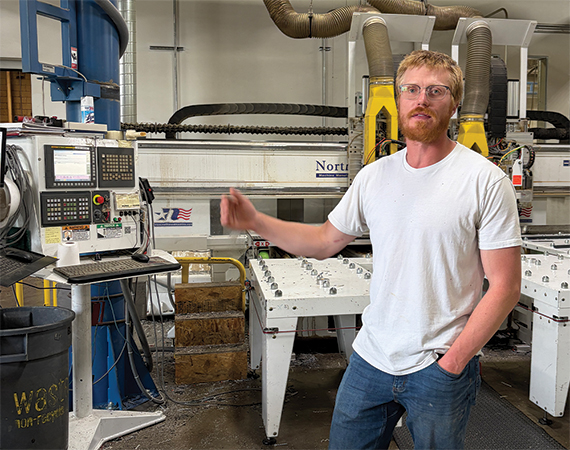
The company currently runs three shifts in its CNC shop year-round, with some of its six machines dedicated to cutting the same part faster than before. With a more automated process, one operator can run two machines. Parts are more frequently nested in each sheet of HDPE, reducing waste and improving production speed.
With the increase in output, Loll has maintained over 98% on-time performance, says Kyle Blood, manufacturing operations director. But hiring and training employees has been a challenge. Loll has stepped up its recruitment efforts, standardized onboarding and training programs, and aggressively cross-trained employees.
The company is reaching out to local universities and technical schools, and it attends events like career fairs to build a pipeline of workers, especially in areas like engineering, which have been a challenge to fill.
New employees go through a detailed four-week onboarding and training program. “Because we track output and efficiencies closely, we know what an average rate of learning looks like,” Blood says. “That allows us to provide early feedback and get ahead of any issues they are having.” The program has led to a lower percentage of new hires remaining at 90 days, but those who get through it are more likely to stay for several years.
Loll also has focused on cross-training to manage seasonal shifts. For instance, shipping department workers typically aren’t as busy after the summer rush and can move into assembly, CNC, or other areas. To encourage cross-training, the company developed an incentive program so workers can receive a pay increase. “For those who really go for it, they could have a 25 to 30 percent hourly rate increase over a couple of years,” Swanson says. “If they are cross-trained in a number of areas, the employee becomes much more valuable to us.” The program has been so successful in the shop, the company is working to implement cross-training in the office as well.
Built on Sustainability
Loll’s focus on sustainability carries over to the commercial market. “It’s in our DNA,” Heydt says. “One of the most important components in sustainability is how long after you ship a new product does it exist in the world.” Plastic lasts nearly forever, so Loll designs its parts to be replaceable. If a dog chews an arm on a chair, the customer can replace the arm rather than the chair.
“To me, that is a really big sustainability factor,” Heydt says. “And, let’s be honest, it’s a value driver too.”
Recycled materials make up 25% to 80% of each product. Pallets are reused, and heat generated in one part of the 110,000 square feet of manufacturing space is redirected to warm other parts of the building. Loll has earned sustainability recognition including Cradle to Cradle certification and a gold certification from Total Resource Use and Efficiency (TRUE), a zero-waste certification program of the U.S. Green Building Council. The company conducts a waste audit each year and discovered 89% of its waste is recyclable.
“Right now, the biggest culprit is pizza boxes,” Swanson says.
Return to the Winter 2026 issue of Enterprise Minnesota® magazine.