Many manufacturers turn to continuous improvement and lean manufacturing to operate as efficiently as possible. But small- and medium-sized manufacturers often lack that expertise in house — losing potential for operational gains or a cushion to carry them through rough times.
Enterprise Minnesota and the Little Falls-based Initiative Foundation wanted to change that by offering a workshop for area manufacturers. In early May, the organizations hosted Lean sessions for central Minnesota manufacturers with fewer than 150 employees.
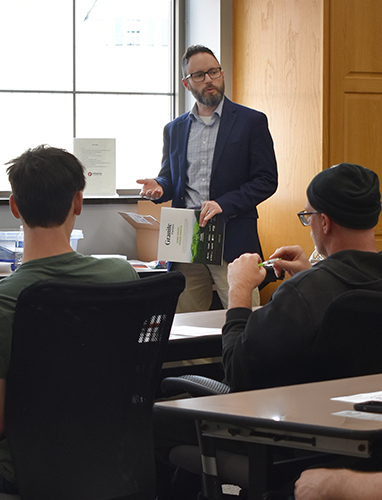
The Initiative Foundation reached out to Enterprise Minnesota to partner on the workshops, aiming to advance its mission to foster thriving economies and communities in its 14-county region, says Donniel Robinson, entrepreneurship programs manager at the Initiative Foundation.
“Small manufacturers are very core in our region, and they help with economic stability and provide good-paying jobs,” Robinson says. “Lean principles help small- and mid-sized manufacturers work smarter, not harder. We want to help them improve their bottom line through efficiency.”
The Initiative Foundation provided a grant that let manufacturers participate without cost, removing the financial barriers that might prevent small- and medium-sized manufacturers from participating in training opportunities.
Robinson teamed up with Andrew Busta, a business development consultant at Enterprise Minnesota, to design the workshop. Together, they created the half-day workshop called Lean Principles in Practice: Lean Fundamentals for the Modern Manufacturer.
Quick hits
Enterprise Minnesota and the Initiative Foundation sought to provide information and insight on lean manufacturing that employees could bring back to their companies and implement on the production floor. “We want to get lean into the bones of the organization if it’s not already thinking lean,” Busta says.
The partners targeted the half-day sessions to production teams, front-line leaders, and supervisors with any level of experience in lean manufacturing. They asked manufacturers to send at least two people to the workshops so employees could work together to put their new knowledge into action, Busta says. All told, nearly 80 people attended.
Focusing on inefficient processes and waste with production teams gave participants an immediate return on investment. “Some initiatives that work to increase efficiency have a longer timeline to come into fruition, where this simple and quick workshop sends people home with same-day action items,” Busta says. “Companies can see immediate, palpable results on a day-to-day basis.”
That objective came true for Josh “Willy” Willenbring and Nicole Seybert of Create a Legacy, a 128-year-old Little Falls company that makes memorials for individuals, cemeteries, funeral homes, and monument dealers. Seybert and Willenbring attended one of the Lean Principles workshops in the morning. By that afternoon, they were meeting with co-workers to discuss ways to incorporate some of these practices at Create a Legacy.
“The workshop was mind-blowing,” says Willenbring, company president, who heard about the opportunity at a meeting of his Enterprise Minnesota Peer Council. “We both had a pile of takeaways. It was a big eye-opener.”
They realized the importance of getting employees involved in any continuous improvement initiative, Willenbring says. He saw that a team’s hands-on engagement helps ensure that the changes last.
Willenbring and Seybert, who has recently stepped into a role focused on continuous improvement, already had started bringing the company’s lean work in house instead of relying on outside experts. They continue to call on the workshop’s lean concepts as Create a Legacy implements changes. Currently, the team is redesigning its purchasing and inventory processes and remaking its yard to incorporate a more efficient flow of materials.
In the past, the company hired consulting engineers to create a lean plan. The consultants would inform employees how to roll it out without really engaging them. “It caused confrontation and conflict. By the time they left, it just never happened,” Willenbring says.
Thanks to the lean workshop, Willenbring and Seybert now see the value of integrating staff in all aspects of lean initiatives. “Having people involved in the process, making suggestions, and having the buy-in from the team helps the solution become more efficient, safe, and productive,” he says.
Concepts in action

The workshop’s flexible design allowed manufacturers to send one employee to a morning session and a second person to the afternoon session to prevent production delays. Two sessions were held May 12 in Little Falls, and two were held May 19 in Big Lake, covering as much of the Initiative Foundation’s region as possible.
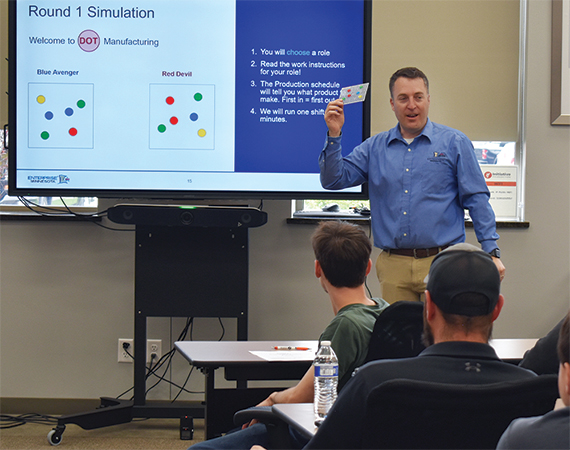
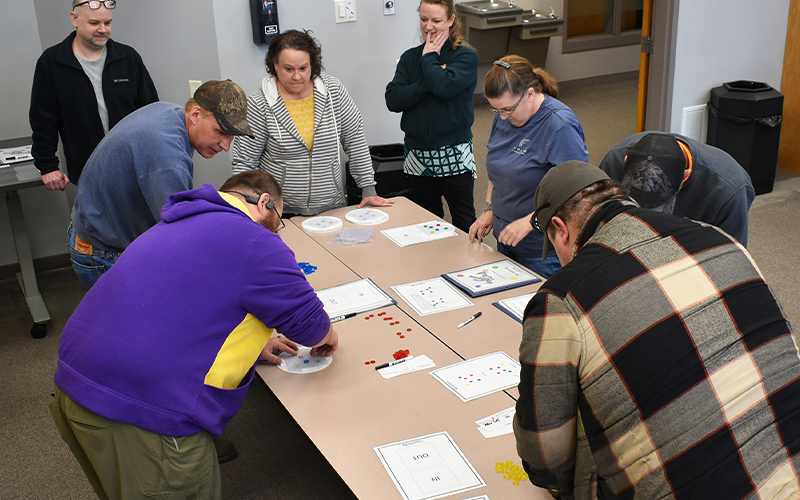
The hands-on events used a simulation format involving Legos to introduce and reinforce lean concepts in an engaging way. Ryan Steinert, a business growth consultant at Enterprise Minnesota, led the workshops. A continuous improvement and lean manufacturing expert, Steinert first taught participants the eight wastes of lean manufacturing — including inventory, waiting, defects, and underutilized talent — as well as 5S visual management, quick changeover, and other efficiency practices.
Then participants completed three rounds of the simulation to apply the concepts they learned. Called Dots, the simulation involved teams working on assembly lines with Legos. Each participant was assigned a role — team leader, assembler, or material handler — along with work instructions. After an initial round of manufacturing, they assessed results, identifying waste and opportunities to deploy their lean tools, Steinert says. Then it was rinse and repeat, becoming more efficient in the second and third rounds.
“We want them to get a good core of lean tools they can use in the future and get them grounded in the idea of seeing waste in their processes,” Steinert says. “Typically, people have some ‘aha!’ moments and come up with ideas or actions that they can apply in their workplace.”
At the end of the workshop, facilitators asked the participants to identify how they will tackle waste in their operations and name a lean action they plan to try. Having a partner to work with on the action item was a key reason the sponsors requested that each company send two employees, Busta says.
Enterprise Minnesota staff plans to follow-up with participants to check each team’s progress, ensuring the teachings from the workshops stick. “In my experience, if you do training and don’t apply it right away, you lose that knowledge,” Steinert says. “This way, they have an action to take with something they learned, and they can apply those concepts.”
Robinson was pleased that the workshops reached a large number of manufacturers with useful and actionable advice. “When we talked about what would be helpful to the community at this time, lean surfaced as a way to help small manufacturers be the best, most efficient manufacturers. We wanted to support their bottom line and help them be stronger manufacturers,” she says. “Ongoing process improvements are a great entry point for small manufacturers.”
Return to the Fall 2026 issue of Enterprise Minnesota® magazine.